







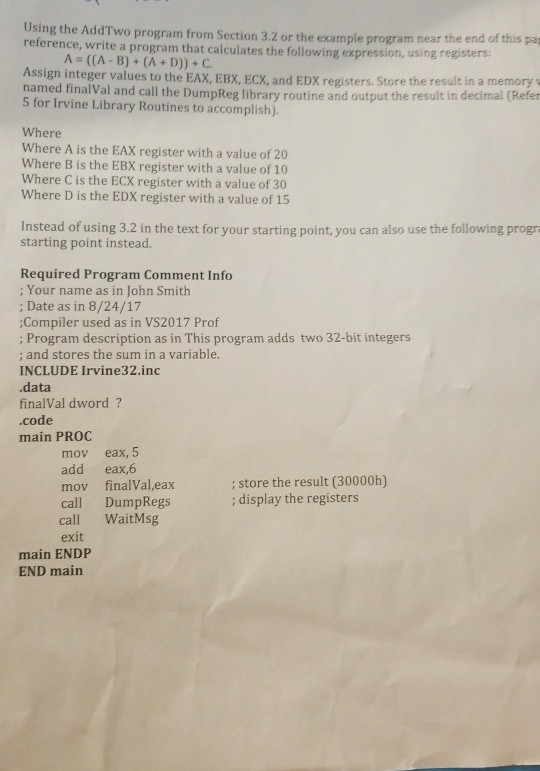
Question: assembly language Using the AddTwo program from Section 3.2 or the example program near the reference, write a program that calculates the following expression, using
assembly language
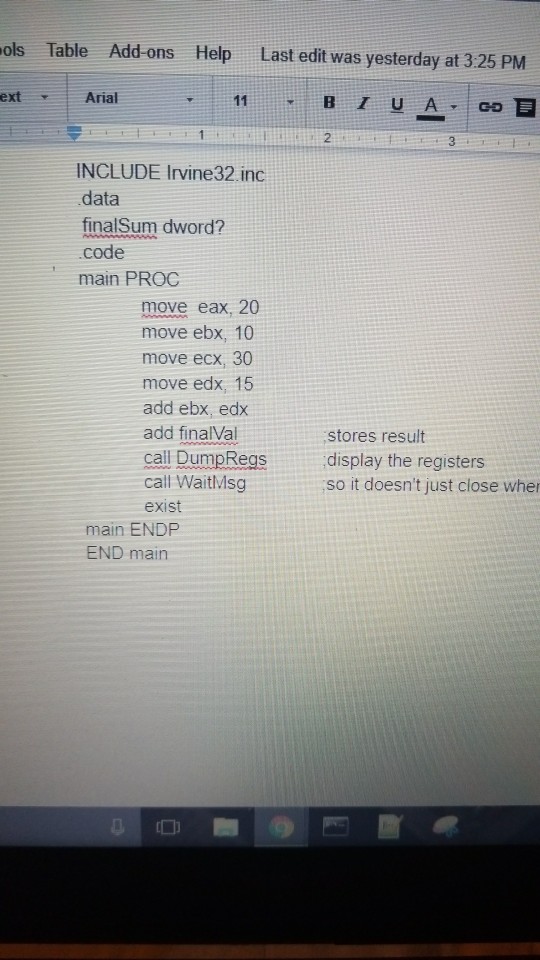
Using the AddTwo program from Section 3.2 or the example program near the reference, write a program that calculates the following expression, using r end of this pa egisters. A ((A-B) (A +D))+C Assign integer values to the EAX, EBX, ECX, and EDX registers. Store the result in a memory named finalVal and call the DumpReg library routine and output the result in decimal (Refer 5 for Irvine Library Routines to accomplish). Where Where A is the EAX register with a value of 20 Where B is the EBX register with a value of 10 Where C is the ECX register with a value of 30 Where D is the EDX register with a value of 15 Instead of using 3.2 in the text for your starting point, you can also use the following progr starting point instead. Required Program Comment Info : Your name as in John Smith ; Date as in 8/24/17 Compiler used as in VS2017 Prof ; Program description as in This program adds two 32-bit integers ; and stores the sum in a variable. INCLUDE Irvine32.inc .data finalVal dword ? .code main PROC mov eax, 5 add eax,6 mov finalVal,eax call DumpRegs call WaitMsg exit ; store the result (30000h) ; display the registers main ENDP END main
Step by Step Solution
There are 3 Steps involved in it

Get step-by-step solutions from verified subject matter experts
 Study Help