







Question: Chapter 2: Performance Measurement from Shareholders' Perspective Case Study: Maximizing Shareholder Value at TMA Inter- national Headquarters es. A privately held, third-generation wholesale distributor of
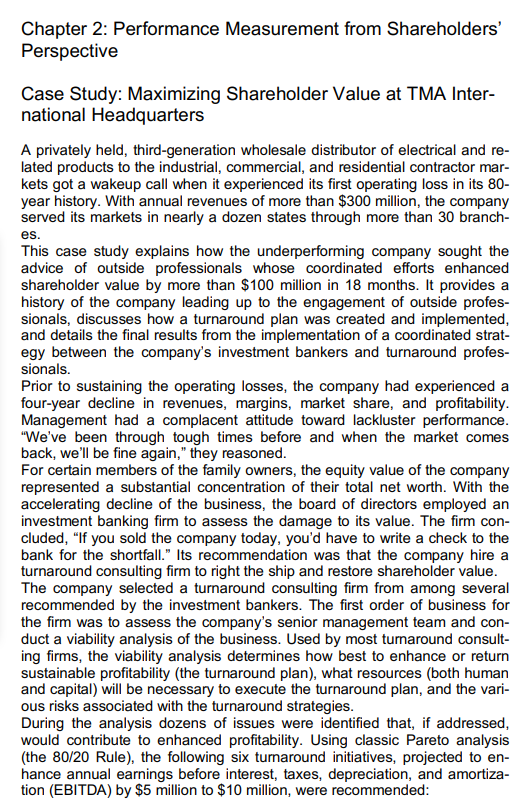
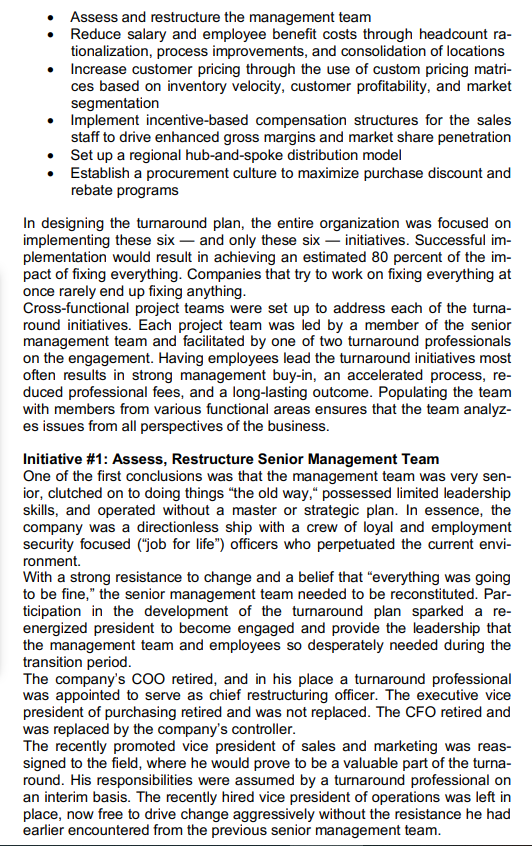
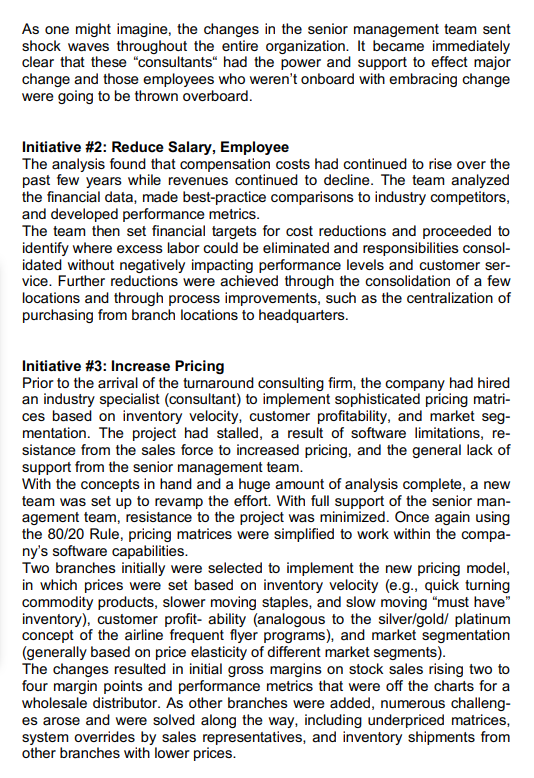
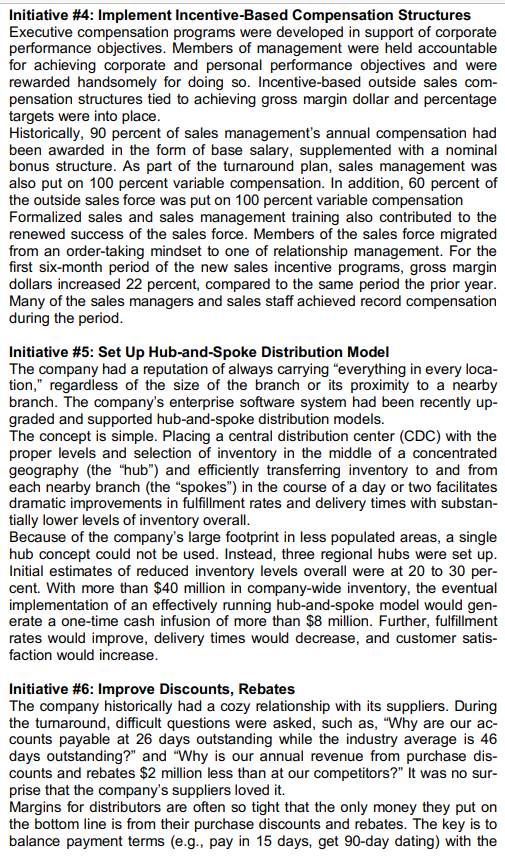
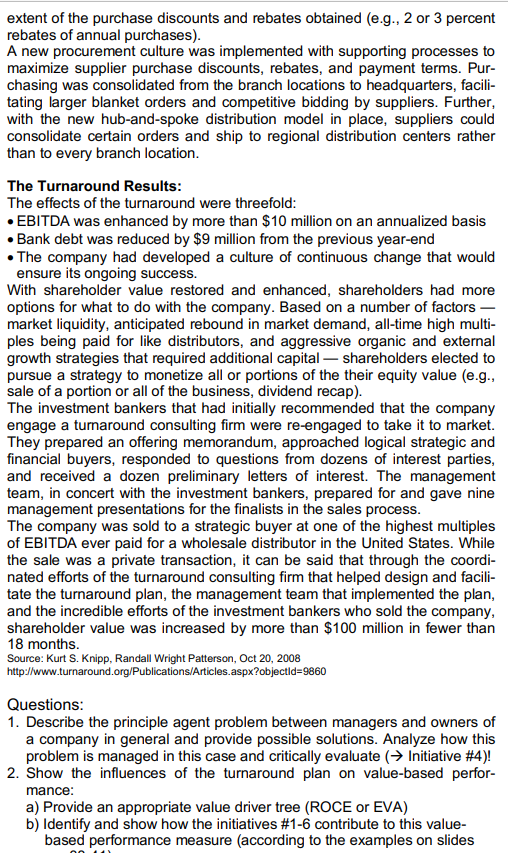
Chapter 2: Performance Measurement from Shareholders' Perspective Case Study: Maximizing Shareholder Value at TMA Inter- national Headquarters es. A privately held, third-generation wholesale distributor of electrical and re- lated products to the industrial, commercial, and residential contractor mar- kets got a wakeup call when it experienced its first operating loss in its 80- year history. With annual revenues of more than $300 million, the company served its markets in nearly a dozen states through more than 30 branch- This case study explains how the underperforming company sought the advice of outside professionals whose coordinated efforts enhanced shareholder value by more than $100 million in 18 months. It provides a history of the company leading up to the engagement of outside profes- sionals, discusses how a turnaround plan was created and implemented, and details the final results from the implementation of a coordinated strat- egy between the company's investment bankers and turnaround profes- sionals. Prior to sustaining the operating losses, the company had experienced a four-year decline in revenues, margins, market share, and profitability. Management had a complacent attitude toward lackluster performance. "We've been through tough times before and when the market comes back, we'll be fine again," they reasoned. For certain members of the family owners, the equity value of the company represented a substantial concentration of their total net worth. With the accelerating decline of the business, the board of directors employed an investment banking firm to assess the damage to its value. The firm con- cluded, "If you sold the company today, you'd have to write a check to the bank for the shortfall." Its recommendation was that the company hire a turnaround consulting firm to right the ship and restore shareholder value. The company selected a turnaround consulting firm from among several recommended by the investment bankers. The first order of business for the firm was to assess the company's senior management team and con- duct a viability analysis of the business. Used by most turnaround consult- ing firms, the viability analysis determines how best to enhance or return sustainable profitability (the turnaround plan), what resources (both human and capital) will be necessary to execute the turnaround plan, and the vari- ous risks associated with the turnaround strategies. During the analysis dozens of issues were identified that, if addressed, would contribute to enhanced profitability. Using classic Pareto analysis (the 80/20 Rule), the following six turnaround initiatives, projected to en- hance annual earnings before interest, taxes, depreciation, and amortiza- tion (EBITDA) by $5 million to $10 million, were recommended: Assess and restructure the management team Reduce salary and employee benefit costs through headcount ra- tionalization, process improvements, and consolidation of locations Increase customer pricing through the use of custom pricing matri- ces based on inventory velocity, customer profitability, and market segmentation Implement incentive-based compensation structures for the sales staff to drive enhanced gross margins and market share penetration Set up a regional hub-and-spoke distribution model Establish a procurement culture to maximize purchase discount and rebate programs In designing the turnaround plan, the entire organization was focused on implementing these six and only these six initiatives. Successful im- plementation would result in achieving an estimated 80 percent of the im- pact of fixing everything. Companies that try to work on fixing everything at once rarely end up fixing anything. Cross-functional project teams were set up to address each of the turna- round initiatives. Each project team was led by a member of the senior management team and facilitated by one of two turnaround professionals on the engagement. Having employees lead the turnaround initiatives most often results in strong management buy-in, an accelerated process, re- duced professional fees, and a long-lasting outcome. Populating the team with members from various functional areas ensures that the team analyz- es issues from all perspectives of the business. Initiative #1: Assess, Restructure Senior Management Team One of the first conclusions was that the management team was very sen- ior, clutched on to doing things "the old way," possessed limited leadership skills, and operated without a master or strategic plan. In essence, the company was a directionless ship with a crew of loyal and employment security focused (job for life") officers who perpetuated the current envi- ronment. With a strong resistance to change and a belief that "everything was going to be fine," the senior management team needed to be reconstituted. Par- ticipation in the development of the turnaround plan sparked a re- energized president to become engaged and provide the leadership that the management team and employees so desperately needed during the transition period. The company's COO retired, and in his place a turnaround professional was appointed to serve as chief restructuring officer. The executive vice president of purchasing retired and was not replaced. The CFO retired and was replaced by the company's controller. The recently promoted vice president of sales and marketing was reas- signed to the field, where he would prove to be a valuable part of the turna- round. His responsibilities were assumed by a turnaround professional on an interim basis. The recently hired vice president of operations was left in place, now free to drive change aggressively without the resistance he had earlier encountered from the previous senior management team. As one might imagine, the changes in the senior management team sent shock waves throughout the entire organization. It became immediately clear that these "consultants had the power and support to effect major change and those employees who weren't onboard with embracing change were going to be thrown overboard. Initiative #2: Reduce Salary, Employee The analysis found that compensation costs had continued to rise over the past few years while revenues continued to decline. The team analyzed the financial data, made best-practice comparisons to industry competitors, and developed performance metrics. The team then set financial targets for cost reductions and proceeded to identify where excess labor could be eliminated and responsibilities consol- idated without negatively impacting performance levels and customer ser- vice. Further reductions were achieved through the consolidation of a few locations and through process improvements, such as the centralization of purchasing from branch locations to headquarters. Initiative #3: Increase Pricing Prior to the arrival of the turnaround consulting firm, the company had hired an industry specialist (consultant) to implement sophisticated pricing matri- ces based on inventory velocity, customer profitability, and market seg- mentation. The project had stalled, a result of software limitations, re- sistance from the sales force to increased pricing, and the general lack of support from the senior management team. With the concepts in hand and a huge amount of analysis complete, a new team was set up to revamp the effort. With full support of the senior man- agement team, resistance to the project was minimized. Once again using the 80/20 Rule, pricing matrices were simplified to work within the compa- ny's software capabilities. Two branches initially were selected to implement the new pricing model, in which prices were set based on inventory velocity (e.g., quick turning commodity products, slower moving staples, and slow moving "must have" inventory), customer profit- ability (analogous to the silver/gold/ platinum concept of the airline frequent flyer programs), and market segmentation (generally based on price elasticity of different market segments). The changes resulted in initial gross margins on stock sales rising two to four margin points and performance metrics that were off the charts for a wholesale distributor. As other branches were added, numerous challeng- es arose and were solved along the way, including underpriced matrices, system overrides by sales representatives, and inventory shipments from other branches with lower prices. Initiative #4: Implement Incentive-Based Compensation Structures Executive compensation programs were developed in support of corporate performance objectives. Members of management were held accountable for achieving corporate and personal performance objectives and were rewarded handsomely for doing so. Incentive-based outside sales com- pensation structures tied to achieving gross margin dollar and percentage targets were into place. Historically, 90 percent of sales management's annual compensation had been awarded in the form of base salary, supplemented with a nominal bonus structure. As part of the turnaround plan, sales management was also put on 100 percent variable compensation. In addition, 60 percent of the outside sales force was put on 100 percent variable compensation Formalized sales and sales management training also contributed to the renewed success of the sales force. Members of the sales force migrated from an order-taking mindset to one of relationship management. For the first six-month period of the new sales incentive programs, gross margin dollars increased 22 percent, compared to the same period the prior year. Many of the sales managers and sales staff achieved record compensation during the period. Initiative #5: Set Up Hub-and-Spoke Distribution Model The company had a reputation of always carrying "everything in every loca- tion," regardless of the size of the branch or its proximity to a nearby branch. The company's enterprise software system had been recently up- graded and supported hub-and-spoke distribution models. The concept is simple. Placing a central distribution center (CDC) with the proper levels and selection of inventory in the middle of a concentrated geography (the hub) and efficiently transferring inventory to and from each nearby branch (the "spokes") in the course of a day or two facilitates dramatic improvements in fulfillment rates and delivery times with substan- tially lower levels of inventory overall. Because of the company's large footprint in less populated areas, a single hub concept could not be used. Instead, three regional hubs were set up. Initial estimates of reduced inventory levels overall were at 20 to 30 per- cent. With more than $40 million in company-wide inventory, the eventual implementation of an effectively running hub-and-spoke model would gen- erate a one-time cash infusion of more than $8 million. Further, fulfillment rates would improve, delivery times would decrease, and customer satis- faction would increase. Initiative #6: Improve Discounts, Rebates The company historically had a cozy relationship with its suppliers. During the turnaround, difficult questions were asked, such as, Why are our ac- counts payable at 26 days outstanding while the industry average is 46 days outstanding?" and "Why is our annual revenue from purchase dis- counts and rebates $2 million less than at our competitors?" It was no sur- prise that the company's suppliers loved it. Margins for distributors are often so tight that the only money they put on the bottom line is from their purchase discounts and rebates. The key is to balance payment terms (e.g., pay in 15 days, get 90-day dating) with the extent of the purchase discounts and rebates obtained (e.g., 2 or 3 percent rebates of annual purchases). A new procurement culture was implemented with supporting processes to maximize supplier purchase discounts, rebates, and payment terms. Pur- chasing was consolidated from the branch locations to headquarters, facili- tating larger blanket orders and competitive bidding by suppliers. Further, with the new hub-and-spoke distribution model in place, suppliers could consolidate certain orders and ship to regional distribution centers rather than to every branch location. The Turnaround Results: The effects of the turnaround were threefold: EBITDA was enhanced by more than $10 million on an annualized basis Bank debt was reduced by $9 million from the previous year-end The company had developed a culture of continuous change that would ensure its ongoing success. With shareholder value restored and enhanced, shareholders had more options for what to do with the company. Based on a number of factors - market liquidity, anticipated rebound in market demand, all-time high multi- ples being paid for like distributors, and aggressive organic and external growth strategies that required additional capital shareholders elected to pursue a strategy to monetize all or portions of the their equity value (e.g., sale of a portion or all of the business, dividend recap). The investment bankers that had initially recommended that the company engage a turnaround consulting firm were re-engaged to take it to market. They prepared an offering memorandum, approached logical strategic and financial buyers, responded to questions from dozens of interest parties, and received a dozen preliminary letters of interest. The management team, in concert with the investment bankers, prepared for and gave nine management presentations for the finalists in the sales process. The company was sold to a strategic buyer at one of the highest multiples of EBITDA ever paid for a wholesale distributor in the United States. While the sale was a private transaction, it can be said that through the coordi- nated efforts of the turnaround consulting firm that helped design and facili- tate the turnaround plan, the management team that implemented the plan, and the incredible efforts of the investment bankers who sold the company, shareholder value was increased by more than $100 million in fewer than 18 months. Source: Kurt S. Knipp, Randall Wright Patterson, Oct 20, 2008 http://www.turnaround.org/Publications/Articles.aspx?objectId=9860 Questions: 1. Describe the principle agent problem between managers and owners of a company in general and provide possible solutions. Analyze how this problem is managed in this case and critically evaluate ( Initiative #4)! 2. Show the influences of the turnaround plan on value-based perfor- mance: a) Provide an appropriate value driver tree (ROCE or EVA) b) Identify and show how the initiatives #1-6 contribute to this value- based performance measure (according to the examples on slides Chapter 2: Performance Measurement from Shareholders' Perspective Case Study: Maximizing Shareholder Value at TMA Inter- national Headquarters es. A privately held, third-generation wholesale distributor of electrical and re- lated products to the industrial, commercial, and residential contractor mar- kets got a wakeup call when it experienced its first operating loss in its 80- year history. With annual revenues of more than $300 million, the company served its markets in nearly a dozen states through more than 30 branch- This case study explains how the underperforming company sought the advice of outside professionals whose coordinated efforts enhanced shareholder value by more than $100 million in 18 months. It provides a history of the company leading up to the engagement of outside profes- sionals, discusses how a turnaround plan was created and implemented, and details the final results from the implementation of a coordinated strat- egy between the company's investment bankers and turnaround profes- sionals. Prior to sustaining the operating losses, the company had experienced a four-year decline in revenues, margins, market share, and profitability. Management had a complacent attitude toward lackluster performance. "We've been through tough times before and when the market comes back, we'll be fine again," they reasoned. For certain members of the family owners, the equity value of the company represented a substantial concentration of their total net worth. With the accelerating decline of the business, the board of directors employed an investment banking firm to assess the damage to its value. The firm con- cluded, "If you sold the company today, you'd have to write a check to the bank for the shortfall." Its recommendation was that the company hire a turnaround consulting firm to right the ship and restore shareholder value. The company selected a turnaround consulting firm from among several recommended by the investment bankers. The first order of business for the firm was to assess the company's senior management team and con- duct a viability analysis of the business. Used by most turnaround consult- ing firms, the viability analysis determines how best to enhance or return sustainable profitability (the turnaround plan), what resources (both human and capital) will be necessary to execute the turnaround plan, and the vari- ous risks associated with the turnaround strategies. During the analysis dozens of issues were identified that, if addressed, would contribute to enhanced profitability. Using classic Pareto analysis (the 80/20 Rule), the following six turnaround initiatives, projected to en- hance annual earnings before interest, taxes, depreciation, and amortiza- tion (EBITDA) by $5 million to $10 million, were recommended: Assess and restructure the management team Reduce salary and employee benefit costs through headcount ra- tionalization, process improvements, and consolidation of locations Increase customer pricing through the use of custom pricing matri- ces based on inventory velocity, customer profitability, and market segmentation Implement incentive-based compensation structures for the sales staff to drive enhanced gross margins and market share penetration Set up a regional hub-and-spoke distribution model Establish a procurement culture to maximize purchase discount and rebate programs In designing the turnaround plan, the entire organization was focused on implementing these six and only these six initiatives. Successful im- plementation would result in achieving an estimated 80 percent of the im- pact of fixing everything. Companies that try to work on fixing everything at once rarely end up fixing anything. Cross-functional project teams were set up to address each of the turna- round initiatives. Each project team was led by a member of the senior management team and facilitated by one of two turnaround professionals on the engagement. Having employees lead the turnaround initiatives most often results in strong management buy-in, an accelerated process, re- duced professional fees, and a long-lasting outcome. Populating the team with members from various functional areas ensures that the team analyz- es issues from all perspectives of the business. Initiative #1: Assess, Restructure Senior Management Team One of the first conclusions was that the management team was very sen- ior, clutched on to doing things "the old way," possessed limited leadership skills, and operated without a master or strategic plan. In essence, the company was a directionless ship with a crew of loyal and employment security focused (job for life") officers who perpetuated the current envi- ronment. With a strong resistance to change and a belief that "everything was going to be fine," the senior management team needed to be reconstituted. Par- ticipation in the development of the turnaround plan sparked a re- energized president to become engaged and provide the leadership that the management team and employees so desperately needed during the transition period. The company's COO retired, and in his place a turnaround professional was appointed to serve as chief restructuring officer. The executive vice president of purchasing retired and was not replaced. The CFO retired and was replaced by the company's controller. The recently promoted vice president of sales and marketing was reas- signed to the field, where he would prove to be a valuable part of the turna- round. His responsibilities were assumed by a turnaround professional on an interim basis. The recently hired vice president of operations was left in place, now free to drive change aggressively without the resistance he had earlier encountered from the previous senior management team. As one might imagine, the changes in the senior management team sent shock waves throughout the entire organization. It became immediately clear that these "consultants had the power and support to effect major change and those employees who weren't onboard with embracing change were going to be thrown overboard. Initiative #2: Reduce Salary, Employee The analysis found that compensation costs had continued to rise over the past few years while revenues continued to decline. The team analyzed the financial data, made best-practice comparisons to industry competitors, and developed performance metrics. The team then set financial targets for cost reductions and proceeded to identify where excess labor could be eliminated and responsibilities consol- idated without negatively impacting performance levels and customer ser- vice. Further reductions were achieved through the consolidation of a few locations and through process improvements, such as the centralization of purchasing from branch locations to headquarters. Initiative #3: Increase Pricing Prior to the arrival of the turnaround consulting firm, the company had hired an industry specialist (consultant) to implement sophisticated pricing matri- ces based on inventory velocity, customer profitability, and market seg- mentation. The project had stalled, a result of software limitations, re- sistance from the sales force to increased pricing, and the general lack of support from the senior management team. With the concepts in hand and a huge amount of analysis complete, a new team was set up to revamp the effort. With full support of the senior man- agement team, resistance to the project was minimized. Once again using the 80/20 Rule, pricing matrices were simplified to work within the compa- ny's software capabilities. Two branches initially were selected to implement the new pricing model, in which prices were set based on inventory velocity (e.g., quick turning commodity products, slower moving staples, and slow moving "must have" inventory), customer profit- ability (analogous to the silver/gold/ platinum concept of the airline frequent flyer programs), and market segmentation (generally based on price elasticity of different market segments). The changes resulted in initial gross margins on stock sales rising two to four margin points and performance metrics that were off the charts for a wholesale distributor. As other branches were added, numerous challeng- es arose and were solved along the way, including underpriced matrices, system overrides by sales representatives, and inventory shipments from other branches with lower prices. Initiative #4: Implement Incentive-Based Compensation Structures Executive compensation programs were developed in support of corporate performance objectives. Members of management were held accountable for achieving corporate and personal performance objectives and were rewarded handsomely for doing so. Incentive-based outside sales com- pensation structures tied to achieving gross margin dollar and percentage targets were into place. Historically, 90 percent of sales management's annual compensation had been awarded in the form of base salary, supplemented with a nominal bonus structure. As part of the turnaround plan, sales management was also put on 100 percent variable compensation. In addition, 60 percent of the outside sales force was put on 100 percent variable compensation Formalized sales and sales management training also contributed to the renewed success of the sales force. Members of the sales force migrated from an order-taking mindset to one of relationship management. For the first six-month period of the new sales incentive programs, gross margin dollars increased 22 percent, compared to the same period the prior year. Many of the sales managers and sales staff achieved record compensation during the period. Initiative #5: Set Up Hub-and-Spoke Distribution Model The company had a reputation of always carrying "everything in every loca- tion," regardless of the size of the branch or its proximity to a nearby branch. The company's enterprise software system had been recently up- graded and supported hub-and-spoke distribution models. The concept is simple. Placing a central distribution center (CDC) with the proper levels and selection of inventory in the middle of a concentrated geography (the hub) and efficiently transferring inventory to and from each nearby branch (the "spokes") in the course of a day or two facilitates dramatic improvements in fulfillment rates and delivery times with substan- tially lower levels of inventory overall. Because of the company's large footprint in less populated areas, a single hub concept could not be used. Instead, three regional hubs were set up. Initial estimates of reduced inventory levels overall were at 20 to 30 per- cent. With more than $40 million in company-wide inventory, the eventual implementation of an effectively running hub-and-spoke model would gen- erate a one-time cash infusion of more than $8 million. Further, fulfillment rates would improve, delivery times would decrease, and customer satis- faction would increase. Initiative #6: Improve Discounts, Rebates The company historically had a cozy relationship with its suppliers. During the turnaround, difficult questions were asked, such as, Why are our ac- counts payable at 26 days outstanding while the industry average is 46 days outstanding?" and "Why is our annual revenue from purchase dis- counts and rebates $2 million less than at our competitors?" It was no sur- prise that the company's suppliers loved it. Margins for distributors are often so tight that the only money they put on the bottom line is from their purchase discounts and rebates. The key is to balance payment terms (e.g., pay in 15 days, get 90-day dating) with the extent of the purchase discounts and rebates obtained (e.g., 2 or 3 percent rebates of annual purchases). A new procurement culture was implemented with supporting processes to maximize supplier purchase discounts, rebates, and payment terms. Pur- chasing was consolidated from the branch locations to headquarters, facili- tating larger blanket orders and competitive bidding by suppliers. Further, with the new hub-and-spoke distribution model in place, suppliers could consolidate certain orders and ship to regional distribution centers rather than to every branch location. The Turnaround Results: The effects of the turnaround were threefold: EBITDA was enhanced by more than $10 million on an annualized basis Bank debt was reduced by $9 million from the previous year-end The company had developed a culture of continuous change that would ensure its ongoing success. With shareholder value restored and enhanced, shareholders had more options for what to do with the company. Based on a number of factors - market liquidity, anticipated rebound in market demand, all-time high multi- ples being paid for like distributors, and aggressive organic and external growth strategies that required additional capital shareholders elected to pursue a strategy to monetize all or portions of the their equity value (e.g., sale of a portion or all of the business, dividend recap). The investment bankers that had initially recommended that the company engage a turnaround consulting firm were re-engaged to take it to market. They prepared an offering memorandum, approached logical strategic and financial buyers, responded to questions from dozens of interest parties, and received a dozen preliminary letters of interest. The management team, in concert with the investment bankers, prepared for and gave nine management presentations for the finalists in the sales process. The company was sold to a strategic buyer at one of the highest multiples of EBITDA ever paid for a wholesale distributor in the United States. While the sale was a private transaction, it can be said that through the coordi- nated efforts of the turnaround consulting firm that helped design and facili- tate the turnaround plan, the management team that implemented the plan, and the incredible efforts of the investment bankers who sold the company, shareholder value was increased by more than $100 million in fewer than 18 months. Source: Kurt S. Knipp, Randall Wright Patterson, Oct 20, 2008 http://www.turnaround.org/Publications/Articles.aspx?objectId=9860 Questions: 1. Describe the principle agent problem between managers and owners of a company in general and provide possible solutions. Analyze how this problem is managed in this case and critically evaluate ( Initiative #4)! 2. Show the influences of the turnaround plan on value-based perfor- mance: a) Provide an appropriate value driver tree (ROCE or EVA) b) Identify and show how the initiatives #1-6 contribute to this value- based performance measure (according to the examples on slides
Step by Step Solution
There are 3 Steps involved in it

Get step-by-step solutions from verified subject matter experts
 Study Help