







Question: Consider an economy where we have two times, today (t = 0) and tomorrow (t = 1). At time t = 1, the economy will
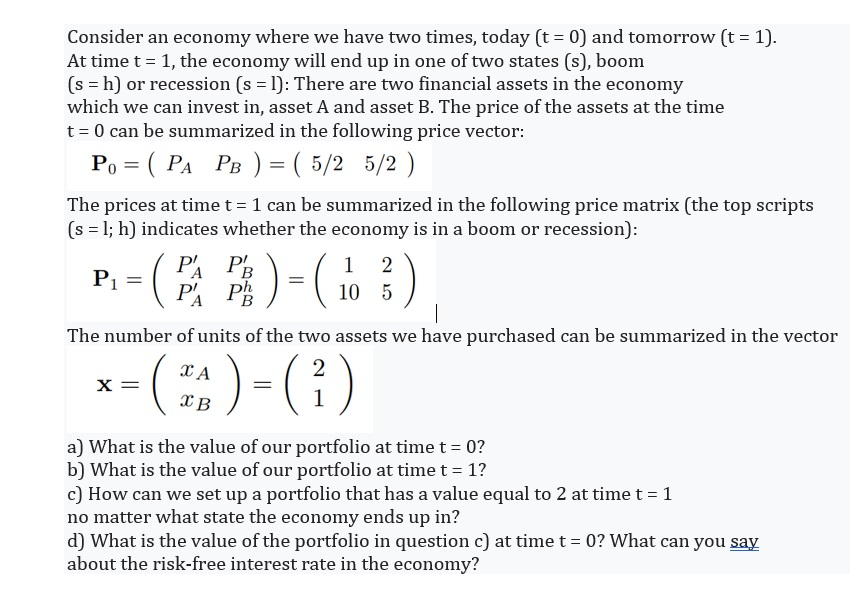
Consider an economy where we have two times, today (t = 0) and tomorrow (t = 1). At time t = 1, the economy will end up in one of two states (s), boom (s = h) or recession (s = 1): There are two financial assets in the economy which we can invest in, asset A and asset B. The price of the assets at the time t = 0 can be summarized in the following price vector: Po = ( PA PB ) = ( 5/25/2 ) The prices at time t = 1 can be summarized in the following price matrix (the top scripts (s = 1; h) indicates whether the economy is in a boom or recession) PA PB 1 2 PX Ph 10 5 Pi The number of units of the two assets we have purchased can be summarized in the vector 2 X= (A)-() a) What is the value of our portfolio at time t = 0? b) What is the value of our portfolio at time t = 1? c) How can we set up a portfolio that has a value equal to 2 at time t = 1 no matter what state the economy ends up in? d) What is the value of the portfolio in question c) at time t = 0? What can you say about the risk-free interest rate in the economy? Consider an economy where we have two times, today (t = 0) and tomorrow (t = 1). At time t = 1, the economy will end up in one of two states (s), boom (s = h) or recession (s = 1): There are two financial assets in the economy which we can invest in, asset A and asset B. The price of the assets at the time t = 0 can be summarized in the following price vector: Po = ( PA PB ) = ( 5/25/2 ) The prices at time t = 1 can be summarized in the following price matrix (the top scripts (s = 1; h) indicates whether the economy is in a boom or recession) PA PB 1 2 PX Ph 10 5 Pi The number of units of the two assets we have purchased can be summarized in the vector 2 X= (A)-() a) What is the value of our portfolio at time t = 0? b) What is the value of our portfolio at time t = 1? c) How can we set up a portfolio that has a value equal to 2 at time t = 1 no matter what state the economy ends up in? d) What is the value of the portfolio in question c) at time t = 0? What can you say about the risk-free interest rate in the economy
Step by Step Solution
There are 3 Steps involved in it

Get step-by-step solutions from verified subject matter experts
 Study Help