







Question: Entropy production by irreversible work. One mole of air at 2 7 C and 5 0 0 kPa in a 1 0 0 kPa atmosphere
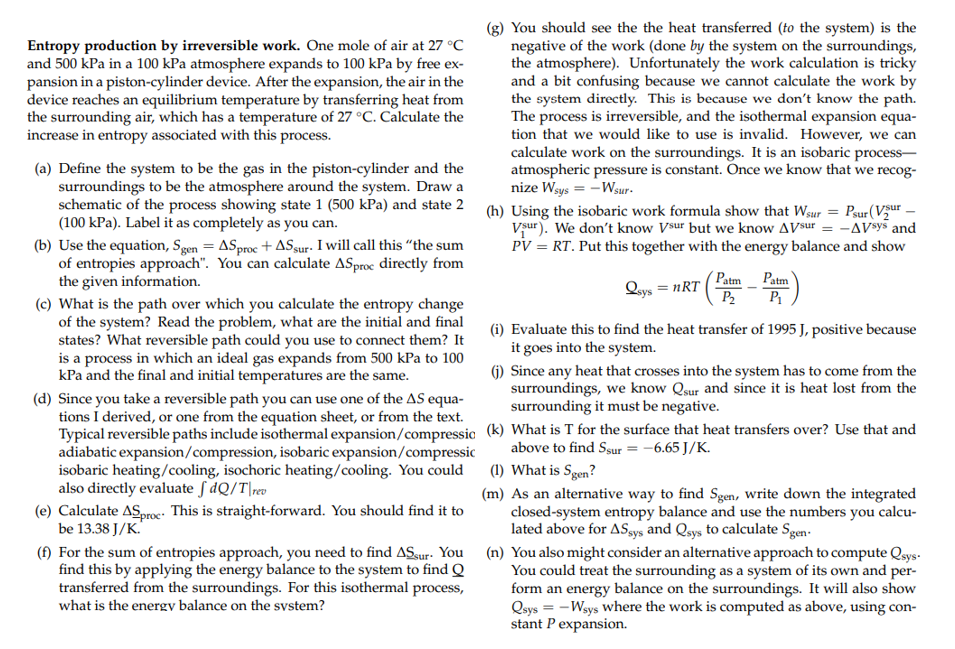
Entropy production by irreversible work. One mole of air at and kPa in a kPa atmosphere expands to kPa by free expansion in a pistoncylinder device. After the expansion, the air in the device reaches an equilibrium temperature by transferring heat from the surrounding air, which has a temperature of Calculate the increase in entropy associated with this process.
a Define the system to be the gas in the pistoncylinder and the surroundings to be the atmosphere around the system. Draw a schematic of the process showing state kPa and state kPa Label it as completely as you can.
b Use the equation, I will call this "the sum of entropies approach". You can calculate directly from the given information.
c What is the path over which you calculate the entropy change of the system? Read the problem, what are the initial and final states? What reversible path could you use to connect them? It is a process in which an ideal gas expands from kPa to kPa and the final and initial temperatures are the same.
d Since you take a reversible path you can use one of the equations I derived, or one from the equation sheet, or from the text. Typical reversible paths include isothermal expansion compression adiabatic expansioncompression isobaric expansioncompression isobaric heatingcooling isochoric heatingcooling You couldalso directly evaluate
e Calculate This is straightforward. You should find it to be
f For the sum of entropies approach, you need to find You find this by applying the energy balance to the system to find transferred from the surroundings. For this isothermal process, what is the energv balance on the svstem?
g You should see the the heat transferred to the system is the negative of the work done by the system on the surroundings, the atmosphere Unfortunately the work calculation is tricky and a bit confusing because we cannot calculate the work by the system directly. This is because we don't know the path. The process is irreversible, and the isothermal expansion equation that we would like to use is invalid. However, we can calculate work on the surroundings. It is an isobaric process atmospheric pressure is constant. Once we know that we recognize
h Using the isobaric work formula show that
: We don't know but we know and
Put this together with the energy balance and show
i Evaluate this to find the heat transfer of positive because
it goes into the system.
j Since any heat that crosses into the system has to come from the
surroundings, we know and since it is heat lost from the
surrounding it must be negative.
k What is for the surface that heat transfers over? Use that and
above to find
l What is
m As an alternative way to find write down the integrated
closedsystem entropy balance and use the numbers you calcu
lated above for and to calculate
n You also might consider an alternative approach to compute
You could treat the surrounding as a system of its own and per
form an energy balance on the surroundings. It will also show
where the work is computed as above, using con
stant expansion.
Step by Step Solution
There are 3 Steps involved in it
1 Expert Approved Answer
Step: 1 Unlock

Question Has Been Solved by an Expert!
Get step-by-step solutions from verified subject matter experts
Step: 2 Unlock
Step: 3 Unlock
 Study Help