







Question: Experiments in Physics Lab Snell's Law and total internal reection Name Score Introduction: When light travels between two different medium, the velocity and wavelength changes.
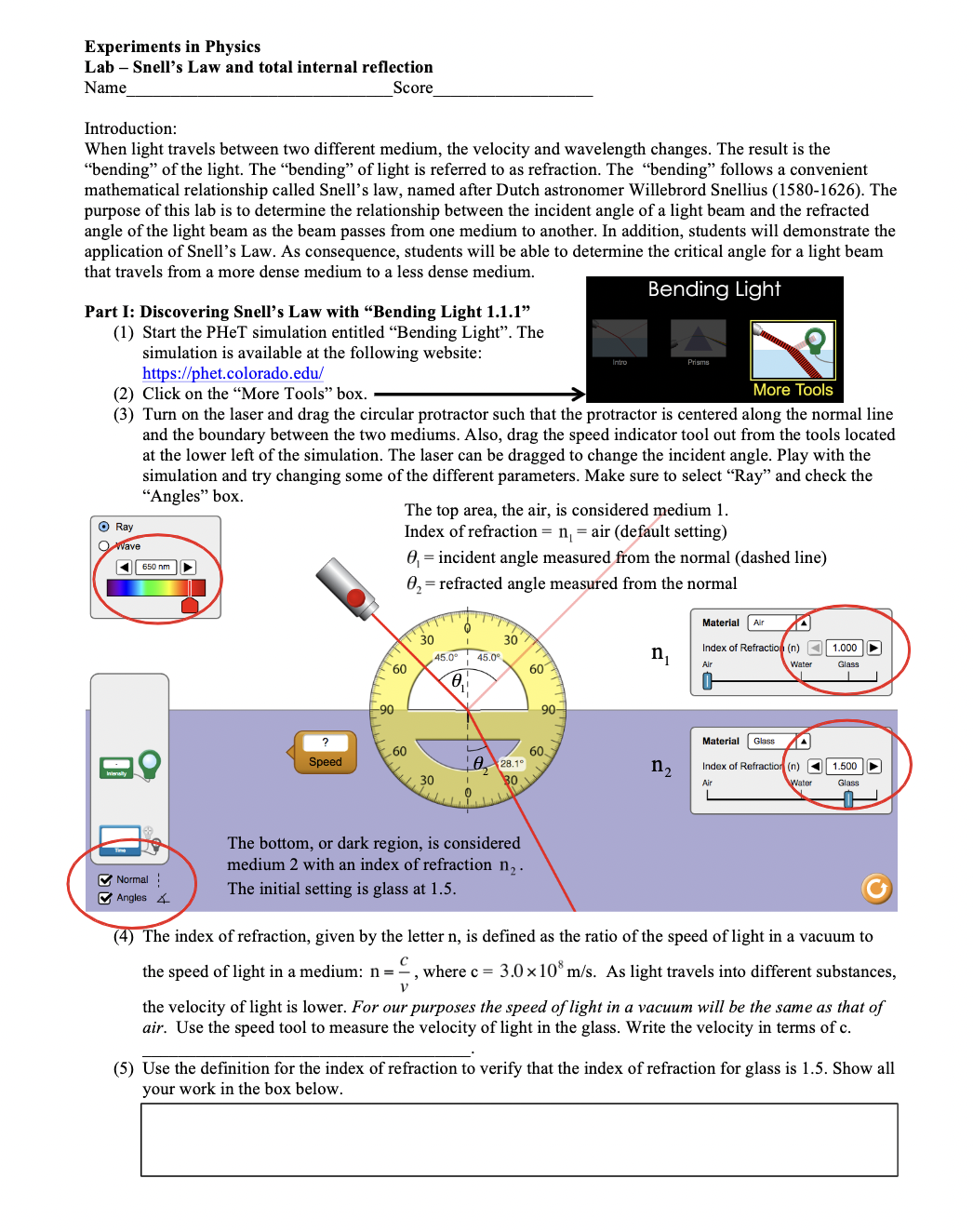
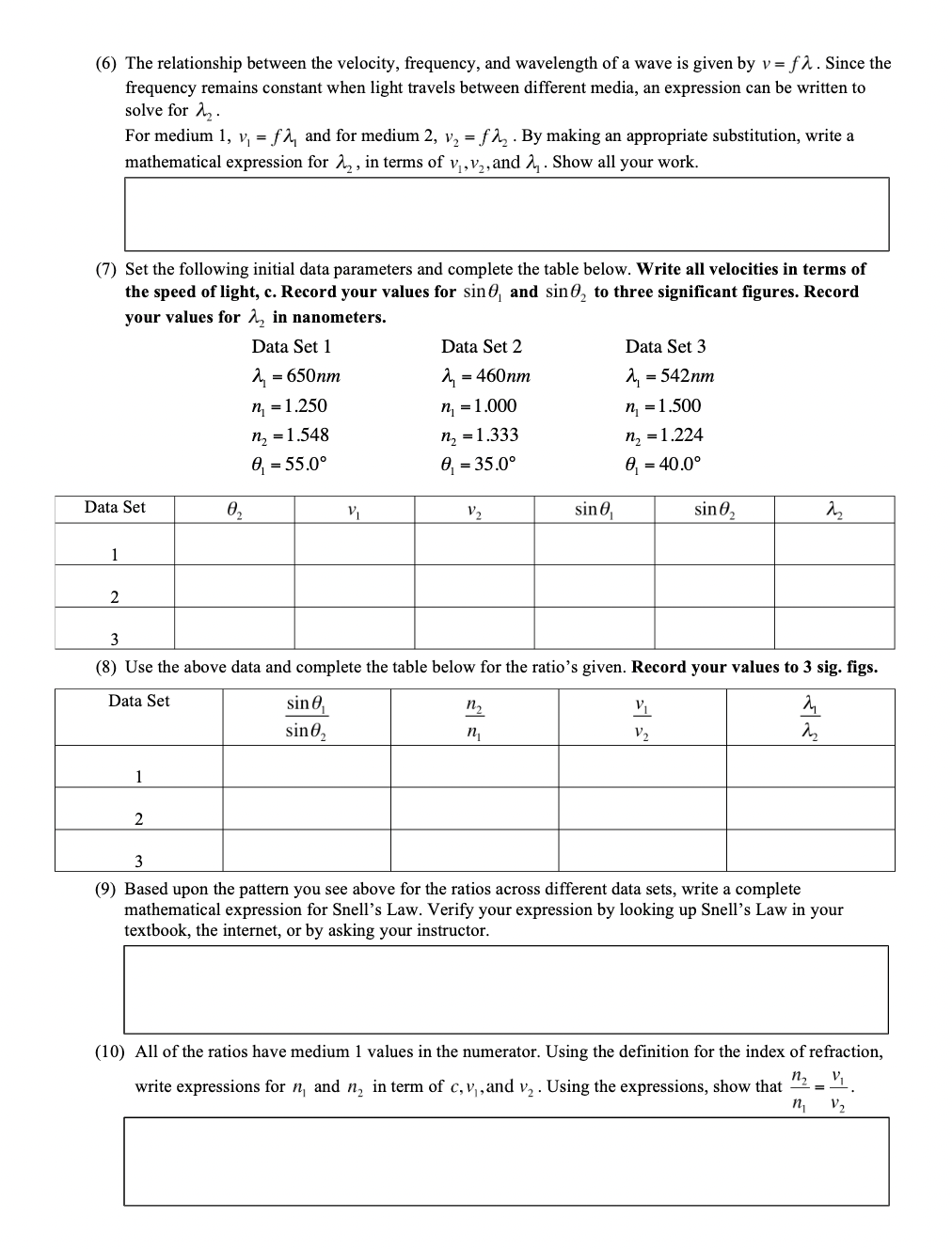
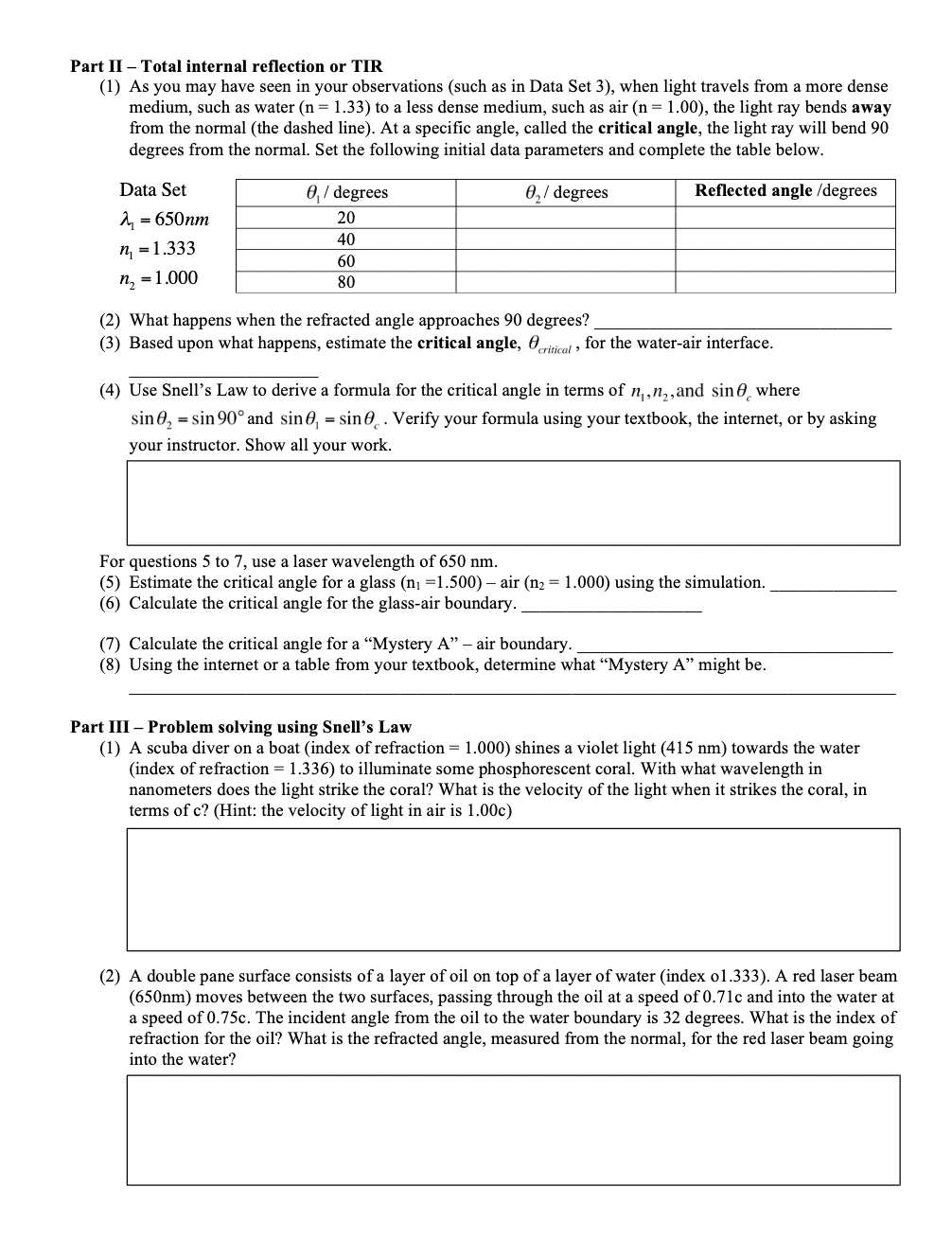
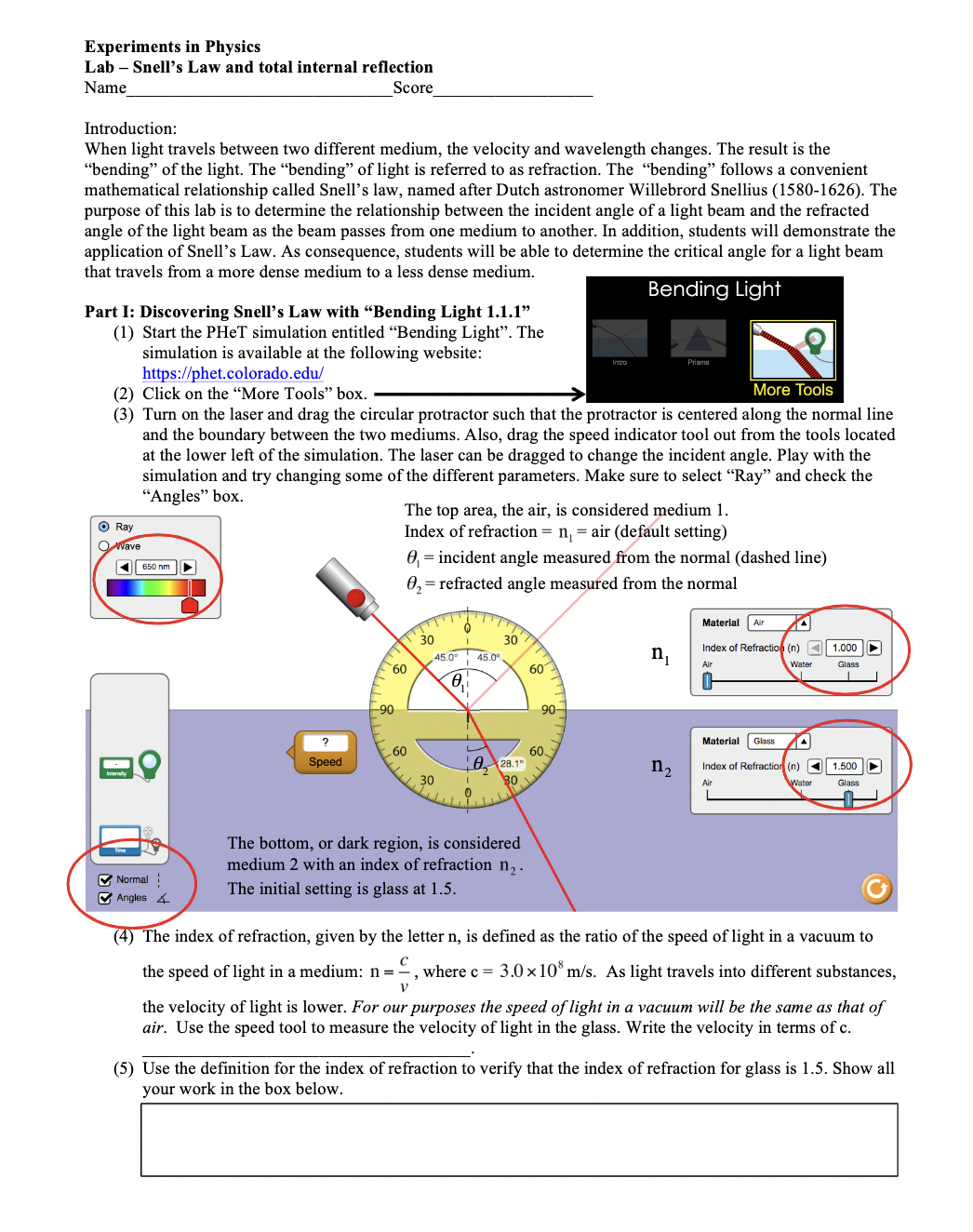
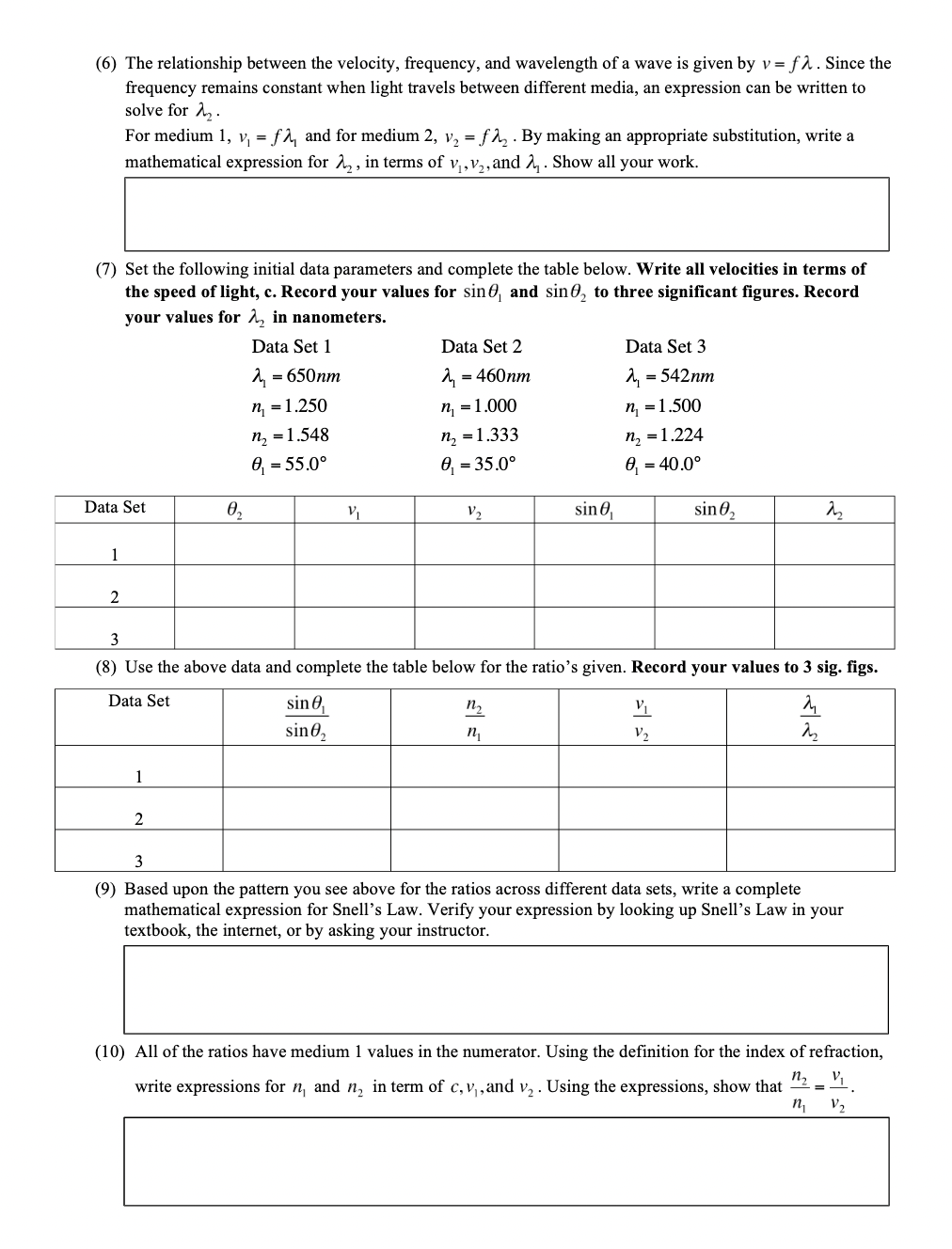
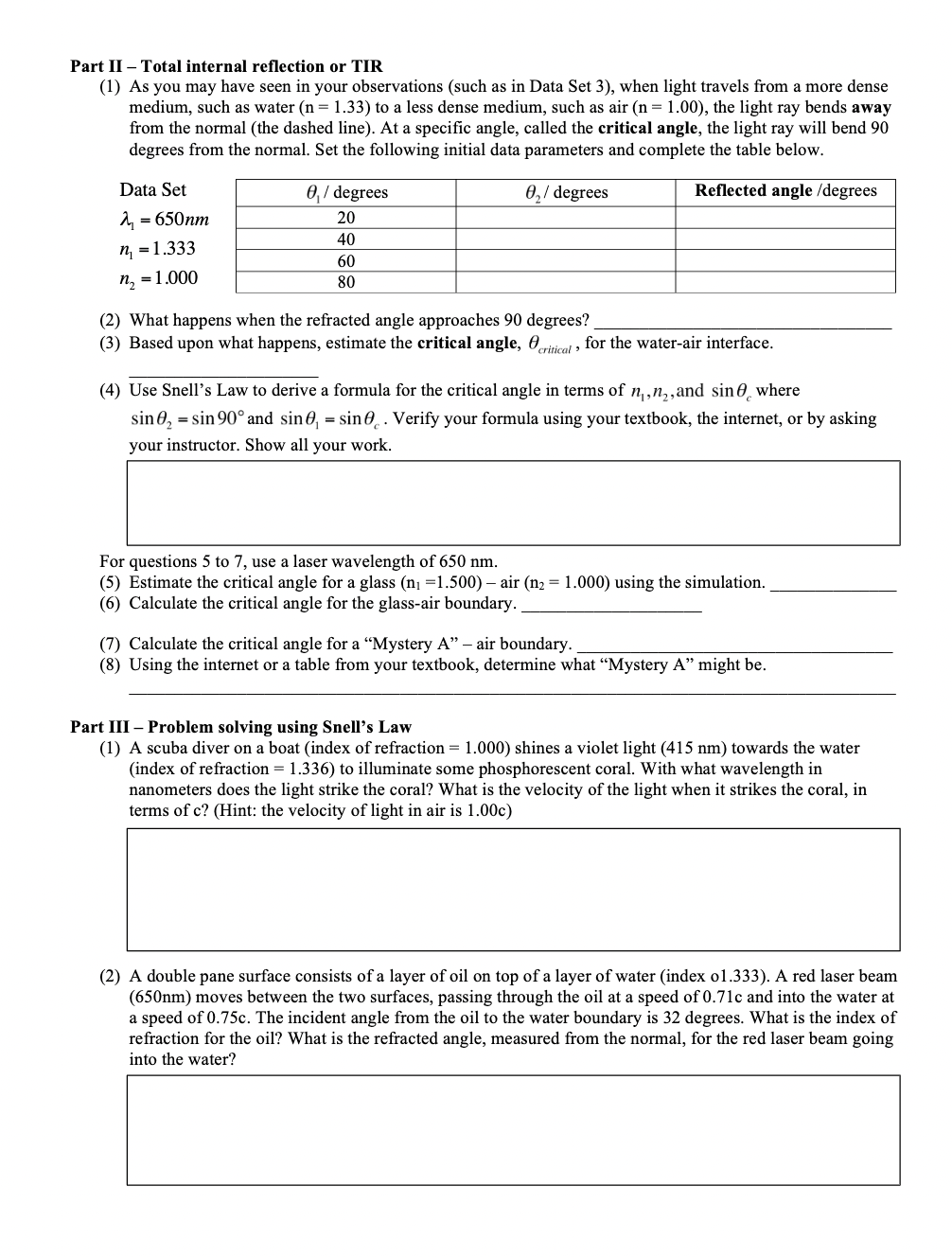
Experiments in Physics Lab Snell's Law and total internal reection Name Score Introduction: When light travels between two different medium, the velocity and wavelength changes. The result is the \"bending\" of the light. The \"bending\" of light is referred to as refraction. The \"bending\" follows a convenient mathematical relationship called Snell's law, named after Dutch astronomer Willebrord Snellius (1580-1626}. The purpose of this lab is to determine the relationship between the incident angle of a light beam and the refracted angle of the light beam as the beam passes from one medium to another. In addition, students will demonstrate the application of Snell's Law. As consequence, students will be able to determine the critical angle for a light beam that travels from a more dense medium to a less dense medium. Bending Light Part I: Discovering Snell's Law with \"Bending Light 1.1.1\" (I) Start the PHeT simulation entitled \"Bending Light\". The simulation is available at the following website: https:tfphet.colorado.edur' (2) Click on the \"More Tools\" box. More T005 (3) Turn on the laser and drag the circular protractor such that the protractor is centered along the normal line and the boundary between the two mediums. Also, drag the speed indicator tool out from the tools located at the lower left of the simulation. The laser can be dragged to change the incident angle. Play with the simulation and try changing some of the different parameters. Make sure to select \"Ray\" and check the \"Angles\" box. The top area, the air, is considered medium 1. Index of refraction = 11' = air (default setting) ,\\ HI = incident angle measured from the normal (dashed line) {'5'2 = refracted angle measured from the normal The bottom, or dark region, is considered medium 2 with an index of refraction n2. The initial setting is glass at 1.5. The index of refraction, given by the letter 11, is defined as the ratio of the speed of light in a vacuum to the speed of light in amedium: n = E , where c = 3.0 X lUH mfs. As light travels into different substances, v the velocity of light is lower. For our purposes the Speed ofght in a vacuum will be the some as that of air. Use the speed tool to measure the velocity of light in the glass. Write the velocity in terms of c. (5) Use the denition for the index of refraction to verify that the index of refraction for glass is 1.5. Show all your work in the box below. (6) The relationship between the velocity, frequency, and wavelength of a wave is given by v = fit . Since the frequency remains constant when light travels between different media, an expression can be written to solve for A: . For medium 1, v, = fl, and for medium 2, FE =ft2 . By making an appropriate substitution, write a mathematical expression for it: , in terms of 1r,,v3.and it, . Show all your work. (7) Set the following initial data parameters and complete the table below. Write all velocities in terms of the speed of light, c. Record your values for sin 9] and Sin bl,1 to three signicant figures. Record your values for 3.1 in nanometers. Data Set 1 Data Set 2 Data Set 3 A, - 650nm A, - 460nm it, - 542nm rtt - 1.250 n, - 1.000 n. -1.500 n2 -1.548 n, -1.333 n, -1.224 61 - 550 6, - 35.0" 6, - 40.0\" Data Set 63 "I v, sin 6, sin 63 A; 1 2 3 (8) Use the above data and complete the table below for the ratio's given. Record your values to 3 sig. figs. Data Set sin 6, 1 i sin 62 \"I v: A: (9) Based upon the pattern you see above for the ratios across different data sets, write a complete mathematical expression for Snell's Law. Verify your expression by looking up Snell's Law in your textbook, the internet, or by asking your instructor. (10) All of the ratios have medium 1 values in the numerator. Using the denition for the index of refraction, . . . . . H. V write express1ons for PII and n2 1n term of t'.u,,and v, . Uslng the expresSions, show that ' = '. n v I 1 Part II Total internal reection or TIR (1) As you may have seen in your observations (such as in Data Set 3), when light travels from a more dense medium, such as water (n = 1.33) to a less dense medium, such as air (11 = 1.00), the light ray bends away from the normal (the dashed line). At a specic angle, called the critical angle, the light ray will bend 90 degrees from the normal. Set the following initial data parameters and complete the table below. Data Set 6' f degrees 63! degrees Reected angle (degrees 2., == 650nm 20 40 == 1 .33 3 "1 60 :12 = 1.000 30 (2) What happens when the refracted angle approaches 90 degrees? (3) Based upon what happens, estimate the critical angle, 6. for the water-air interface. : n'm'al ' (4) Use Snell's Law to derive a formula for the critical angle in terms of nl.n2.and sin 6', where sin 9, = sin 90 and sin 6', = sin 9, . Verify your formula using your textbook, the internet, or by asking your instructor. Show all your work. For questions 5 to 7, use a laser wavelength of 650 nm. (5) Estimate the critical angle for a glass (11. =l.500) air (11; = 1.000) using the simulation. (6) Calculate the critical angle for the glass-air boundary. (7) Calculate the critical angle for a \"Mystery A\" air boundary. (8} Using the intemet or a table from your textbook, determine what \"Mystery A\" might be. Part III Problem solving using Snell's Law (1} A scuba diver on a boat (index of refraction = 1.000) shines a violet light (415 nm) towards the water (index of refraction = 1.3 36) to illuminate some phosphorescent coral. With what wavelength in nanometers does the light strike the coral? What is the velocity of the light when it strikes the coral, in terms of c? (Hint: the velocity of light in air is 1.00c) (2) A double pane surface consists ofa layer of oil on top ofa layer of water (index ol.333). A red laser beam (650nm) moves between the two surfaces, passing through the oil at a speed of 0.71c and into the water at a speed of 0.75c. The incident angle from the oil to the water boundary is 32 degrees. What is the index of refraction for the oil? What is the refracted angle, measured from the normal, for the red laser beam going into the water
Step by Step Solution
There are 3 Steps involved in it

Get step-by-step solutions from verified subject matter experts
 Study Help