







Question: i need help with questions 2 & 5 please 21 EXPERIMENT 21 Reactivities of Alkyl Halides 5,1/5,7 cm Relaterte Reactii The activities of alkyl halide
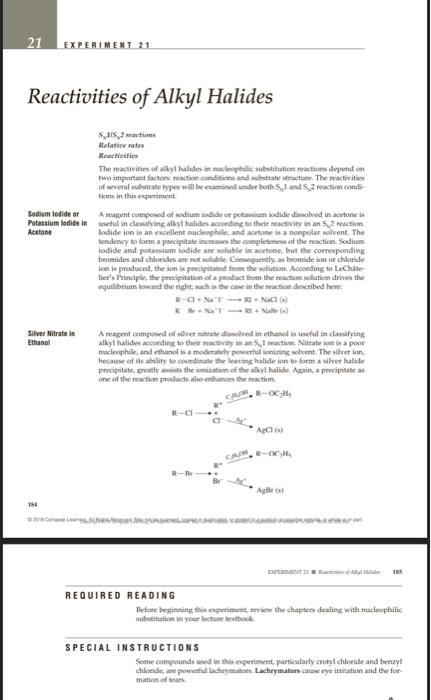
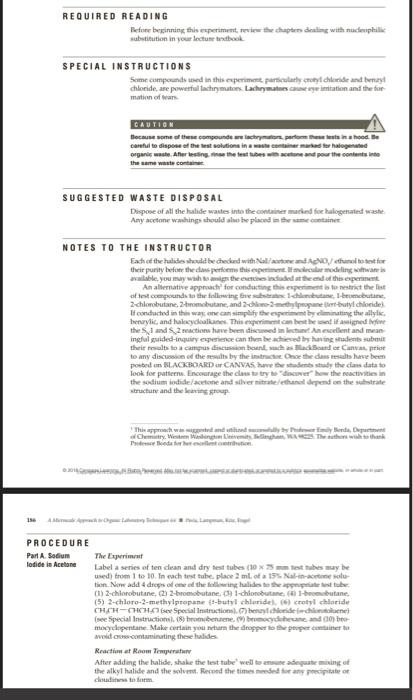
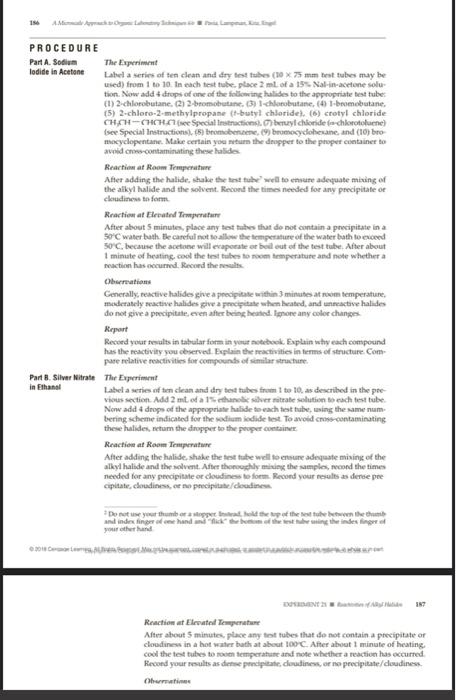
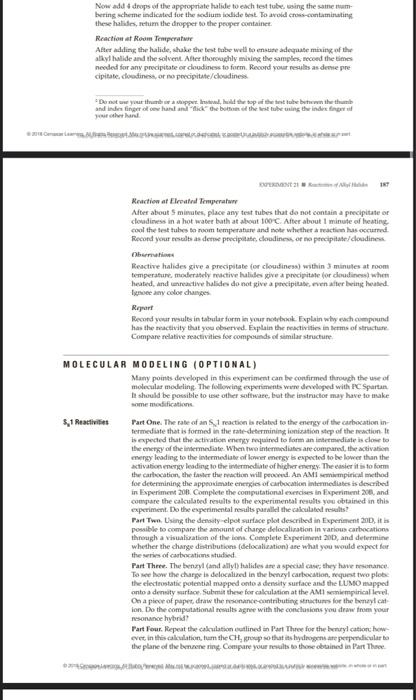
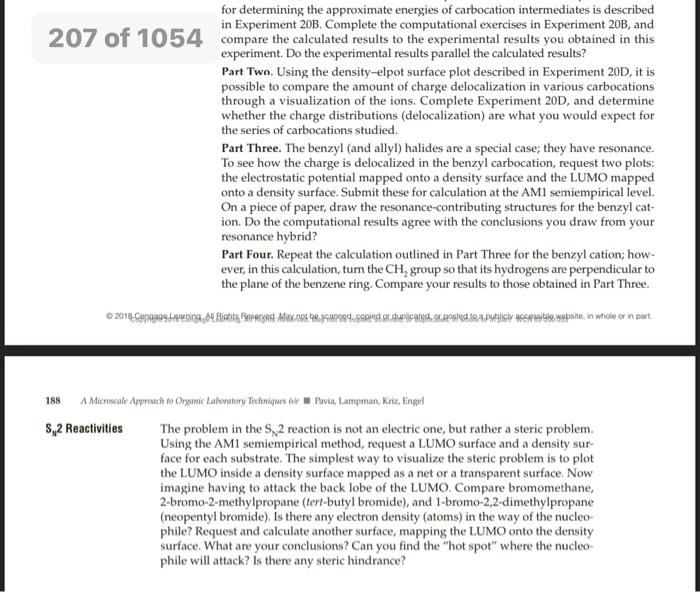
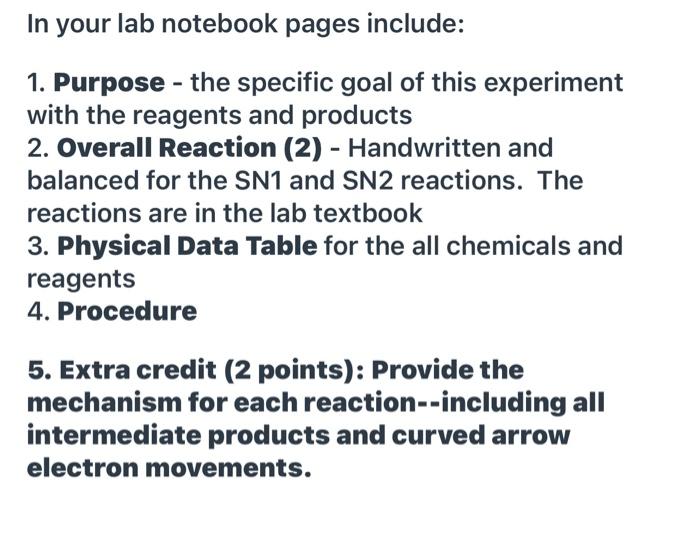
21 EXPERIMENT 21 Reactivities of Alkyl Halides 5,1/5,7 cm Relaterte Reactii The activities of alkyl halide in macheophilic substitution reactions depend on two important factors reaction conditions and strate nature. The reactivities of several substrate types will be minder both 51 and 52 action condi mns in this experiment Sodium Iodide ar Amagent componed of sodiumdide e potassium iodide solved in acetone is Potassium ladite in useful in classifying all thalides according to their reactivity in an 2 reaction Acetone Iodide ion is an excellent nucleophile, and one is a nonpolar solvent. The tendency to form a precipitate cases the completeness of the reaction, Sodium lodide and potassium Sodide are soluble in acetone, but the corresponding bromides and chlorides are not able Consequently as bromide son de chonde on is producedthe son is precipitated from the solution. According to Leite lier's Principle, the precipitation of a product from the reaction solution drives the equilibrium toward the right och the case in the action described here RENTNICI Silver Nitrate in Ethanol A reagent composed of silver med in that is useful in classifying alkyl halides according to their activity in an 5, I reaction. Nitrate son is a poor nucleophile, and ethanol is a moderately powerful ioning olent. The silver son, because of its ability to coordinate the leaving halide on to form a silver halide precipitate ratly is the one the skyi halide Aguin, a precipitates one of the action products alonhances the action R- OCH CA s-a ACT CH A 154 REQUIRED READING Before winning this experiment view the chapters dealing with nucleophilie substitution in your lecture book SPECIAL INSTRUCTIONS Some compounds used in this experiment, particularly crotyl chloride and benzyl chloride, are powerful lechymate Lachrymatersceye imitation and the for mation REQUIRED READING Before beginning this experiment review the chapters destine with nadevphili substitution in your lectus tebook SPECIAL INSTRUCTIONS Some compounds sed in this experiment particularly conchide and best chloride are powerful factorymatex Lachyscitation and their mation of CAUTION thecame some of these compoundector pertoets in hood. De careful to dispose of the test solutions in a contra for halogenated Organic waste Alertesting in the tests with one and pour the content inte the same waste con SUGGESTED WASTE DISPOSAL Dispose of all the halide wastes into the container marked for halogenated waste Any acetone washing should be placed in the same containe NOTES TO THE INSTRUCTOR Each of the slides she be checked with all/thumolto set for their purity before the dis perform this experien. I mear modeling was available, you may was the readed attento this experiment An alternative approace for conducting this experiment is to restrict the list of test compounds to the following free cutanel-bumbutan 2-chlorobutane, 2-tromobutane, and hope butyl chloride If conducted in this was can simplify the experiment by climate the allyl. henrylic and haloydalanes. This experimentan beste wiede the sand S 2 reactie ave been dised in Ancellent and mean ingful guided-inquiry experience can then be achieved to having students submit their results to campus diction bantuchado Canvas, prit to any discussion of the results by the hoe the dates have been posted on BLACKBOARD OF CANVAS have the students study the cas data to look for patterne. Encourage the class to try to die how the reactivities in the sodium iodidecetone and silver nitate/ethnal depend on the substrate structure and the group This approached and send Department Che West Wings Whether than PROCEDURE Part A Sedium todidel Acetone The Experiment Label a series of ten clean and dry test tubes (30 tubes may be used from 1 to 10. in each test tube place 2 ml of 15 Nal-in-one solo tion. Now add 4 drops and the following halides to the appropriatest tube (1) 2-chlorobutane, 22-bromobutanen 1-chlorobutane, homebutane (5) 2-chloro-2-methylpropanes-butyl chloridel, crochloride CHCH-CHCH.se Special Instructions.) bendichtune (see Special Instruction. (8 hromberene, became and be mocyclopentane. Make certain you turn the dropper to the peoper container void contaminating these falides Reactim at Room Trnar After adding the halide, shake the state well to determining of the alkyl halide and the solved. Record the timesheded for any precipitate or AM PROCEDURE Part A. Sodium fodide in Acetone The Experiment Label a series of ten clean and dry test tubes (10 x 75 mm test tubes may be wied) from 1 to 10 In each test tube place 2 ml of a 15 Nal-in-acetone solo tion. Now add 4 drops of one of the following halides to the appropriate test tubes El) 2-chlorobutane. (2) 2-bromobutane. 3) 1-chlorobutane (4 1-bromobutane. (5) 2-chloro-3-methylpropane butyl chloride). (6) crotyl chloride CHCH-CHCH. Special Instructions beyl chloridea-chlorotoluene) (see Special Instructions (5) bromobenzene, bomocyclohexane, and (10) bro mocyclopentane. Make certain you turn the dropper to the proper container to andw.contaminating these halde Reaction at Room Temperature Alter adding the halide shake the tube well to ensure adequate mixing of the alkyl halide and the solvent. Record the time needed for any precipitate of cloudines to form Reactional leated Trum After about 5 minutes, place any test the lat do not contain a precipitate in a 30C water bath. Be careful not allow the temperature of the water bath to od 50c, because the acetone will evaporate or boil out of the test tube. After about 1 minute of heating.cool the test tubes to room temperature and note whether a reaction has und Record the Oberrations Generally, reactive halides give a precipitate within 3 minutes at room temperature, moderately active halides give a precipitate when heated, and unreactive halides do not give a precipitate, even after being heated. Ignore any color changes Report Record your results in tabular form in your notebook Explain why each compound has the reactivity you deserved. Explain the reactivities in terms of structure. Com pare relative activities for compounds of similar structure Part B. Silver Nitrate The Experiment in Ethanol Label a series of ten clean and dry test tubes from 1 to 10, as described in the pre vious section. Add 2 mtod a 15 ethanol silver atrate solution to each test tube Now add 4 drops of the appropriate balade to each test tube, wing the same num bering scheme indicated for the sodium iodide test. To avoid cross-contaminating these halder, retam the dropper to the proper container Reaction at Room Temperature After adding the halide, shake the test tube well to ensure adequate mixing of the alkyl halide and the solvent. After thoroughly mining the samples, record the times needed for any precipitate or cloudiness to foem. Record your results as dense pee cipitate, cloudiness or ne precipitate/dadines Dorot use your thumb the path towe them and index finger one hand of the in the indesing your other hand 691#Larrassore JaatregaLMbekanammakaraavashesara: DONNA 35 Reaction at Elevatelem After about 5 minutes, place any tattubes that do not contain a precipitate or cloudines in a hot water bath at about 100C. After about 1 minute of heating, cool the test tubes to room temperature and note whether a reaction has occurred Record your results as de precipitate deudiness, or ne precipitate/doudiness Ohumtime Now add 4 drops of the appropriate Halide to each test tube sing the same num bering scheme indicated for the sedium iodidest. To avoid cs-contaminating these halides, retum the dropper to the proper containet. Reaction at Room Temperature After adding the halide shake the test tabe well to ensure adequate mixing of the alkyl halide and the solvent. After thoroughly mixing the samples, record the times needed for any precipitate or doudines to form Record your results as dense pre cipitate, dootiness, or no precipitate/cloudines Denet wer your apport de top of the totale between the then and indesinger of what the bed the best being the index PERDAN Reaction of Electra Tema After about 5 minutes, place any test tubes that do not contain a precipitate or cloudiness in a hot water bath at about 100C. After about 1 minute of heating cool the test tubes to room temperature and note whether a reaction has occurred Record your resulbas dere precipitate, cloudiness or no precipitate/cloudiness Oberries Reactive halides give a precipitate for cloudiness) within 3 minutes at room temperature, moderately active des give a precipitate for cloudines when heated and creative holide do not give a precipitatter being heated In any color changes Rant Record your results in tabular form in your notebook Explain why each compound has the activity that you observed. Explain the activities in terms of structure Compare relative reactivities for compounds of similar structure MOLECULAR MODELING (OPTIONAL) Many points developed in this experiment can be confirmed through the use of molecular modeling. The following experiments were developed with PC Spartan te should be possible to see other sottware but the instructor may have to make some modifications $1 Reactivities Part One. The rate of an S1 reaction la related to the energy of the carbocation in termediate that is formed in the rate-determining ionization step of the action. It is expected that the activation energy equired to form an intermediate is close to the energy of the intermediate. When we intermediates are compared the activation energy leading to the intermediate of lower mergy is expected to be lower than the activation energy leading to the intermediate of higher energy. The easier it is to form the carecation, the faster the praction will proced. An AMI mimpirical method for determining the approximate energies of carbocation intermediates is described in Experiment 2018. Complete the computational exercises in Experiment 200, and compare the calculated results to the experimental results you obtained in this experiment. Do the experimental results and the calculated results! Part Twn. Using the density-elpot surface plot described in Experiment 20, it is possible to compare the amount of charge delocalisation in various carbocations through a visualisation of the ion Complete Experiment 200, and determine whether the charge distributions (delocalization are what you would expect for the wries of carbocation studied Part Three. The benzyl and allyl) halides are a special case they have sonance To see how the charge is delocalized in the benzylcarbocation request two plote the electrostatic potential mapped onto a density surface and the LUMO mapped onto a density surface Submit these for calculation at the AMI semiempirical level On a piece of paper draw the resonance contributing stractures for the benzylcat fon. Do the computational results agree with the conclusions you draw from your resonance hybrid Part Four. Repeat the calculation etlined in Part Three for the beneyication how evet in the callationum theCH, so that its hydrogen perpendicular to the plane of the benzere in compare your results to the obtained in Part Three In your lab notebook pages include: 1. Purpose - the specific goal of this experiment with the reagents and products 2. Overall Reaction (2) - Handwritten and balanced for the SN1 and SN2 reactions. The reactions are in the lab textbook 3. Physical Data Table for the all chemicals and reagents 4. Procedure 5. Extra credit (2 points): Provide the mechanism for each reaction--including all intermediate products and curved arrow electron movements
Step by Step Solution
There are 3 Steps involved in it

Get step-by-step solutions from verified subject matter experts
 Study Help