







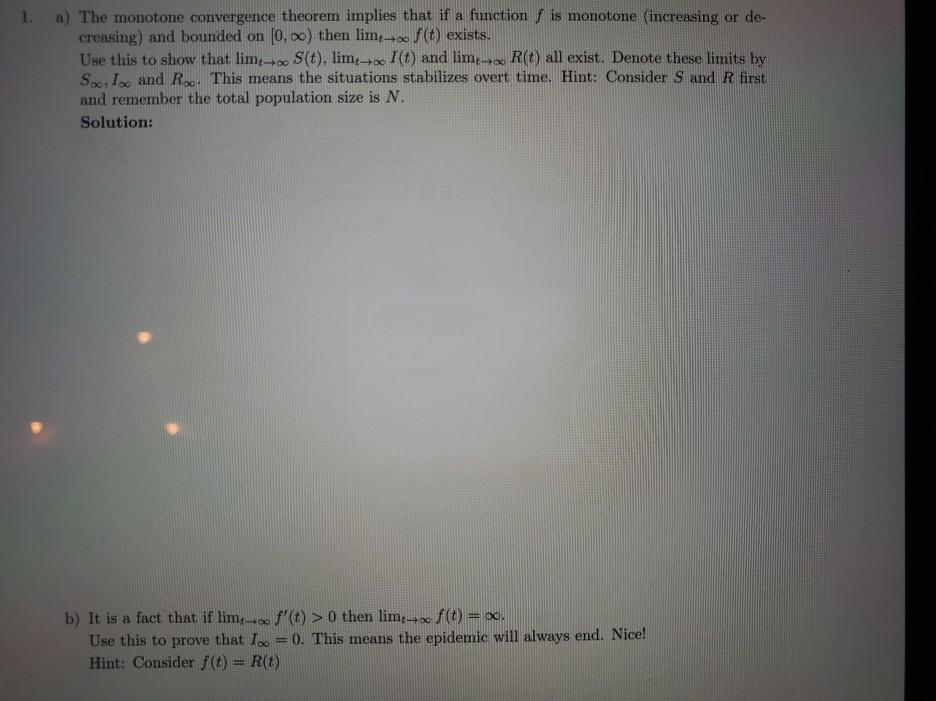
Question: Need help on question 1 part a and b 1. a) The monotone convergence theorem implies that if a function f is monotone (increasing or
Need help on question 1 part a and b
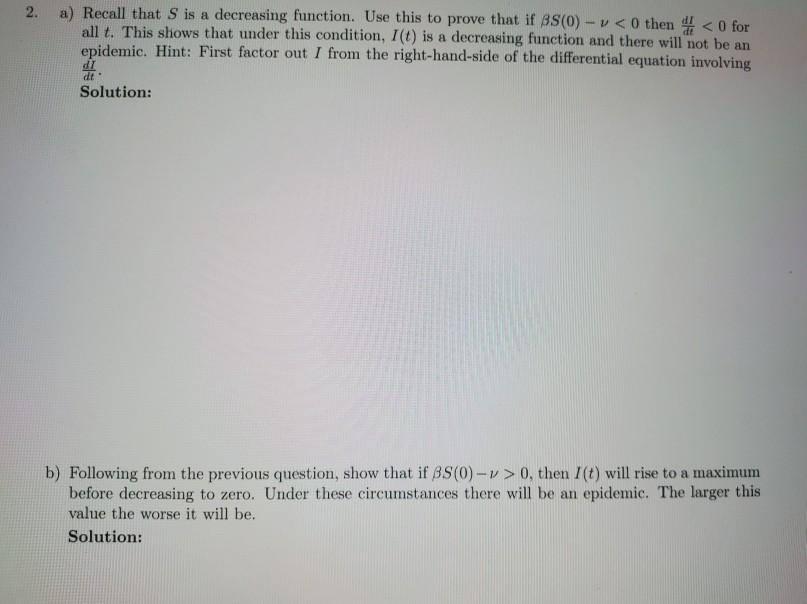
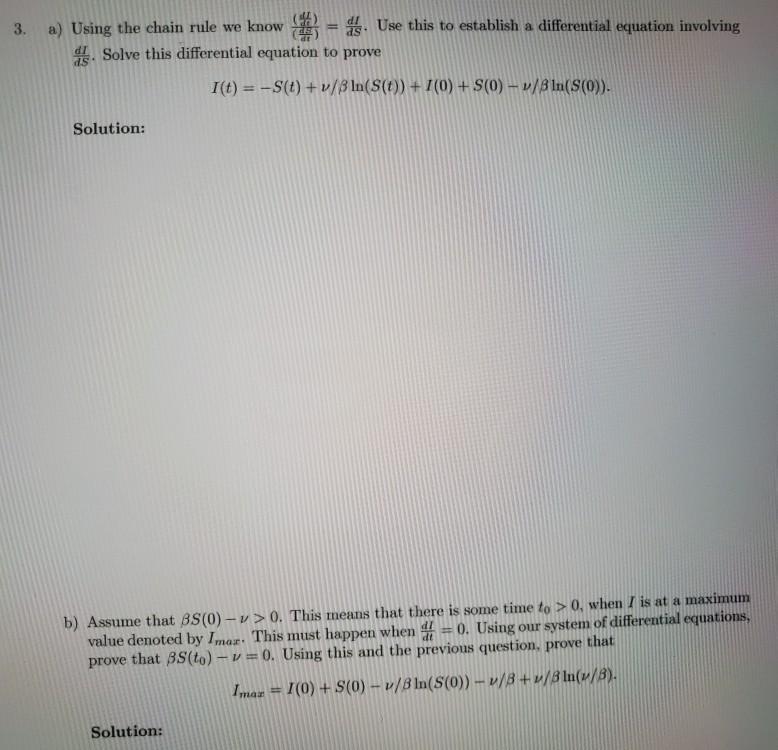
1. a) The monotone convergence theorem implies that if a function f is monotone (increasing or de- creasing) and bounded on (0,00) then limf(texists. Use this to show that lim 7. S(t), lime-(t) and lim - R(t) all exist. Denote these limits by S..I. and R... This means the situations stabilizes overt time. Hint: Consider S and R first and remember the total population size is N. Solution: b) It is a fact that if limyo f'(t) > 0 then lim-f(t) = o. Use this to prove that l = 0. This means the epidemic will always end. Nice! Hint: Consider f(t) = R(t) 2. a) Recall that S is a decreasing function. Use this to prove that if 85(0) - v 0, then I(t) will rise to a maximum before decreasing to zero. Under these circumstances there will be an epidemic. The larger this value the worse it will be. Solution: 3. a) Using the chain rule we know - . Use this to establish a differential equation involving Solve this differential equation to prove I(t) = -(t) + v/8 In(S(t))+ (0) + S(0) - w/Bin(S(O)). ds Solution: b) Assume that BS(0) -v> 0. This rneans that there is some time to > 0, when I is at a maximum value denoted by Imar. This must happen when = 0. Using our system of differential equations, prove that BS(to) - v = 0. Using this and the previous question, prove that Imar = I(0) + S(0) - v/Bin(S(0)) - v/8+v/8 ln(v/8). Solution: 1. a) The monotone convergence theorem implies that if a function f is monotone (increasing or de- creasing) and bounded on (0,00) then limf(texists. Use this to show that lim 7. S(t), lime-(t) and lim - R(t) all exist. Denote these limits by S..I. and R... This means the situations stabilizes overt time. Hint: Consider S and R first and remember the total population size is N. Solution: b) It is a fact that if limyo f'(t) > 0 then lim-f(t) = o. Use this to prove that l = 0. This means the epidemic will always end. Nice! Hint: Consider f(t) = R(t) 2. a) Recall that S is a decreasing function. Use this to prove that if 85(0) - v 0, then I(t) will rise to a maximum before decreasing to zero. Under these circumstances there will be an epidemic. The larger this value the worse it will be. Solution: 3. a) Using the chain rule we know - . Use this to establish a differential equation involving Solve this differential equation to prove I(t) = -(t) + v/8 In(S(t))+ (0) + S(0) - w/Bin(S(O)). ds Solution: b) Assume that BS(0) -v> 0. This rneans that there is some time to > 0, when I is at a maximum value denoted by Imar. This must happen when = 0. Using our system of differential equations, prove that BS(to) - v = 0. Using this and the previous question, prove that Imar = I(0) + S(0) - v/Bin(S(0)) - v/8+v/8 ln(v/8). Solution
Step by Step Solution
There are 3 Steps involved in it

Get step-by-step solutions from verified subject matter experts
 Study Help