







Question: please help me out with this question. Thanks 4 Question (5 points) See page 474 One proposed source of clean energy is the combustion of
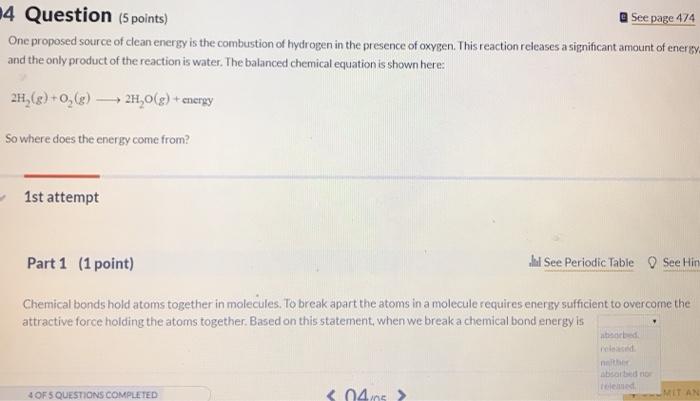
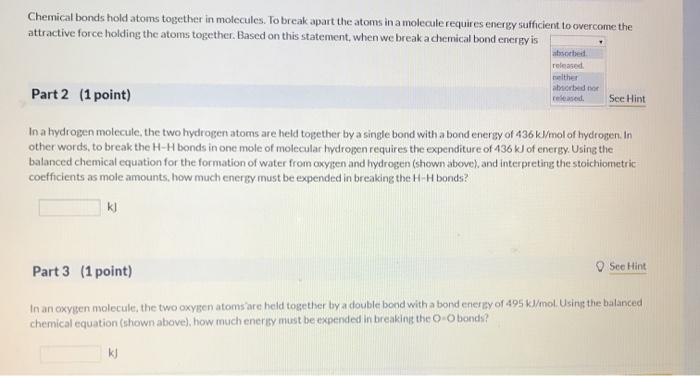
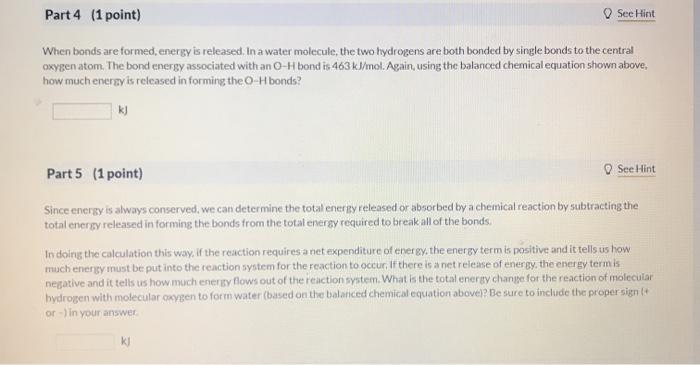
4 Question (5 points) See page 474 One proposed source of clean energy is the combustion of hydrogen in the presence of oxygen. This reaction releases a significant amount of energy and the only product of the reaction is water. The balanced chemical equation is shown here: 2H,(g) +0,($) -24,0(g) + energy So where does the energy come from? 1st attempt Part 1 (1 point) al See Periodic Table See Hin Chemical bonds hold atoms together in molecules. To break apart the atoms in a molecule requires energy sufficient to overcome the attractive force holding the atoms together. Based on this statement, when we break a chemical bond energy is berbed bisabedno ed 4 OF 5 QUESTIONS COMPLETED MIT AN Chemical bonds hold atoms together in molecules. To break apart the atoms in a molecule requires energy sufficient to overcome the attractive force holding the atoms together. Based on this statement, when we break a chemical bond energy is absorber released ther absorbed or released Part 2 (1 point) See Hint In a hydropen molecule, the two hydrogen atoms are held together by a single bond with a bond energy of 436 kJ/mol of hydropen. In other words, to break the H-H bonds in one mole of molecular hydrogen requires the expenditure of 436 kJ of energy. Using the balanced chemical equation for the formation of water from oxyiten and hydrogen (shown above), and interpreting the stoichiometric coefficients as mole amounts. how much energy must be expended in breaking the H-H bonds? k) Part 3 (1 point) See Hint In an oxysten molecule, the two oxygen atoms are held together by a double bond with a bond energy of 495 kJ/mol. Using the balanced chemical equation (shown above), how much enersy must be expended in breaking the oO bonds? KJ Part 4 (1 point) See Hint When bonds are formed, energy is released. In a water molecule, the two hydrogens are both bonded by single bonds to the central oxygen atom. The bond energy associated with an O-H bond is 463 kJ/mol. Again, using the balanced chemical equation shown above. how much energy is released in forming the O-H bonds? ki Part 5 (1 point) See Hint Since energy is always conserved, we can determine the total energy released or absorbed by a chemical reaction by subtracting the total energy released in forming the bonds from the total energy required to break all of the bonds, In doing the calculation this way. If the reaction requires a net expenditure of energy, the energy term is positive and it tells us how much energy must be put into the reaction system for the reaction to occur, If there is a netrelease of energy, the energy termis negative and it tells us how much energy flows out of the reaction system. What is the total energy change for the reaction of molecular hydropen with modecular crypen to form water (based on the balanced chemical equation abovel? Be sure to include the proper sign (+ or in your
Step by Step Solution
There are 3 Steps involved in it

Get step-by-step solutions from verified subject matter experts
 Study Help