







Question: Please help with these questions We've discussed how basic quantitative analysis in marketing is essential for understanding a firm's marketing operations and the financial consequences
Please help with these questions
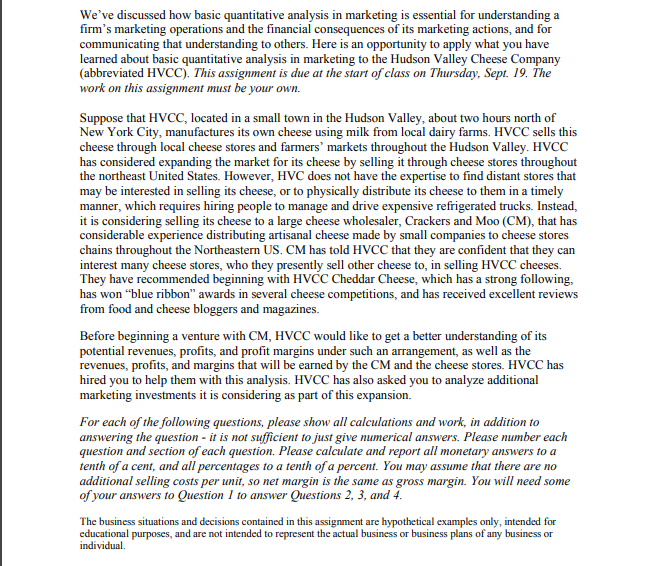
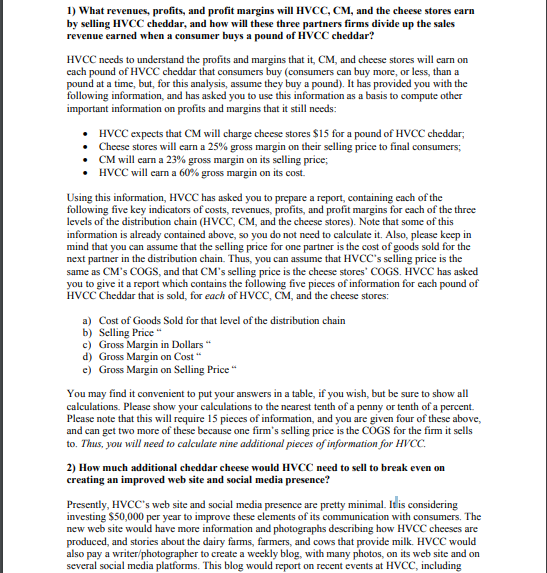
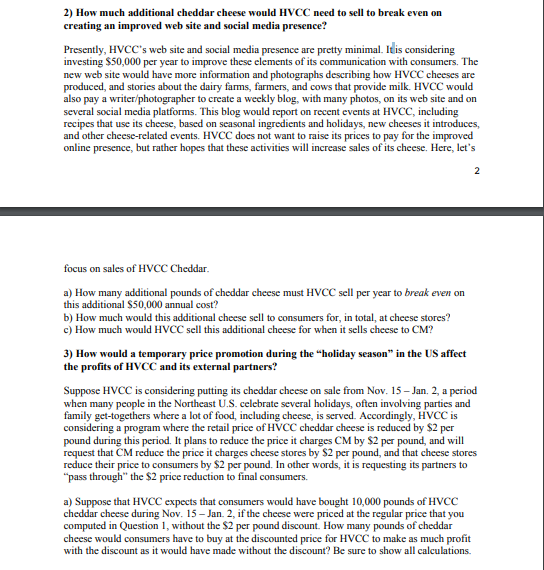
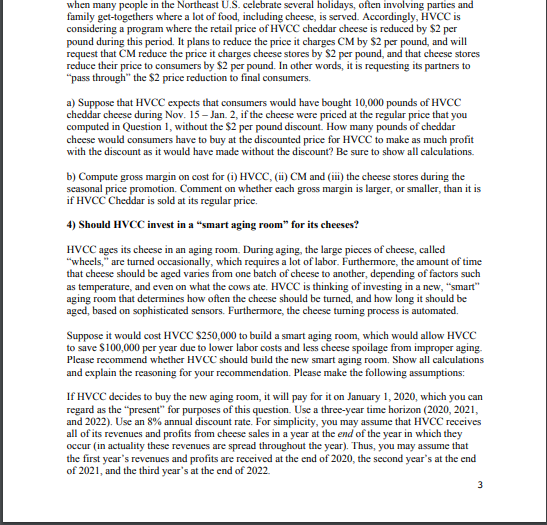
We've discussed how basic quantitative analysis in marketing is essential for understanding a firm's marketing operations and the financial consequences of its marketing actions, and for communicating that understanding to others. Here is an opportunity to apply what you have learned about basic quantitative analysis in marketing to the Hudson Valley Cheese Company (abbreviated HVCC). This assignment is due at the start of class on Thursday, Sept. 19. The work on this assignment must be your own. Suppose that HVCC, located in a small town in the Hudson Valley, about two hours north of New York City, manufactures its own cheese using milk from local dairy farms. HVCC sells this cheese through local cheese stores and farmers' markets throughout the Hudson Valley. HVCC has considered expanding the market for its cheese by selling it through cheese stores throughout the northeast United States. However, HVC does not have the expertise to find distant stores that may be interested in selling its cheese, or to physically distribute its cheese to them in a timely manner, which requires hiring people to manage and drive expensive refrigerated trucks. Instead, it is considering selling its cheese to a large cheese wholesaler, Crackers and Moo (CM), that has considerable experience distributing artisanal cheese made by small companies to cheese stores chains throughout the Northeastern US, CM has told HVCC that they are confident that they can interest many cheese stores, who they presently sell other cheese to, in selling HVCC cheeses. They have recommended beginning with HVCC Cheddar Cheese, which has a strong following, has won "blue ribbon" awards in several cheese competitions, and has received excellent reviews from food and cheese bloggers and magazines. Before beginning a venture with CM, HVCC would like to get a better understanding of its potential revenues, profits, and profit margins under such an arrangement, as well as the revenues, profits, and margins that will be earned by the CM and the cheese stores. HVCC has hired you to help them with this analysis. HVCC has also asked you to analyze additional marketing investments it is considering as part of this expansion. For each of the following questions, please show all calculations and work, in addition to answering the question - it is not sufficient to just give numerical answers. Please number each question and section of each question. Please calculate and report all monetary answers to a tenth of a cent, and all percentages to a tenth of a percent. You may assume that there are no additional selling costs per unit, so net margin is the same as gross margin. You will need some of your answers to Question I to answer Questions 2, 3, and 4. The business situations and decisions contained in this assignment are hypothetical examples only, intended for educational purposes, and are not intended to represent the actual business or business plans of any business or individual 1) What revenues, profits, and profit margins will HVCC, CM, and the cheese stores carn by selling HVCC cheddar, and how will these three partners firms divide up the sales revenue earned when a consumer buys a pound of HVCC cheddar? HVCC needs to understand the profits and margins that it, CM, and cheese stores will earn on cach pound of HVCC cheddar that consumers buy (consumers can buy more or less than a pound at a time, but, for this analysis, assume they buy a pound). It has provided you with the following information, and has asked you to use this information as a basis to compute other important information on profits and margins that it still needs: HVCC expects that CM will charge cheese stores $15 for a pound of HVCC cheddar Cheese stores will carn a 25% gross margin on their selling price to final consumers, CM will earn a 23% gross margin on its selling price; HVCC will earn a 60% gross margin on its cost. Using this information, HVCC has asked you to prepare a report, containing cach of the following five key indicators of costs, revenues, profits, and profit margins for each of the three levels of the distribution chain (HVCC, CM, and the cheese stores). Note that some of this information is already contained above, so you do not need to calculate it. Also, please keep in mind that you can assume that the selling price for one partner is the cost of goods sold for the next partner in the distribution chain. Thus, you can assume that HVCC's selling price is the same as CM's COGS, and that CM's selling price is the cheese stores' COGS. HVCC has asked you to give it a report which contains the following five pieces of information for each pound of HVCC Cheddar that is sold, for each of HVCC, CM, and the cheese stores: a) Cost of Goods Sold for that level of the distribution chain b) Selling Price c) Gross Margin in Dollars d) Gross Margin on Cost" e) Gross Margin on Selling Price You may find it convenient to put your answers in a table, if you wish, but be sure to show all calculations. Please show your calculations to the nearest tenth of a penny or tenth of a percent. Please note that this will require 15 pieces of information, and you are given four of these above, and can get two more of these because one firm's selling price is the COGS for the firm it sells to. Thus, you will need to calculate nine additional pieces of information for HVCC. 2) How much additional cheddar cheese would HVCC need to sell to break even on creating an improved web site and social media presence? Presently, HVCC's web site and social media presence are pretty minimal. It is considering investing $50,000 per year to improve these elements of its communication with consumers. The new web site would have more information and photographs describing how HVCC cheeses are produced, and stories about the dairy farms, farmers, and cows that provide milk. HVCC would also pay a writer photographer to create a weekly blog, with many photos, on its web site and on several social media platforms. This blog would report on recent events at HVCC, including 2) How much additional cheddar cheese would HVCC need to sell to break even on creating an improved web site and social media presence? Presently, HVCC's web site and social media presence are pretty minimal. It is considering investing $50,000 per year to improve these elements of its communication with consumers. The new web site would have more information and photographs describing how HVCC cheeses are produced, and stories about the dairy farms, farmers, and cows that provide milk. HVCC would also pay a writer/photographer to create a weekly blog, with many photos, on its web site and on several social media platforms. This blog would report on recent events at HVCC, including recipes that use its cheese, based on seasonal ingredients and holidays, new cheeses it introduces, and other cheese-related events. HVCC does not want to raise its prices to pay for the improved online presence, but rather hopes that these activities will increase sales of its cheese. Here, let's focus on sales of HVCC Cheddar. a) How many additional pounds of cheddar cheese must HVCC sell per year to break even on this additional $50,000 annual cost? b) How much would this additional cheese sell to consumers for, in total, at cheese stores? c) How much would HVCC sell this additional cheese for when it sells cheese to CM? 3) How would a temporary price promotion during the holiday season" in the US affect the profits of HVCC and its external partners? Suppose HVCC is considering putting its cheddar cheese on sale from Nov. 15-Jan. 2, a period when many people in the Northeast U.S. celebrate several holidays, often involving parties and family get-togethers where a lot of food, including cheese, is served. Accordingly, HVCC is considering a program where the retail price of HVCC cheddar cheese is reduced by $2 per pound during this period. It plans to reduce the price it charges CM by $2 per pound, and will request that CM reduce the price it charges cheese stores by $2 per pound, and that cheese stores reduce their price to consumers by $2 per pound. In other words, it is requesting its partners to "pass through the $2 price reduction to final consumers. a) Suppose that HVCC expects that consumers would have bought 10,000 pounds of HVCC cheddar cheese during Nov. 15 - Jan. 2, if the cheese were priced at the regular price that you computed in Question 1, without the $2 per pound discount. How many pounds of cheddar cheese would consumers have to buy at the discounted price for HVCC to make as much profit with the discount as it would have made without the discount? Be sure to show all calculations when many people in the Northeast U.S. celebrate several holidays, often involving parties and family get-togethers where a lot of food, including cheese, is served. Accordingly, HVCC is considering a program where the retail price of HVCC cheddar cheese is reduced by $2 per pound during this period. It plans to reduce the price it charges CM by S2 per pound, and will request that CM reduce the price it charges cheese stores by $2 per pound, and that cheese stores reduce their price to consumers by $2 per pound. In other words, it is requesting its partners to "pass through the $2 price reduction to final consumers. a) Suppose that HVCC expects that consumers would have bought 10,000 pounds of HVCC cheddar cheese during Nov. 15-Jan. 2. if the cheese were priced at the regular price that you computed in Question 1, without the $2 per pound discount. How many pounds of cheddar cheese would consumers have to buy at the discounted price for HVCC to make as much profit with the discount as it would have made without the discount? Be sure to show all calculations b) Compute gross margin on cost for (i) HVCC, CM and (iii) the cheese stores during the seasonal price promotion. Comment on whether each gross margin is larger, or smaller than it is if HVCC Cheddar is sold at its regular price. 4) Should HVCC invest in a "smart aging room" for its cheeses? HVCC ages its cheese in an aging room. During aging, the large pieces of cheese, called "wheels," are turned occasionally, which requires a lot of labor. Furthermore, the amount of time that cheese should be aged varies from one batch of cheese to another, depending of factors such as temperature, and even on what the cows ate. HVCC is thinking of investing in a new,"smart" aging room that determines how often the cheese should be turned, and how long it should be aged, based on sophisticated sensors. Furthermore, the cheese turning process is automated Suppose it would cost HVCC $250,000 to build a smart aging room, which would allow HVCC to save $100,000 per year due to lower labor costs and less cheese spoilage from improper aging Please recommend whether HVCC should build the new smart aging room. Show all calculations and explain the reasoning for your recommendation. Please make the following assumptions: If HVCC decides to buy the new aging room, it will pay for it on January 1, 2020, which you can regard as the "present" for purposes of this question. Use a three-year time horizon 2020, 2021, and 2022). Use an 8% annual discount rate. For simplicity, you may assume that HVCC receives all of its revenues and profits from cheese sales in a year at the end of the year in which they occur in actuality these revenues are spread throughout the year). Thus, you may assume that the first year's revenues and profits are received at the end of 2020, the second year's at the end of 2021, and the third year's at the end of 2022 We've discussed how basic quantitative analysis in marketing is essential for understanding a firm's marketing operations and the financial consequences of its marketing actions, and for communicating that understanding to others. Here is an opportunity to apply what you have learned about basic quantitative analysis in marketing to the Hudson Valley Cheese Company (abbreviated HVCC). This assignment is due at the start of class on Thursday, Sept. 19. The work on this assignment must be your own. Suppose that HVCC, located in a small town in the Hudson Valley, about two hours north of New York City, manufactures its own cheese using milk from local dairy farms. HVCC sells this cheese through local cheese stores and farmers' markets throughout the Hudson Valley. HVCC has considered expanding the market for its cheese by selling it through cheese stores throughout the northeast United States. However, HVC does not have the expertise to find distant stores that may be interested in selling its cheese, or to physically distribute its cheese to them in a timely manner, which requires hiring people to manage and drive expensive refrigerated trucks. Instead, it is considering selling its cheese to a large cheese wholesaler, Crackers and Moo (CM), that has considerable experience distributing artisanal cheese made by small companies to cheese stores chains throughout the Northeastern US, CM has told HVCC that they are confident that they can interest many cheese stores, who they presently sell other cheese to, in selling HVCC cheeses. They have recommended beginning with HVCC Cheddar Cheese, which has a strong following, has won "blue ribbon" awards in several cheese competitions, and has received excellent reviews from food and cheese bloggers and magazines. Before beginning a venture with CM, HVCC would like to get a better understanding of its potential revenues, profits, and profit margins under such an arrangement, as well as the revenues, profits, and margins that will be earned by the CM and the cheese stores. HVCC has hired you to help them with this analysis. HVCC has also asked you to analyze additional marketing investments it is considering as part of this expansion. For each of the following questions, please show all calculations and work, in addition to answering the question - it is not sufficient to just give numerical answers. Please number each question and section of each question. Please calculate and report all monetary answers to a tenth of a cent, and all percentages to a tenth of a percent. You may assume that there are no additional selling costs per unit, so net margin is the same as gross margin. You will need some of your answers to Question I to answer Questions 2, 3, and 4. The business situations and decisions contained in this assignment are hypothetical examples only, intended for educational purposes, and are not intended to represent the actual business or business plans of any business or individual 1) What revenues, profits, and profit margins will HVCC, CM, and the cheese stores carn by selling HVCC cheddar, and how will these three partners firms divide up the sales revenue earned when a consumer buys a pound of HVCC cheddar? HVCC needs to understand the profits and margins that it, CM, and cheese stores will earn on cach pound of HVCC cheddar that consumers buy (consumers can buy more or less than a pound at a time, but, for this analysis, assume they buy a pound). It has provided you with the following information, and has asked you to use this information as a basis to compute other important information on profits and margins that it still needs: HVCC expects that CM will charge cheese stores $15 for a pound of HVCC cheddar Cheese stores will carn a 25% gross margin on their selling price to final consumers, CM will earn a 23% gross margin on its selling price; HVCC will earn a 60% gross margin on its cost. Using this information, HVCC has asked you to prepare a report, containing cach of the following five key indicators of costs, revenues, profits, and profit margins for each of the three levels of the distribution chain (HVCC, CM, and the cheese stores). Note that some of this information is already contained above, so you do not need to calculate it. Also, please keep in mind that you can assume that the selling price for one partner is the cost of goods sold for the next partner in the distribution chain. Thus, you can assume that HVCC's selling price is the same as CM's COGS, and that CM's selling price is the cheese stores' COGS. HVCC has asked you to give it a report which contains the following five pieces of information for each pound of HVCC Cheddar that is sold, for each of HVCC, CM, and the cheese stores: a) Cost of Goods Sold for that level of the distribution chain b) Selling Price c) Gross Margin in Dollars d) Gross Margin on Cost" e) Gross Margin on Selling Price You may find it convenient to put your answers in a table, if you wish, but be sure to show all calculations. Please show your calculations to the nearest tenth of a penny or tenth of a percent. Please note that this will require 15 pieces of information, and you are given four of these above, and can get two more of these because one firm's selling price is the COGS for the firm it sells to. Thus, you will need to calculate nine additional pieces of information for HVCC. 2) How much additional cheddar cheese would HVCC need to sell to break even on creating an improved web site and social media presence? Presently, HVCC's web site and social media presence are pretty minimal. It is considering investing $50,000 per year to improve these elements of its communication with consumers. The new web site would have more information and photographs describing how HVCC cheeses are produced, and stories about the dairy farms, farmers, and cows that provide milk. HVCC would also pay a writer photographer to create a weekly blog, with many photos, on its web site and on several social media platforms. This blog would report on recent events at HVCC, including 2) How much additional cheddar cheese would HVCC need to sell to break even on creating an improved web site and social media presence? Presently, HVCC's web site and social media presence are pretty minimal. It is considering investing $50,000 per year to improve these elements of its communication with consumers. The new web site would have more information and photographs describing how HVCC cheeses are produced, and stories about the dairy farms, farmers, and cows that provide milk. HVCC would also pay a writer/photographer to create a weekly blog, with many photos, on its web site and on several social media platforms. This blog would report on recent events at HVCC, including recipes that use its cheese, based on seasonal ingredients and holidays, new cheeses it introduces, and other cheese-related events. HVCC does not want to raise its prices to pay for the improved online presence, but rather hopes that these activities will increase sales of its cheese. Here, let's focus on sales of HVCC Cheddar. a) How many additional pounds of cheddar cheese must HVCC sell per year to break even on this additional $50,000 annual cost? b) How much would this additional cheese sell to consumers for, in total, at cheese stores? c) How much would HVCC sell this additional cheese for when it sells cheese to CM? 3) How would a temporary price promotion during the holiday season" in the US affect the profits of HVCC and its external partners? Suppose HVCC is considering putting its cheddar cheese on sale from Nov. 15-Jan. 2, a period when many people in the Northeast U.S. celebrate several holidays, often involving parties and family get-togethers where a lot of food, including cheese, is served. Accordingly, HVCC is considering a program where the retail price of HVCC cheddar cheese is reduced by $2 per pound during this period. It plans to reduce the price it charges CM by $2 per pound, and will request that CM reduce the price it charges cheese stores by $2 per pound, and that cheese stores reduce their price to consumers by $2 per pound. In other words, it is requesting its partners to "pass through the $2 price reduction to final consumers. a) Suppose that HVCC expects that consumers would have bought 10,000 pounds of HVCC cheddar cheese during Nov. 15 - Jan. 2, if the cheese were priced at the regular price that you computed in Question 1, without the $2 per pound discount. How many pounds of cheddar cheese would consumers have to buy at the discounted price for HVCC to make as much profit with the discount as it would have made without the discount? Be sure to show all calculations when many people in the Northeast U.S. celebrate several holidays, often involving parties and family get-togethers where a lot of food, including cheese, is served. Accordingly, HVCC is considering a program where the retail price of HVCC cheddar cheese is reduced by $2 per pound during this period. It plans to reduce the price it charges CM by S2 per pound, and will request that CM reduce the price it charges cheese stores by $2 per pound, and that cheese stores reduce their price to consumers by $2 per pound. In other words, it is requesting its partners to "pass through the $2 price reduction to final consumers. a) Suppose that HVCC expects that consumers would have bought 10,000 pounds of HVCC cheddar cheese during Nov. 15-Jan. 2. if the cheese were priced at the regular price that you computed in Question 1, without the $2 per pound discount. How many pounds of cheddar cheese would consumers have to buy at the discounted price for HVCC to make as much profit with the discount as it would have made without the discount? Be sure to show all calculations b) Compute gross margin on cost for (i) HVCC, CM and (iii) the cheese stores during the seasonal price promotion. Comment on whether each gross margin is larger, or smaller than it is if HVCC Cheddar is sold at its regular price. 4) Should HVCC invest in a "smart aging room" for its cheeses? HVCC ages its cheese in an aging room. During aging, the large pieces of cheese, called "wheels," are turned occasionally, which requires a lot of labor. Furthermore, the amount of time that cheese should be aged varies from one batch of cheese to another, depending of factors such as temperature, and even on what the cows ate. HVCC is thinking of investing in a new,"smart" aging room that determines how often the cheese should be turned, and how long it should be aged, based on sophisticated sensors. Furthermore, the cheese turning process is automated Suppose it would cost HVCC $250,000 to build a smart aging room, which would allow HVCC to save $100,000 per year due to lower labor costs and less cheese spoilage from improper aging Please recommend whether HVCC should build the new smart aging room. Show all calculations and explain the reasoning for your recommendation. Please make the following assumptions: If HVCC decides to buy the new aging room, it will pay for it on January 1, 2020, which you can regard as the "present" for purposes of this question. Use a three-year time horizon 2020, 2021, and 2022). Use an 8% annual discount rate. For simplicity, you may assume that HVCC receives all of its revenues and profits from cheese sales in a year at the end of the year in which they occur in actuality these revenues are spread throughout the year). Thus, you may assume that the first year's revenues and profits are received at the end of 2020, the second year's at the end of 2021, and the third year's at the end of 2022
Step by Step Solution
There are 3 Steps involved in it

Get step-by-step solutions from verified subject matter experts
 Study Help