







Question: Question 1 Z Point on bisecting line Charge Q + + + + + + + + X What is the electric potential at the
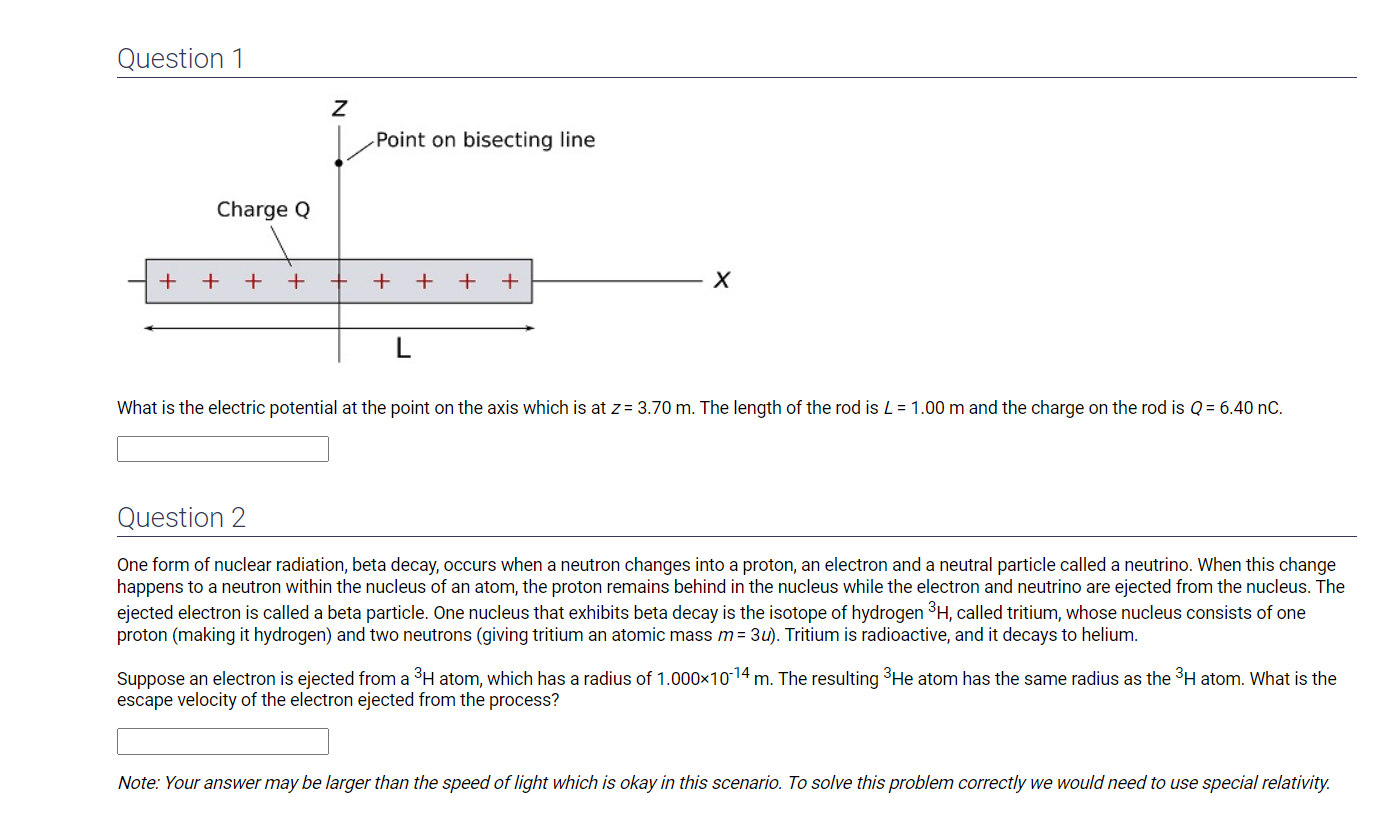
Question 1 Z Point on bisecting line Charge Q + + + + + + + + X What is the electric potential at the point on the axis which is at z = 3.70 m. The length of the rod is _ = 1.00 m and the charge on the rod is Q = 6.40 nc. Question 2 One form of nuclear radiation, beta decay, occurs when a neutron changes into a proton, an electron and a neutral particle called a neutrino. When this change happens to a neutron within the nucleus of an atom, the proton remains behind in the nucleus while the electron and neutrino are ejected from the nucleus. The ejected electron is called a beta particle. One nucleus that exhibits beta decay is the isotope of hydrogen "H, called tritium, whose nucleus consists of one proton (making it hydrogen) and two neutrons (giving tritium an atomic mass m = 3u). Tritium is radioactive, and it decays to helium. Suppose an electron is ejected from a 3H atom, which has a radius of 1.000x10⁻¹⁴ m. The resulting He atom has the same radius as the 3H atom. What is the escape velocity of the electron ejected from the process? Note: Your answer may be larger than the speed of light which is okay in this scenario. To solve this problem correctly we would need to use special relativity
Step by Step Solution
There are 3 Steps involved in it

Get step-by-step solutions from verified subject matter experts
 Study Help