







Question: REFERENCE:https://drive.google.com/file/d/14z7ysR9wgFR7fNxqUCPVwKYTMEOvPf8B/view?usp=sharing please open the link for the module. thank you, answer every item with solution thank you. i will give a high rate dont worry.
REFERENCE:https://drive.google.com/file/d/14z7ysR9wgFR7fNxqUCPVwKYTMEOvPf8B/view?usp=sharing
please open the link for the module. thank you, answer every item with solution thank you. i will give a high rate dont worry.
thanks
can you please drop the solutions you made for the numbers that need a solution, such as the number 2,6, 11 test 1, and the number 4, 5 ,6 of the assessment
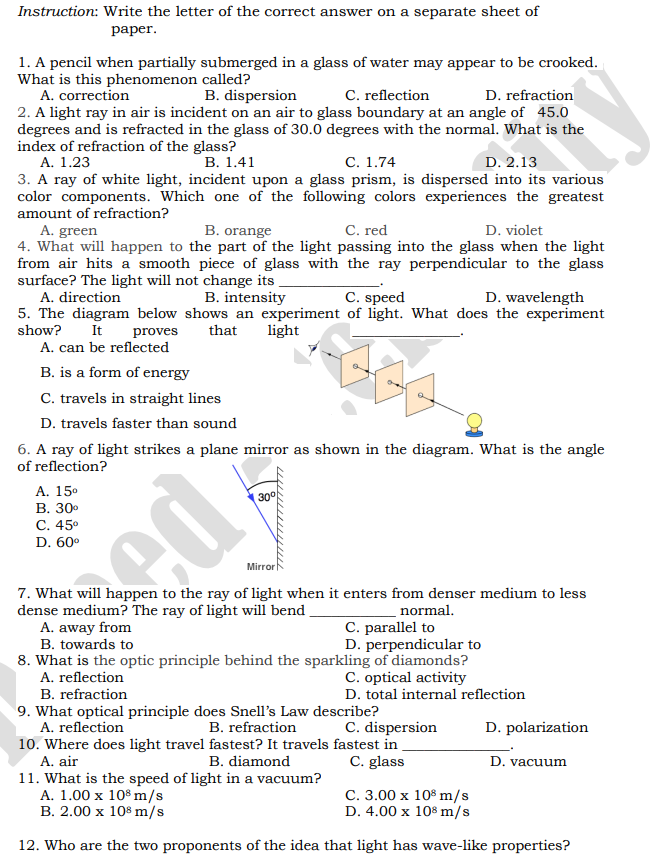
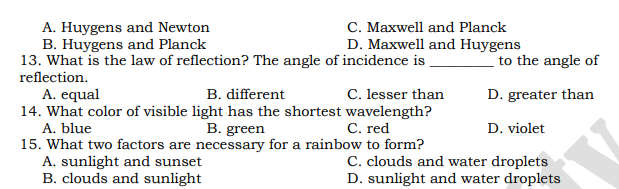
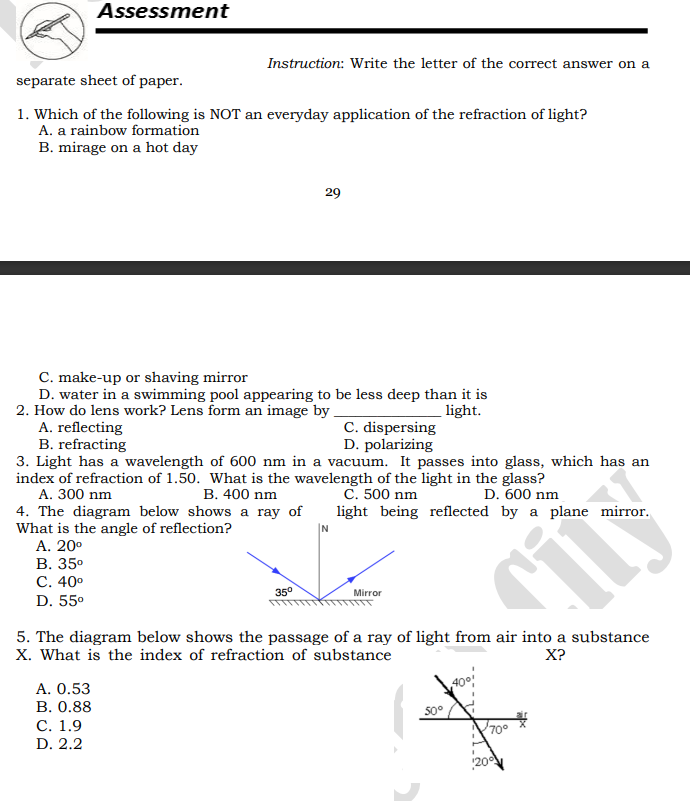
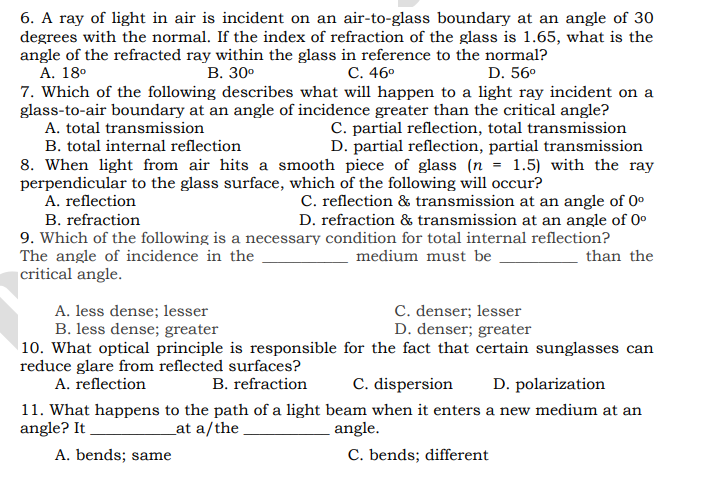
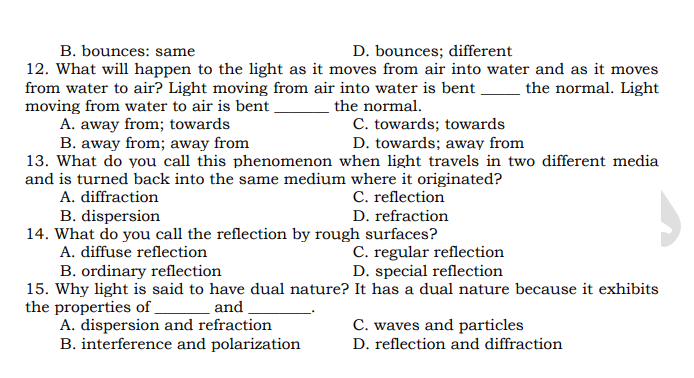
Instruction: Write the letter of the correct answer on a separate sheet of paper. 1. A pencil when partially submerged in a glass of water may appear to be crooked. What is this phenomenon called? A. correction B. dispersion C. reflection D. refraction 2. A light ray in air is incident on an air to glass boundary at an angle of 45.0 degrees and is refracted in the glass of 30.0 degrees with the normal. What is the index of refraction of the glass? A. 1.23 B. 1.41 C. 1.74 D. 2.13 3. A ray of white light, incident upon a glass prism, is dispersed into its various color components. Which one of the following colors experiences the greatest amount of refraction? A. green B. orange C. red D. violet 4. What will happen to the part of the light passing into the glass when the light from air hits a smooth piece of glass with the ray perpendicular to the glass surface? The light will not change its A. direction B. intensity C. speed D. wavelength 5. The diagram below shows an experiment of light. What does the experiment show? It proves that light A. can be reflected B. is a form of energy C. travels in straight lines D. travels faster than sound 6. A ray of light strikes a plane mirror as shown in the diagram. What is the angle of reflection? A. 150 B. 30 C. 450 D. 60 Mirror 7. What will happen to the ray of light when it enters from denser medium to less dense medium? The ray of light will bend normal. A. away from C. parallel to B. towards to D. perpendicular to 8. What is the optic principle behind the sparkling of diamonds? A. reflection C. optical activity B. refraction D. total internal reflection 9. What optical principle does Snell's Law describe? A. reflection B. refraction C. dispersion D. polarization 10. Where does light travel fastest? It travels fastest in A. air B. diamond C. glass D. vacuum 11. What is the speed of light in a vacuum? A. 1.00 x 10⁸ m/s C. 3.00 x 10⁸ m/s B. 2.00 x 10⁸ m/s D. 4.00 x 10⁸ m/s 12. Who are the two proponents of the idea that light has wave-like properties?A. Huygens and Newton C. Maxwell and Planck B. Huygens and Planck D. Maxwell and Huygens 13. What is the law of reflection? The angle of incidence is to the angle of reflection. A. equal B. different C. lesser than D. greater than 14. What color of visible light has the shortest wavelength? A. blue B. green C. red D. violet 15. What two factors are necessary for a rainbow to form? A. sunlight and sunset C. clouds and water droplets B. clouds and sunlight D. sunlight and water dropletsAssessment Instruction: Write the letter of the correct answer on a separate sheet of paper. 1. Which of the following is NOT an everyday application of the refraction of light? A. a rainbow formation B. mirage on a hot day 29 C. make-up or shaving mirror D. water in a swimming pool appearing to be less deep than it is 2. How do lens work? Lens form an image by light. A. reflecting C. dispersing B. refracting D. polarizing 3. Light has a wavelength of 600 nm in a vacuum. It passes into glass, which has an index of refraction of 1.50. What is the wavelength of the light in the glass? A. 300 nm B. 400 nm C. 500 nm D. 600 nm 4. The diagram below shows a ray of light being reflected by a plane mirror. What is the angle of reflection? A. 20 B. 350 C. 40 350 D. 550 Mirror 5. The diagram below shows the passage of a ray of light from air into a substance X. What is the index of refraction of substance X? 4091 A. 0.53 B. 0.88 C. 1.9 D. 2.2 1206. A ray of light in air is incident on an air-to-glass boundary at an angle of 30 degrees with the normal. If the index of refraction of the glass is 1.65, what is the angle of the refracted ray within the glass in reference to the normal? A. 180 B. 30 C. 46 D. 560 7. Which of the following describes what will happen to a light ray incident on a glass-to-air boundary at an angle of incidence greater than the critical angle? A. total transmission C. partial reflection, total transmission B. total internal reflection D. partial reflection, partial transmission 8. When light from air hits a smooth piece of glass (n = 1.5) with the ray perpendicular to the glass surface, which of the following will occur? A. reflection C. reflection & transmission at an angle of 0. B. refraction D. refraction & transmission at an angle of 0 9. Which of the following is a necessary condition for total internal reflection? The angle of incidence in the medium must be than the critical angle. A. less dense; lesser C. denser; lesser B. less dense; greater D. denser; greater 10. What optical principle is responsible for the fact that certain sunglasses can reduce glare from reflected surfaces? A. reflection B. refraction C. dispersion D. polarization 11. What happens to the path of a light beam when it enters a new medium at an angle? It at a/ the angle. A. bends; same C. bends; differentB. bounces: same D. bounces; different 12. What will happen to the light as it moves from air into water and as it moves from water to air? Light moving from air into water is bent the normal. Light moving from water to air is bent the normal. A. away from; towards C. towards; towards B. away from; away from D. towards; away from 13. What do you call this phenomenon when light travels in two different media and is turned back into the same medium where it originated? A. diffraction C. reflection B. dispersion D. refraction 14. What do you call the reflection by rough surfaces? A. diffuse reflection C. regular reflection B. ordinary reflection D. special reflection 15. Why light is said to have dual nature? It has a dual nature because it exhibits the properties of and A. dispersion and refraction C. waves and particles B. interference and polarization D. reflection and diffraction
Step by Step Solution
There are 3 Steps involved in it

Get step-by-step solutions from verified subject matter experts
 Study Help