







Question: The nose is an extremely sensitive detector of odors; it can be matched only by the most sensitive instrumental techniques. As a result of some
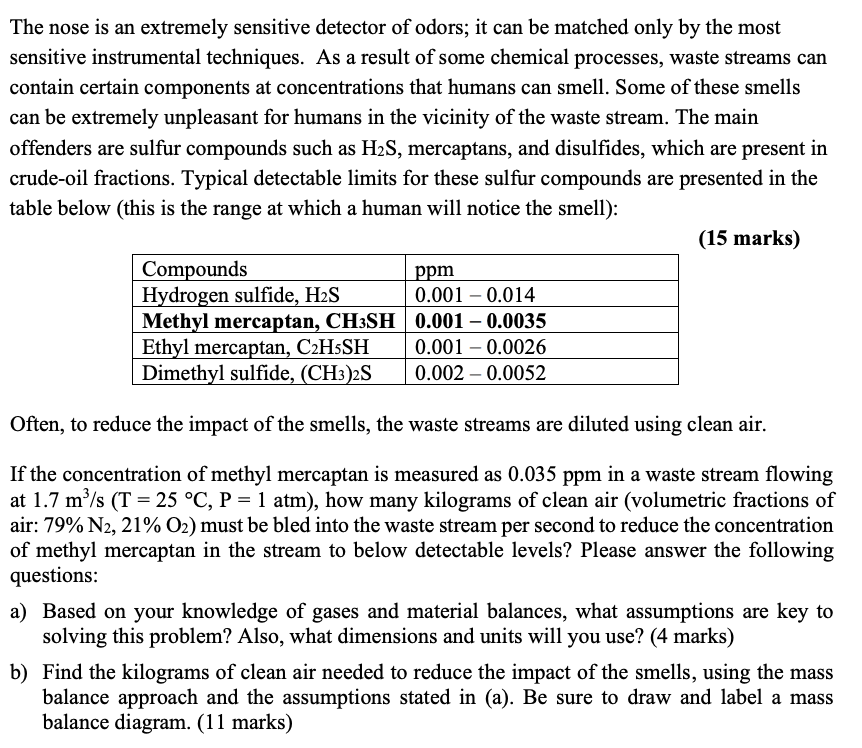
The nose is an extremely sensitive detector of odors; it can be matched only by the most sensitive instrumental techniques. As a result of some chemical processes, waste streams can contain certain components at concentrations that humans can smell. Some of these smells can be extremely unpleasant for humans in the vicinity of the waste stream. The main offenders are sulfur compounds such as H2S, mercaptans, and disulfides, which are present in crude oil fractions. Typical detectable limits for these sulfur compounds are presented in the table below (this is the range at which a human will notice the smell): (15 marks) Compounds ppm Hydrogen sulfide, H2S 0.001 0.014 Methyl mercaptan, CH3SH0.001 - 0.0035 Ethyl mercaptan, C2HsSH 0.001 -0.0026 Dimethyl sulfide, (CH3)2S 0.002 -0.0052 Often, to reduce the impact of the smells, the waste streams are diluted using clean air. If the concentration of methyl mercaptan is measured as 0.035 ppm in a waste stream flowing at 1.7 m/s (T = 25 C, P = 1 atm), how many kilograms of clean air (volumetric fractions of air: 79% N2, 21% O2) must be bled into the waste stream per second to reduce the concentration of methyl mercaptan in the stream to below detectable levels? Please answer the following questions: a) Based on your knowledge of gases and material balances, what assumptions are key to solving this problem? Also, what dimensions and units will you use? (4 marks) b) Find the kilograms of clean air needed to reduce the impact of the smells, using the mass balance approach and the assumptions stated in (a). Be sure to draw and label a mass balance diagram. (11 marks)
Step by Step Solution
There are 3 Steps involved in it

Get step-by-step solutions from verified subject matter experts
 Study Help