







Question: This week, we will practice applying concepts from Chapters 1 3 - 1 4 . Submit a Word document with your responses and be sure
This week, we will practice applying concepts from Chapters Submit a Word document with your responses and be sure to also attach any relevant Excel files with your submission.
Chapter Exercises
Why is it generally necessary to add nonnegativity constraints to an optimization model? Wouldn't Solver automatically choose nonnegative values for the decision variable cells?
A furniture company manufactures desks and chairs. Each desk uses four units of wood, and each chair uses three units of wood. A desk contributes $ to profit, and a chair contributes $ Marketing restrictions require that the number of chairs produced be at least twice the number of desks produced. There are units of wood available.
Use Solver to maximize the company's profit.
Confirm graphically that the solution in part a maximizes the company's profit.
Use SolverTable to see what happens to the decision variables and the total profit when the availability of wood varies from to in unit increments. Based on your findings, how much would the company be willing to pay for each extra unit of wood over its current units? How much profit would the company lose if it lost any of its current units?
Chapter Exercises
The employee scheduling model in this chapter was purposely made small only seven decision variable cells What would make a similar problem for a company like McDonald's much harder? What types of constraints would be required? How many decision variable cells approximately might there be
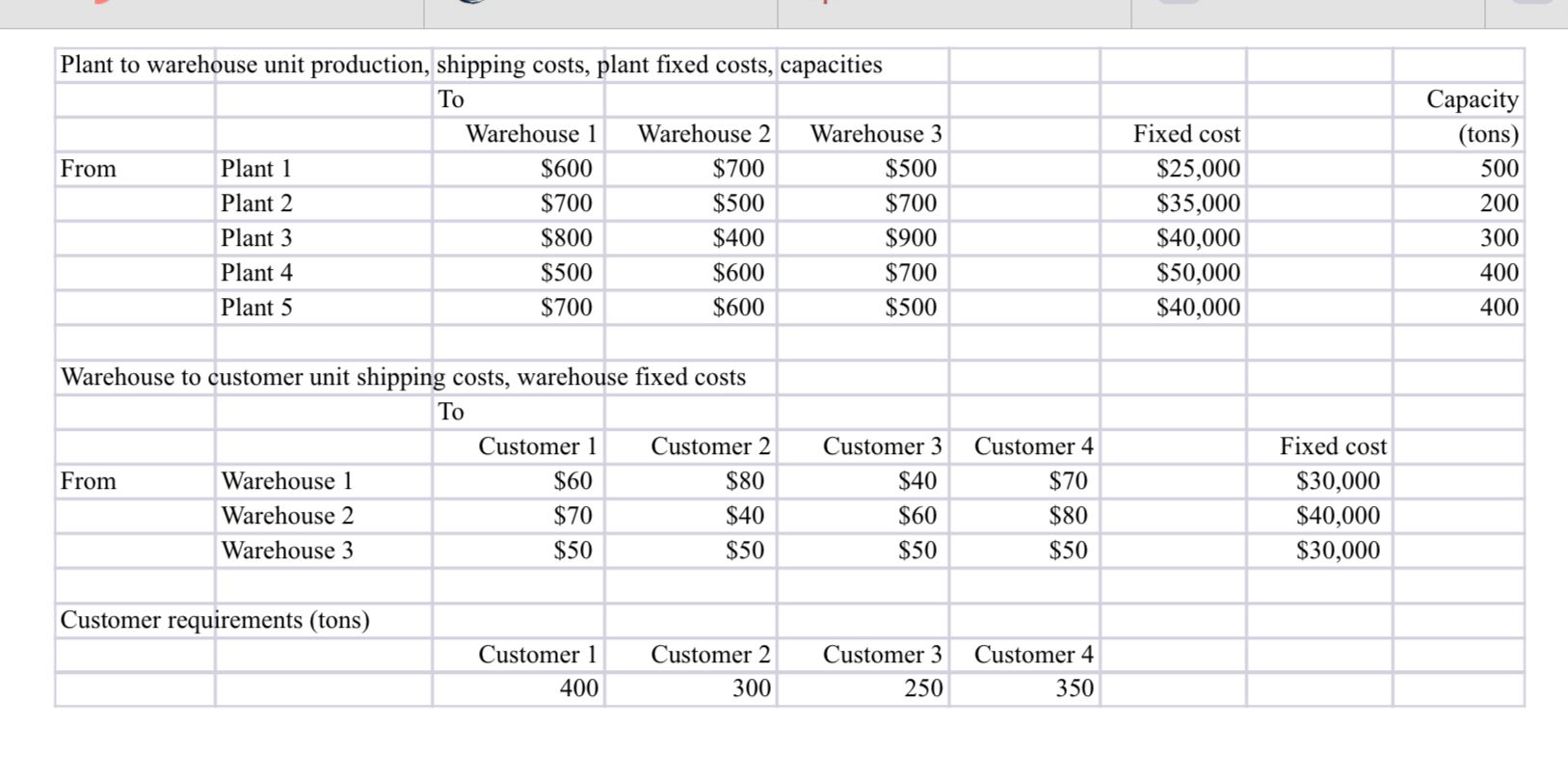
A food company produces tomato sauce at five different plants. The tomato sauce is then shipped to one of three warehouses, where it is stored until it is shipped to one of the company's four customers. All of the inputs for the problem are given in the file Pxlsx as follows:
The plant capacities in tons
The cost per ton of producing tomato sauce at each plant and shipping it to each warehouse
The cost of shipping a ton of sauce from each warehouse to each customer
The customer requirements in tons of sauce
The fixed annual cost of operating each plant and warehouse.
The company must decide which plants and warehouses to open, and which routes from plants to warehouses and from warehouses to customers to use. All customer demand must be met. A given customer's demand can be met from more than one warehouse, and a given plant can ship to more than one warehouse.
Determine the minimumcost method for meeting customer demands.
Use SolverTable to see how a change in the capacity of plant affects the total cost.
Use SolverTable to see how a change in the customer demand affects the total cost.tablePlant to warehouse unit production, shipping costs, plant fixed costs, capacitiesToCapacityWarehouse Warehouse Warehouse Fixed cost,,tonsFromPlant $$$$Plant $$$$Plant $$$$Plant $$$$Plant $$$$Warehouse to customer unit shipping costs, warehouse fixed costsToCustomer Customer Customer Customer Fixed cost,FromWarehouse $$$$$Warehouse $$$$$Warehouse $$$$$Customer requirements tonsCustomer Customer Customer Customer
Step by Step Solution
There are 3 Steps involved in it
1 Expert Approved Answer
Step: 1 Unlock

Question Has Been Solved by an Expert!
Get step-by-step solutions from verified subject matter experts
Step: 2 Unlock
Step: 3 Unlock
 Study Help