


Thermodynamics and Thermochemistry 105 [Useful information : 1 J= 1kg m's-2, 1 Pa = 1 kg...
Fantastic news! We've Found the answer you've been seeking!
Question:
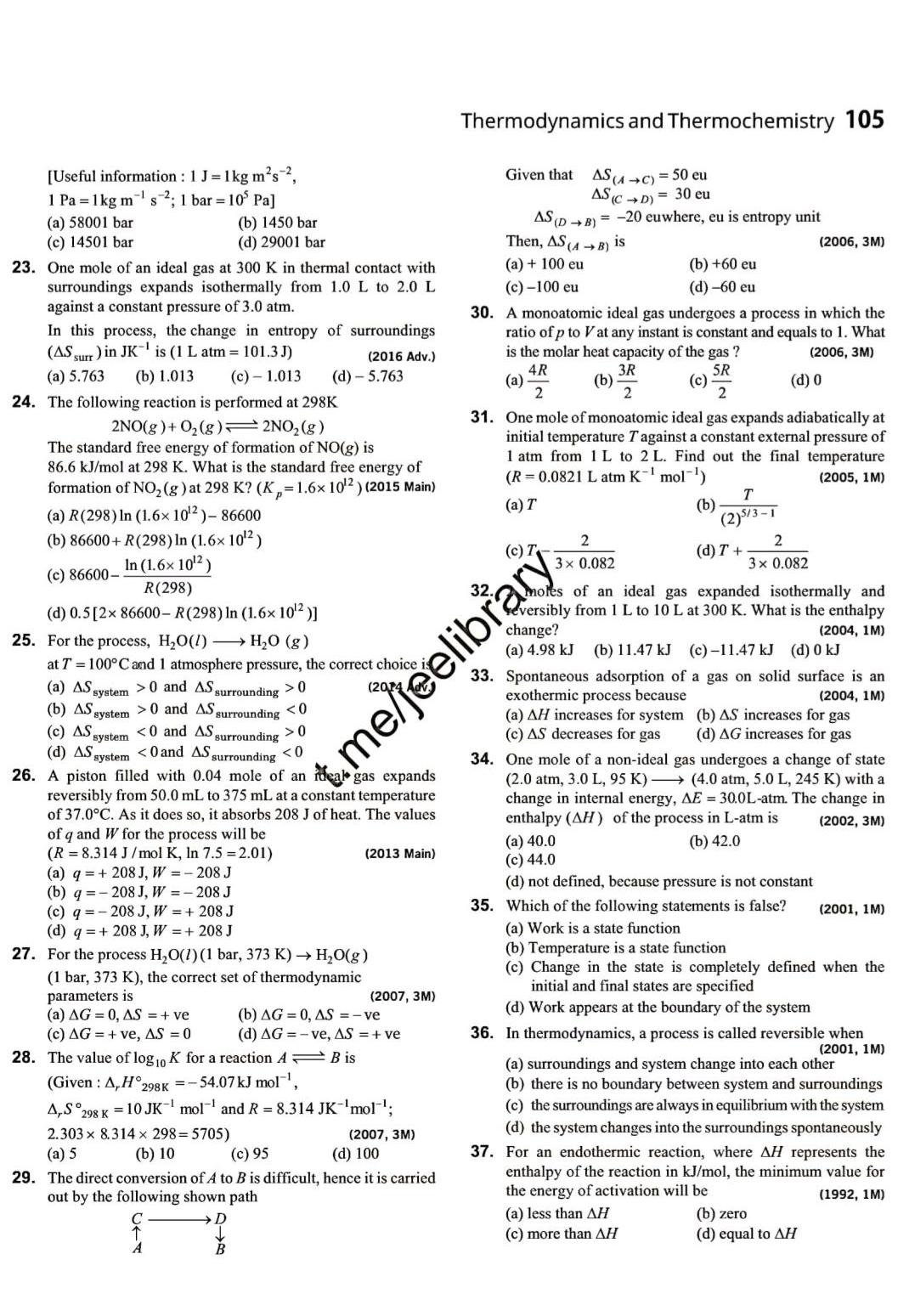
Transcribed Image Text:
Thermodynamics and Thermochemistry 105 [Useful information : 1 J= 1kg m's-2, 1 Pa = 1 kg m s; 1 bar 10° Pa] Given that AS (A +C) = 50 eu AS C + D) = 30 eu AS (D - B) = -20 euwhere, eu is entropy unit (a) 58001 bar (c) 14501 bar (b) 1450 bar (d) 29001 bar Then, AS (A → B) is (2006, 3M) (a) + 100 eu (b) +60 eu 23. One mole of an ideal gas at 300 K in thermal contact with surroundings expands isothermally from 1.0 L to 2.0 L against a constant pressure of 3.0 atm. (с) -100 eu (d) -60 eu In this process, the change in entropy of surroundings (AS surr) in JK' is (1 L atm = 101.3 J) 30. A monoatomic ideal gas undergoes a process in which the ratio of p to Vat any instant is constant and equals to 1. What is the molar heat capacity of the gas ? (2016 Adv.) (2006, 3M) 4R (a) 3R (b) 2 5R (c) (a) 5.763 (b) 1.013 (с) - 1.013 (d) – 5.763 (d) 0 24. The following reaction is performed at 298K 2NO(g)+ 02(g ) 2NO,(g) The standard free energy of formation of NO(g) is 86.6 kJ/mol at 298 K. What is the standard free energy of formation of NO, (g) at 298 K? (K,=1.6x 10²) (2015 Main) 31. One mole of monoatomic ideal gas expands adiabatically at initial temperature Tagainst a constant external pressure of 1 atm from 1L to 2 L. Find out the final temperature (R = 0.0821 L atm K- mol-) (2005, 1M) T (b) (2)5/3 -1 (a) T (a) R(298) In (1.6x 10²)- 86600 (b) 86600+ R(298) In (1.6x 10²) In (1.6x 10¹²) (d) T + 3x 0.082 3 x 0.082 (c) 86600- R(298) moles of an ideal gas expanded isothermally and eversibly from 1L to 10 L at 300 K. What is the enthalpy change? (a) 4.98 kJ (d) 0.5[2x 86600- R(298) In (1.6x 10² )] (2004, 1M) 25. For the process, H20(1) → H20 (g) at T = 100°C and 1 atmosphere pressure, the correct choice (b) 11.47 kJ (c) -11.47 kJ (d)0 kJ 33. Spontaneous adsorption of a gas on solid surface is an exothermic process because (a) AH increases for system (b) AS increases for gas (c) AS decreases for gas (а) AS >0 and AS surrounding O system (2004, 1M) (b) AS gystem >0 and AS gurrounding <0 (c) AS system <0 and AS, >0 (d) AG increases for gas surrounding (d) AS system < 0 and AS surrounding <0 34. One mole of a non-ideal gas undergoes a change of state (2.0 atm, 3.0 L, 95 K) (4.0 atm, 5.0 L, 245 K) with a change in internal energy, AE = 30.0L-atm. The change in enthalpy (AH) of the process in L-atm is (а) 40.0 (c) 44.0 (d) not defined, because pressure is not constant 35. Which of the following statements is false? Mea gas expands tmeljeelibrarý 26. A piston filled with 0.04 mole of an reversibly from 50.0 mL to 375 mL at a constant temperature of 37.0°C. As it does so, it absorbs 208 J of heat. The values of q and W for the process will be (R = 8.314 J/mol K, In 7.5 2.01) (a) q = + 208 J, W =- 208 J (b) q =- 208 J, W = - 208J (c) q = - 208 J, W = + 208 J (d) q = + 208 J, W =+ 208 J (2002, 3M) (b) 42.0 (2013 Main) (2001, 1M) (a) Work is a state function (b) Temperature is a state function (c) Change in the state is completely defined when the initial and final states are specified (d) Work appears at the boundary of the system 27. For the process H,0(1)(1 bar, 373 K) → H,0(g) (1 bar, 373 K), the correct set of thermodynamic parameters is (a) AG = 0, AS = + ve (c) AG = + ve, AS = 0 (2007, 3M) (b) AG = 0, AS =- ve (d) AG = - ve, AS =+ ve 36. In thermodynamics, a process is called reversible when (2001, 1M) 28. The value of log 10 K for a reaction A B is (Given : A,H°298K =- 54.07 kJ mol (a) surroundings and system change into each other (b) there is no boundary between system and surroundings (c) the surroundings are always in equilibrium with the system (d) the system changes into the surroundings spontaneously 37. For an endothermic reaction, where AH represents the A,S°% °298 K = 10 JK- mol and R = 8.314 JK-'mol: 2.303 x 8.314 x 298=5705) (a) 5 (2007, 3M) (b) 10 (c) 95 (d) 100 29. The direct conversion of A to B is difficult, hence it is carried out by the following shown path enthalpy of the reaction in kJ/mol, the minimum value for the energy of activation will be (1992, 1M) (a) less than AH (c) more than AH (b) zero (d) equal to AH Thermodynamics and Thermochemistry 105 [Useful information : 1 J= 1kg m's-2, 1 Pa = 1 kg m s; 1 bar 10° Pa] Given that AS (A +C) = 50 eu AS C + D) = 30 eu AS (D - B) = -20 euwhere, eu is entropy unit (a) 58001 bar (c) 14501 bar (b) 1450 bar (d) 29001 bar Then, AS (A → B) is (2006, 3M) (a) + 100 eu (b) +60 eu 23. One mole of an ideal gas at 300 K in thermal contact with surroundings expands isothermally from 1.0 L to 2.0 L against a constant pressure of 3.0 atm. (с) -100 eu (d) -60 eu In this process, the change in entropy of surroundings (AS surr) in JK' is (1 L atm = 101.3 J) 30. A monoatomic ideal gas undergoes a process in which the ratio of p to Vat any instant is constant and equals to 1. What is the molar heat capacity of the gas ? (2016 Adv.) (2006, 3M) 4R (a) 3R (b) 2 5R (c) (a) 5.763 (b) 1.013 (с) - 1.013 (d) – 5.763 (d) 0 24. The following reaction is performed at 298K 2NO(g)+ 02(g ) 2NO,(g) The standard free energy of formation of NO(g) is 86.6 kJ/mol at 298 K. What is the standard free energy of formation of NO, (g) at 298 K? (K,=1.6x 10²) (2015 Main) 31. One mole of monoatomic ideal gas expands adiabatically at initial temperature Tagainst a constant external pressure of 1 atm from 1L to 2 L. Find out the final temperature (R = 0.0821 L atm K- mol-) (2005, 1M) T (b) (2)5/3 -1 (a) T (a) R(298) In (1.6x 10²)- 86600 (b) 86600+ R(298) In (1.6x 10²) In (1.6x 10¹²) (d) T + 3x 0.082 3 x 0.082 (c) 86600- R(298) moles of an ideal gas expanded isothermally and eversibly from 1L to 10 L at 300 K. What is the enthalpy change? (a) 4.98 kJ (d) 0.5[2x 86600- R(298) In (1.6x 10² )] (2004, 1M) 25. For the process, H20(1) → H20 (g) at T = 100°C and 1 atmosphere pressure, the correct choice (b) 11.47 kJ (c) -11.47 kJ (d)0 kJ 33. Spontaneous adsorption of a gas on solid surface is an exothermic process because (a) AH increases for system (b) AS increases for gas (c) AS decreases for gas (а) AS >0 and AS surrounding O system (2004, 1M) (b) AS gystem >0 and AS gurrounding <0 (c) AS system <0 and AS, >0 (d) AG increases for gas surrounding (d) AS system < 0 and AS surrounding <0 34. One mole of a non-ideal gas undergoes a change of state (2.0 atm, 3.0 L, 95 K) (4.0 atm, 5.0 L, 245 K) with a change in internal energy, AE = 30.0L-atm. The change in enthalpy (AH) of the process in L-atm is (а) 40.0 (c) 44.0 (d) not defined, because pressure is not constant 35. Which of the following statements is false? Mea gas expands tmeljeelibrarý 26. A piston filled with 0.04 mole of an reversibly from 50.0 mL to 375 mL at a constant temperature of 37.0°C. As it does so, it absorbs 208 J of heat. The values of q and W for the process will be (R = 8.314 J/mol K, In 7.5 2.01) (a) q = + 208 J, W =- 208 J (b) q =- 208 J, W = - 208J (c) q = - 208 J, W = + 208 J (d) q = + 208 J, W =+ 208 J (2002, 3M) (b) 42.0 (2013 Main) (2001, 1M) (a) Work is a state function (b) Temperature is a state function (c) Change in the state is completely defined when the initial and final states are specified (d) Work appears at the boundary of the system 27. For the process H,0(1)(1 bar, 373 K) → H,0(g) (1 bar, 373 K), the correct set of thermodynamic parameters is (a) AG = 0, AS = + ve (c) AG = + ve, AS = 0 (2007, 3M) (b) AG = 0, AS =- ve (d) AG = - ve, AS =+ ve 36. In thermodynamics, a process is called reversible when (2001, 1M) 28. The value of log 10 K for a reaction A B is (Given : A,H°298K =- 54.07 kJ mol (a) surroundings and system change into each other (b) there is no boundary between system and surroundings (c) the surroundings are always in equilibrium with the system (d) the system changes into the surroundings spontaneously 37. For an endothermic reaction, where AH represents the A,S°% °298 K = 10 JK- mol and R = 8.314 JK-'mol: 2.303 x 8.314 x 298=5705) (a) 5 (2007, 3M) (b) 10 (c) 95 (d) 100 29. The direct conversion of A to B is difficult, hence it is carried out by the following shown path enthalpy of the reaction in kJ/mol, the minimum value for the energy of activation will be (1992, 1M) (a) less than AH (c) more than AH (b) zero (d) equal to AH
Expert Answer:
Related Book For 

Posted Date:
Students also viewed these chemistry questions
-
One mole of an ideal gas is heated slowly so that it goes from the PV state (Pi , Vi) to (3Pi, 3Vi) in such a way that the pressure is directly proportional to the volume. (a) How much work is done...
-
One mole of an ideal gas whose adiabatic exponent equals undergoes a process in which the gas pressure relates to the temperature as p = aTa, where a and a are constants. Find: (a) The work performed...
-
One mole of an ideal gas is contained in a cylinder with a movable piston. The initial pressure, volume, and temperature are Pi, Vi, and Ti, respectively. Find the work done on the gas for the...
-
Find keys K such that DESK (DESK (x)) = x, for all x Such a key is sometimes called a weak key. How many weak keys can you find? To solve this problem you need to look up the exact key schedule...
-
Two emission lines have wavelengths λ and λ + Πλ, respectively, where Πλ Where d is the slit separation and m is the order at which...
-
One of the main issues to consider during systems development is to determine the feasibility of the proposed project. Discuss the purpose of a feasibility study, and discuss examples of different...
-
Is there a field line pattern that could everywhere represent either the magnetic field due to a magnet or the electric field due to a system of fixed charged particles?
-
The demand for haddock has been estimated as log Q = a + b log P + c log I + d log Pm Where Q = quantity of haddock sold in New England P = price per pound of haddock I = a measure of personal income...
-
a) Explain the following principles of valuation i. Principle of conformity ii. Principle of substitution iii. Principle of highest and best use iv. Principle of supply and demand v. Principle of...
-
What are the major causes of information risk? How can information risk be reduced?
-
On January 1, 2001, United Corporation issued $10 million (10,000 units of $1,000 bond) of 8% convertible bonds at 105. The bonds mature in 20 years. Each $1,000 convertible bond can be converted to...
-
Who are other wise unfamiliar with the product, does the website illustrate any factors that may affect comprehension in a way that interferes with this goal? What is the intended figure, and what is...
-
A Planner wants to determine the required safety stock to achieve a 99.5% service level. Data for the last 12 periods is shown below Period 1 2 3 4 5 6 7 8 9 10 11 12 Demand 1250 1600 1345 1090 2100...
-
Find three people who have had bosses or CEOs who were either charismatic or transformational. a. Ask them to describe what the leader was like, what were the values, the behaviors? b. Ask them to...
-
If Wilson decides to accept Monk's offer, it will need to find an additional 30,000 windows to meet both the special order and normal sales. Larkspur Panes has offered to provide them to Wilson at a...
-
When the transient heat diffusion equation for the plane wall is solved, the temperature depends on 8 physical parameters. When this equation is non-dimensionalized, the dependence of non-dimensional...
-
Use the division theorem to show that every prime except 2 and 3 is of the form 6n+1 or 6n+5.
-
Write the given system without the use of matrices. D) - ()- d (x sin t + 8 (2+ 1)
-
Mong Corporation makes auto batteries. The company claims that 80% of its LL70 batteries are good for 70 months or longer. A consumer agency wanted to check if this claim is true. The agency took a...
-
The mean consumption of water per household in a city was 1245 cubic feet per month. Due to a water shortage because of a drought, the city council campaigned for water use conservation by...
-
Reconsider the data on the numbers of orders received for a sample of 30 hours at the Timesaver Mail Order Company given in Exercise 2.71. Create a dotplot for those data.
-
Consider the feedback system shown in Figure 10.26. a. Using Routh's stability criterion, determine the range of the control gain \(K\) for which the closed-loop system is stable. b. Use MATLAB...
-
Figure 10.40 shows a negative feedback control system. a. Design a P controller such that the damping ratio of the closed-loop system is 0.5 . b. Estimate the rise time, overshoot, and \(2 \%\)...
-
The transfer function of a dynamic system is given by \[G(s)=\frac{s+1}{4 s^{4}+5 s^{3}+2 s^{2}+s+6} \] a. Using Routh's stability criterion, determine the stability of the system. b. Using MATLAB,...

Study smarter with the SolutionInn App