







Question: 2. Define mass number, A. 3. Define atomic number, Z. 4. What are the relative masses of a proton, a neutron and an electron? 5.
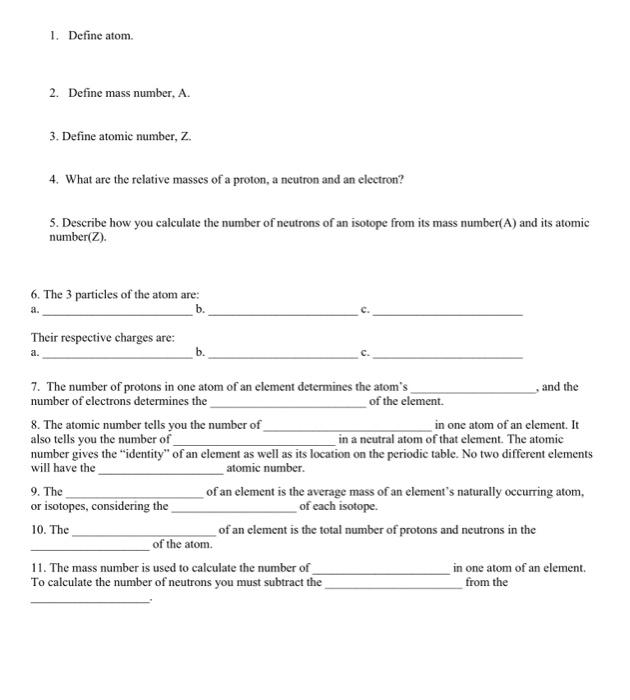
2. Define mass number, A. 3. Define atomic number, Z. 4. What are the relative masses of a proton, a neutron and an electron? 5. Describe how you calculate the number of neutrons of an isotope from its mass number(A) and its atomic number(Z). 6. The 3 particles of the atom are: a. b. c. Their respective charges are: a. b. c. 7. The number of protons in one atom of an element determines the atom's number of electrons determines the of the element. 8. The atomic number tells you the number of in one atom of an element. It also tells you the number of in a neutral atom of that element. The atomic number gives the "identity" of an element as well as its location on the periodic table. No two different elements will have the atomic number. 9. The or isotopes, considering the of an element is the average mass of an element's naturally occurring atom, 10. The, of each isotope. of the atom. 11. The mass number is used to calculate the number of in one atom of an element. To calculate the number of neutrons you must subtract the from the
Step by Step Solution
There are 3 Steps involved in it

Get step-by-step solutions from verified subject matter experts
 Study Help