







Question: CASE 4: GOING TO THE X-STREAM By Roy Smollan, Auckland University of Technology, New Zealand Gil Reihana was the chief executive officer of X-Stream, a
CASE 4: GOING TO THE X-STREAM
By Roy Smollan, Auckland University of Technology, New Zealand
Gil Reihana was the chief executive officer of X-Stream, a company he launched in Auckland, New Zealand, six years ago at the age of 25, after graduating with a bachelors degree in information technology and management. He had inherited $300,000 and had persuaded various family members to invest additional money. X-Stream assembled personal computers for the New Zealand and Australian markets and sold them through a number of chain stores and independent retailers. The company had soon established a reputation for quality hardware, customized products, excellent delivery times and after-sales service.Six months ago it had started a software division, specializing in webpage design and consulting on various applications for the development of electronic business.
Gil was driven by a desire to succeed. He had started working part-time at an electronics retailer at age 16 and in his spare time took apart old computers in his garage to see how they were made. He was extroverted, energetic, and enthusiastic, often arriving at work by 5 a.m. and seldom leaving before 7 p.m. He felt that work should be challenging but fun too. He had initially picked a young senior management team that he thought shared his outlook. A casual, almost irreverent atmosphere developed. However, a poorly organized accounting department led to the replacement of the first accountant after two years. Gil believed that major decisions should be made by consensus and that individuals should then be empowered to implement these decisions in their own way. In the beginning he had met with each staff member in January to discuss with them how happy they were in their jobs, what their ambitions were, and what plans they would like to make for the coming year in terms of their own professional development. These one-on-one meetings became more difficult as the company grew, so senior management team members were eventually delegated the task of conducting reviews with their own staff.
However, Gil was unsure whether every manager was actually performing the reviews or how well they were working. Now he tried to keep in touch with staff by having lunch with them in the cafeteria occasionally. Denise Commins (affectionately known to all staff as Dot Com) was the chief financial officer. She and Gil could not be more different. Denise was quiet, methodical, and very patient. Her superb interpersonal skills complemented a highly analytical mind. At 55, she was considerably older than most of the employees and often showed a strong maternal side. Many of her team (and several from other departments as well) frequently consulted her on work issues and personal problems too. She enjoyed the informal relationships she had built up but found that the technical aspects of her role were becoming less rewarding.
Don Head, the marketing manager, was considered to be a rather ruthless operator, often undercutting the competition in terms of price, and, on more than one occasion, by circulating false rumors of defects in their products. He deemed himself a ladies man and was known to flirt with a number of the staff. A case of sexual harassment had been dropped after a 22-year-old secretary had been paid a sizeable sum of money. Gil and the members of the senior management team had been furious but Don had denied any wrongdoing, claiming that she had led him on. Don had been at university with Gil and they spent many hours after work at a pub around the corner from the factory. With sales rising year after year, his marketing expertise and cunning were regarded as essential to the companys continuing growth. He had a department of eight whom he had carefully screened as ambitious self-starters. They were required to set and achieve their own targets, as long as they were big hairy ambitious goals, a phrase he had heard at a seminar.
Jason Palu, the production manager, was a soft spoken man who had started as a supervisor and who had quickly worked his way to the top position. He set extremely high standards for the production staff and was considered to be a perfectionist. He was highly regarded by his colleagues for his efficiency and reliability. There were very few occasions when an order could not be fulfilled on time and his goal was zero defects. He tended to be autocratic and some people complained that he never listened to them, allocated work hours that did not suit people, and often required staff to work (paid) overtime on very short notice. When one production worker complained, he tersely remarked that we have a job to do and we just have to get on with it. The company depends on us.
Heather Berkowitz was the chief webpage designer. She had blue hair, a ring through her nose, and she dressed in exotic clothes that had been sourced from a number of secondhand stores. She seldom arrived at work much before 11 a.m. and often left before 4 p.m. She said she did her best work at home, often at night, so why should she punch the clock like the drones on the assembly line? Gil and others had often received e-mails from her that had been sent at all hours of the night. She had established a reputation as a top webpage designer, and although her physical appearance did not go down too well with some of the companys clients (or staff) the quality and quantity of her work was extremely high.
On Tuesdays at 9 a.m. the senior staff met to discuss weekly plans and any significant issues that had arisen. All employees were invited to the meeting, and some accepted this opportunity to attend. Gil trusted all staff to keep confidential matters within the company. He believed that if the organization shared information with employees they would be more likely to support management decisions. The meetings lacked formality and usually started with some jokes, usually at the expense of some members of staff. By and large the jokes were meant to be inoffensive, but were not always taken that way. Nicknames were often assigned to staff, mostly by Don Head, some quite derogatory. You were thought to be a wet blanket if you objected. Don seemed oblivious to the unflattering nickname he had been given, preferring to call himself Braveheart, sometimes even signing memos in this fashion.
Although employment agreements referred to a 40-hour week there was an expectation that staff would put in substantially more than that. Only the assembly line workers had to clock in and out, but this, Jason had explained, was due to the overtime that assembly staff were required to work to meet deadlines. The overtime pay was welcomed by some production staff and resented by some employees in other departments who believed they should be entitled to the same benefits. Recently a conflict had arisen between Jason and Don. The company had been developing for some time a top-of-the-range laptop which was scheduled for launching in two weeks time. Jason had been urging senior management to delay the introduction of the new X-MH until some glitches had been sorted out. A batch of chips acquired from abroad had contained some defective features. Jason wanted to postpone the new model until these problems had been completely sorted out, a process which he believed would take another month. Don found this to be unacceptable.
A former New Zealand rugby team (All Blacks) captain had been contracted to attend the launch and market the new model on a roadshow that would travel to New Zealand and Australias main cities. He would not be available at the time Jason was prepared to release the X-MH. At a heated staff meeting, some of the senior staff backed Don, while others agreed with Jason. Don had urged all of his department to attend the meeting, to present a united front and convey an image of power.
Heather Berkowitz had arrived halfway through the meeting and with a mouthful of muffin proclaimed that there was no rush to get out the new toy. The company had plenty of other issues to which it could devote its energy. She said she had met the head of information technology of a chain of fast-food restaurants that wanted to revitalize its website. She maintained she needed three extra staff to get this up and running. She left the meeting five minutes later. Don was fuming at the interruption and demanded that Gil should stick to the original launch date of the X-MH. Gil calmly replied that he understood Dons frustration but that more consultation was necessary. He said that it would be discussed by the parties concerned during the week and a final decision would be made at the following Tuesdays staff meeting. Don spent the rest of the day lobbying other members of the senior staff. He offered Dorothy the use of his beach cottage if she backed him and promised to support her on the acquisition of expensive new accounting software. She just laughed and said that she was convinced the senior management team would approve the new software. She also informed Don that a member of her staff had seen one of his sales representatives entering a strip joint the previous week at a time when the sales force had been engaged in a staff meeting.
Other problems had arisen in recent months. Ramesh Patel, the newly recruited head of e-business applications had, with help from a personal contact, developed a software program that would help hotels and restaurants source products and services over the Internet. It was beginning to generate useful revenue. His contact had now billed X-Stream for $25,000 in consultancy fees and development costs. Ramesh claimed that his contact had owed him a favor and that no mention of money had ever been made. X-Stream had referred the matter to its legal counsel. Les Kong, the research and development manager (hardware), had complained to Gil that he could no longer work under Jason Palu. While he considered him a very pleasant man, and a very capable production manager, he could no longer tolerate his strict control style. You cant do creative work on command! was his lament. He loved his job and had spent hours over several weekends developing and refining a new product. There was considerable resentment from Jason and Don about the resources that had been invested in the software division, partly because they did not see the need for the company to diversify and partly because they claimed that money was being diverted from their departments to fund the new ventures.
Ramesh claimed that a good e-business starts at homewe should open up all our procurement via the Internet. His suggestion did not go down well with Jason and Don. Gil had been pondering the structure of X-Stream for some time. The old functional structure no longer seemed appropriate. Silo mentality and departmental interests seemed to predominate and turf wars took place. The company had grown to 64 staff in New Zealand and 8 in Australia. The ongoing development of new hardware and the introduction of the software side of the business had made management tasks somewhat complicated. He missed the old days when he knew every member of staff. The informal decision-making that was characteristic of the business might have to give way to more formal processes. Yet he did not want to lose the creativity that underpinned its success. Despite the open invitation to attend the management meetings, many staff complained that they never knew what was going on. He expected all senior managers to keep their departmental staff informed of developments. Some had done this admirably, while others had virtually ignored his wishes.
A human resources manager, Alkina Bennelong, had been appointed a month previously and reported to Denise Commins. She had been reviewing the companys loosely worded job descriptions and person specifications and the recruitment and selection systems and had suggested more professional but more elaborate approaches. She had also suggested the introduction of a performance management system, including feedback from peers, direct reports and outsiders, such as suppliers and customers. Over my dead body! was the retort of Don Head. How can you allow subordinates to tell you how to do your job? queried Jason Palu. Cant see what the fuss is all about, said Heather Berkowitz. Everybody keeps telling me what to do anyway, even though they dont understand the first thing about my job! But it doesnt worry me.
- What is your diagnosis of the situation in the company and the accounting department? Use 4 theories from chapters 1-4 in the textbook to diagnose the situation.
- What interventions would you recommend and why?
- For your preferred intervention, develop an action plan.
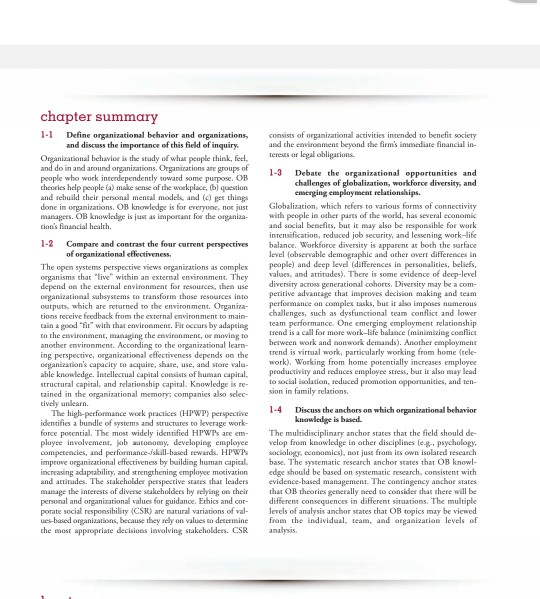
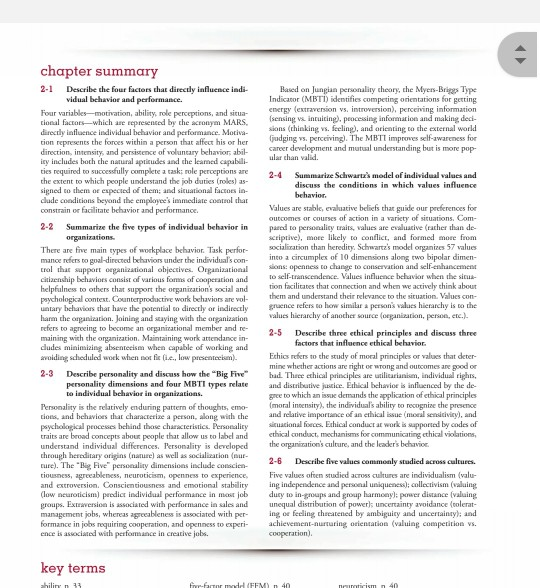
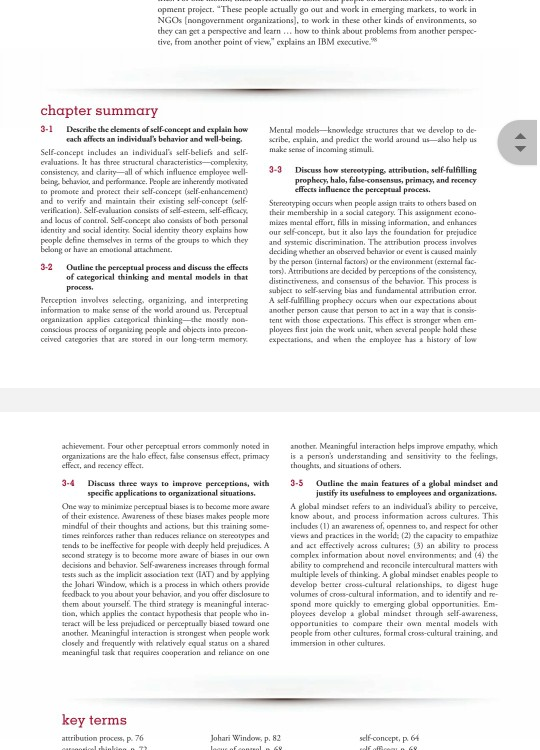
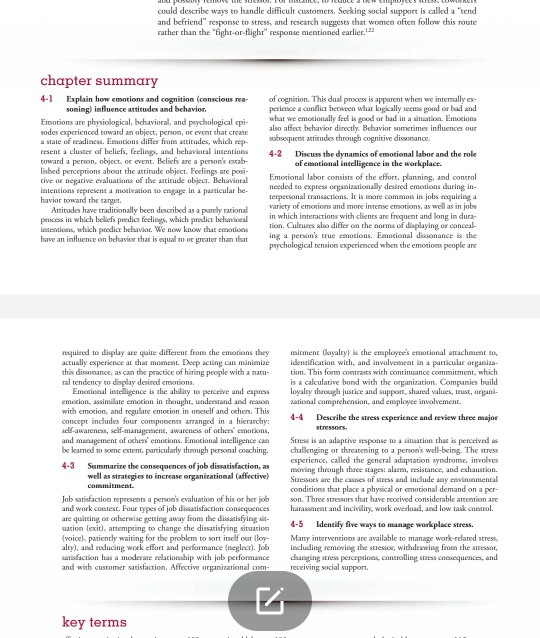
chapter summary 1.1 Define organizational behavior and organizations, and discuss the importance of this field of inquiry Organizational behavior is the study of what people think, feel. and do in and around organizations. Organizations are groups of people who work interdependently toward some purpose. OB theories help people (a) make sense of the workplace, (b) question and rebuild their personal mental models, and (c) ger things done in organizations. OB knowledge is for everyone, not just managers. OB knowledge is just as important for the organiza- Lion's financial health. 1-2 Compare and contrast the four current perspectives of organizational effectiveness. The open systems perspective views organizations as complex organisms that live within an external environment. They depend on the external environment for resources, then use organizational subsystems to transform those resources into outputs, which are returned to the environment. Organiza- tions receive feedback from the external environment to main- cain a good fit with that environment. Fit occurs by adapting to the environment, managing the environment, or moving to another environment. According to the organizational learn- ing perspective, organizational effectiveness depends on the organization's capacity to acquire, share, use, and store valu able knowledge. Intellectual capital consists of human capital, structural capital, and relationship capital. Knowledge is re- tained in the organizational memory, companies also selec- cively unlearn. The high-performance work practices (HPWP) perspective identifies a bundle of systems and structures to leverage work- force potential. The most widely identified HPI's are em- ployee involvement job autonomy, developing employee competencies, and performance skill-based rewards. HPWP improve organizational effectiveness by building human capital, increasing adaptability, and strengthening employee motivation and attitude. The stakeholder perspective states that leaders manage the interests of diverse stakeholders by relying on their personal and organizational values for guidance. Ethics and cor porate social responsibility (CSR) are natural variations of val. ues-based organizations, because they rely on values to determine the most appropriate decisions involving stakeholders. CSR consists of organizational activities intended to benefit society and the environment beyond the firm's immediate financial in terests or legal obligations 1-3 Debate the organizational opportunities and challenges of globalization, workforce diversity, and emerging employment relationships. Globalization, which refers to various forms of connectivity with people in other parts of the world, has several economic and social benefits, but it may also be responsible for work intensification, reduced job security, and lessening work-life balance. Workforce diversity is apparent at both the surface level (observable demographic and other over differences in people) and deep level (differences in personalities, beliefs, values, and attitudes). There is some evidence of deep-level diversity across generational cohorts. Diversity may be a com- petitive advantage that improves decision making and team performance on complex tasks, but it also impases numerous challenges, such as dysfunctional team conflict and lower team performance. One emerging employment relationship trend is a call for more work-life balance (minimizing conflict between work and nonwork demands). Another employment trend is virtual work, particularly working from home (tele- work). Working from home potentially increases employee productivity and reduces employee stress, but it also may lead to social isolation, reduced promotion opportunities, and ten sion in family relations 1-4 Discuss the anchors on which organizational behavior knowledge is based The multidisciplinary anchor states that the field should de velop from knowledge in other disciplines le psychology sociology, economics), not just from its own isolated research base. The systematic research anchor states that OB knowl- edge should be based on systematic research, consistent with evidence-based management. The contingency anchor states that OB theories generally need to consider that there will be different consequences in different situations. The multiple levels of analysis anchor states that OB topics may be viewed from the individual. team, and organization levels of analysis chapter summary 2-1 Describe the four factors that directly influence indi- vidual behavior and performance. Four variables-motivation, ability, role perceptions, and situa- tional factors which are represented by the acronym MARS. directly influence individual behavior and performance. Motiva tion represents the forces within a person that affect his or her direction, intensity, and persistence of voluntary behavior, abil- ity includes both the natural aparudes and the learned capabili ties required to successfully complete a tasks role perceptions are the extent to which people understand the job duties (roles) as- signed to them or expected of them; and situational factors in clude conditions beyond the employee's immediate control thar constrain or facilitate behavior and performance. 2-2 Summarize the five types of individual behavior in organizations There are five main types of workplace behavior. Task perfor mance refers to goal-directed behaviors under the individual's con- trol that support organizational objectives. Organizational citizenship behaviors consist of various forms of cooperation and helpfulness to others that support the organization's social and psychological context. Counterproductive work behaviors are vol. untary behaviors that have the potential to directly or indirectly harm the organization. Joining and staying with the organization refers to agreeing to become an organizational member and re- maining with the organization. Maintaining work attendance in dudes minimizing absenteeism when capable of working and avoiding scheduled work when not fir lie., low presenteeism). 2-3 Describe personality and discuss how the Big Five personality dimensions and four MBTI types relate to individual behavior in organizations. Personality is the relatively enduring pattern of thoughts, emo- tions, and behavioes that characterize a person, along with the psychological processes behind those characteristics. Personality traits are broad concepts about people that allow us to label and understand individual differences. Personality is developed through hereditary origins (nature) as well as socialization (nur ture). The "Big Five" personality dimensions include conscien- ciousness, agreableness, neuroticism, openness to experience and extroversion. Conscientiousness and emotional stability (low neuroticism) predict individual performance in mast job groups. Extraversion is associated with performance in sales and management jobs, whereas agrecableness is associated with per formance in jobs requiring cooperation, and openness to experi ence is associated with performance in creative jobs. Based on Jungian personality theory, the Myers-Briggs Type Indicator (MBTI) identifies competing orientations for getting energy extraversion vs. introversion), perceiving information (sensing vs intuicing), processing information and making deci sions (chinking vs. feeling), and orienting to the external world judging vs. perceiving). The MBTT improves self-awareness for career development and mutual understanding but is more pop- ular than valid. 2-4 Summarize Schwarta's model of individual values and discuss the conditions in which values influence behavior. Values are stable, evaluative beliefs that guide our preferences for outcomes or courses of action in a variety of situations. Com- pared to personality traits, values are evaluative (rather than de scriptive), more likely to conflict, and formed more from socialization than heredity. Schwartz's model organizes 57 values into a circumplex of 10 dimensions along two bipolar dimen- sions: openness to change to conservation and self-enhancement to self-transcendence. Values influence behavior when the simu tion facilitates that connection and when we actively think about them and understand their relevance to the situation, Values con- gruence refers to how similar a person's values hierarchy is to the values hierarchy of another source organization, pension, etc.). 2-5 Describe three ethical principles and discuss three factors that influence ethical behavior Ethics refers to the study of moral principles or values that deter- mine whether actions are right or wrong and outcomes are good or had. These ethical principles are utilitarianism, individual rights, and distributive justice. Ethical behavior is influenced by the de gree to which an issue demands the application of ethical principles (moral intensity), the individual's ability to recognize the presence and relative importance of an ethical issue moral sensitivity), and situational forces. Ethical conduct at work is supported by codes of ethical conduct, mechanisms for communicating ethical violations, the organization's culture, and the leader's behavior 2-6 Describe five valus commonly studied across cultures. Five values often studied across cultures are individualism (valu ing independence and personal uniqueness); collectivism (valuing duty to in-grups and group harmonyl power distance (valaing unequal distribution of power's uncertainty avoidance (colerat- ing or feeling threatened by ambiguity and uncertainty): and achievement-nurturing orientation (valuing competition vs. cooperation) key terms abilir 33 feartor me (FEM) 40 numis opment project. These people actually go out and work in emerging markets, to work in NGOs (nongovernment organizations), to work in these other kinds of environments, so they can get a perspective and learn... how to think about problems from another perspec- tive, from another point of view;" explains an IBM executive chapter summary 3-1 Describe the elements of self-concept and explain how cach affects an individual's behavior and well-being, Self-concept includes an individual's self-beliefs and self- evaluations. It has three structural characteristics-complexity consistency, and darity all of which influence employee well- being, behavior, and performance. People are inherendy motivated to promote and protect their self-concept (self-enhancement) and to verify and maintain their existing self-concept (self- verification). Self-evaluation consists of self-esteem, self-efficacy. and locus of control. Self-concepe also consists of hoch personal identity and social identity Social identity theory explains how people define themselves in terms of the groups to which they belong or have an emotional attachment. Outline the perceptual process and discuss the effects of categorical thinking and mental models in that process. Perception involves selecting, organizing, and interpreting information to make sense of the world around us. Perceptual organization applies categorical thinking the mostly now conscious process of organizing people and objects into precon- ceived categories that are stored in our long-term memory Mental models knowledge structures that we develop to de scribe, explain, and predict the world around us also help us make sense of incoming simuli. 3-3 Discuss how stereotyping, attribution, self-fulfilling prophecy, halo, false-consensus, primacy, and recency effects influence the perceptual process. Stereotyping occurs when people assign traits to others based on their membership in a social category. This assignment econo- mizes mental effort, fills in missing information, and enhances our self-concept, but it also lays the foundation for prejudice and systemic discrimination. The attribution process involves deciding whether an observed behavice or event is caused mainly by the person internal factors) or the environment (external fac- tors). Attributions are decided by perceptions of the consistency distinctiveness, and consensus of the behavior. This process is subject to self-serving bias and fundamental attribution error. A self-fulfilling prophecy occurs when our expectations about another person cause that person to act in a way that is consis- tent with those expectations. This effect is stronger when em- ployees fiest join the work unit, when several people hold these expectations, and when the employee has a history of low achievement. Four other perceptual errors commonly noted in organizations are the balo effect, false consensus effect, primacy effect, and recency effect. 3-4 Discuss three ways to improve perceptions, with specific applications to organizational situations. One way to minimize perceptual biases is to become more aware of their existence. Awareness of these biases makes people more mindful of their thoughts and actions, but this training some times reinforces rather than reduce reliance on stereotypes and tends to be ineffective for people with deeply held prejudices. A second strategy is to become more aware of biases in our own decisions and behavior. Self-awareness increases through formal Tests such as the implicit asociation text (LAT) and by applying the Johari Window, which is a process in which others provide feedback to you about your behavior, and you offer disclosure to them about yourself. The third strategy is meaningful interac- tion, which applies the contact hypothesis that people who in- teract will be less prejudiced or perceptually biased toward one anocher. Meaningful interaction is strongest when people work closely and frequently with relatively equal status on a shared meaningful task that requires cooperation and reliance on one another. Meaningful interaction helps improve empathy, which is a person's understanding and sensitivity to the feelings, thoughes, and situations of ochers. 3-5 Outline the main features of a global mindset and justify its usefulness to employees and organizations. A global mindset refers to an individual's ability to perceive. know about, and process information across cultures. This indudes (1) an awareness of openness to, and respect for other views and practices in the world: (2) the capacity to empathize and act effectively across cultures: (3) an ability to process complex information about novel environments; and (4) the ability to comprehend and reconcile intercultural matters with multiple levels of thinking A global mindset enables people to develop better cross-cultural relationships to digest huge volumes of cross-cultural information, and to identify and re- spond more quickly to emerging global opportunities. Em- ployees develop a global mindset through self-awareness, opportunities to compare their own mental models with people from other cultures, formal cross-cultural training, and xrsion in other cultures. key terms attribution process, p. 76 colbinin Johari Window, p. 82 of contul self-concept. p. 64 JE 6Y could describe ways to handle difficult customers. Seeking social support is called a "tend and befriend" response to stress, and research suggests that women often follow this route rather than the fight-or-flight" response mentioned earlier.122 chapter summary 4.1 Explain how emotions and cognition (conscious rea- soning) influence attitudes and behavior. Emotions are physiological, behavioral, and psychological cpi- sodes experienced toward an object, person, or event that create a state of readiness. Emotions differ from atitudes, which rep- resent a cluster of beliefs, feelings, and behavioral intentions toward a person, object, or event. Beliefs are a person's estab- lished perceptions about the attitude object. Feelings are posi- tive or negative evaluations of the attitude object. Behavioral intentions represent a motivation to engage in a particular be- havior toward the target Attitudes have traditionally been described as a purely rational process in which beliefs predict feelings, which prodice behavioral intentions, which predict behavior. We now know that emotions have an influence on behavior that is equal to or greater than that of cognition. This dual process is apparent when we internally er- perience a conflict between what logically seems good or bad and what we emotionally feel is good or had in a situation. Emocions also affect behavior directly. Behavior sometimes influences our subsequent attitudes through cognitive dissonance. 4-2 Discuss the dynamics of emotional labor and the role of emotional intelligence in the workplace. Emotional labor consists of the effort, planning, and control needed to express organizationally desired emotions during in terpersonal transactions. It is more common in jobs requiring a variety of emotions and more intense emotions, as well as in jobs in which interactions with clients are frequent and long in dura- tion. Calcunes ako differ on the norms of displaying or conceal ing a person's true emocions. Emocional dissonance is the psychological tension experienced when the emotions people are required to display are quite different from the emotions they actually experience at that moment. Deep acting can minimize this dissonance, as can the practice of hiring people with a natu- ral tendency to display desired emotions. Emotional intelligence is the ability to perceive and express emocion, assimilate emocion in thought, understand and reason with emocion, and regulate emotion in oneself and others. This concept includes four components arranged in a hierarchy: self-awareness, self-management, awareness of others' emotions, and management of oches emocions. Emocional intelligence can be learned to some extent, particularly through personal coaching, Summarize the consequences of job dissatisfaction, as well as strategies to increase organizational (affective) commitment Job satisfaction represents a person's evaluation of his or her job and work context. Four types of job disatisfaction consequences are quitting or otherwise getting away from the dissatisfying sit- uation (exit) attempting to change the dissatisfying situation (voice), patiently waiting for the problem to sort itself out (loy- alty), and reducing work effort and performance (neglect). Job satisfaction has a moderate relationship with job performance and with customer satisfaction. Affective organizational.com mitment loyalty) is the employee's emotional attachment to identification with, and involvement in a particular organiza- tion. This form contrasts with continuance commitment, which is a calculative bond with the organization. Companies build loyalty through justice and support shared values, trust, organi- zational comprehension, and employee involvement. 4-4 Describe the stress experience and review three major stressors. Stress is an adaptive response to a situation that is perceived as challenging or threatening to a person's well-being. The stress experience, called the general adaptation syndrome, involves moving through three stages: alarm, resistance, and exhaustion. Stresses are the causes of stress and include any environmental conditions that place a physical or emotional demand on a per- son. Three stressors that have received considerable attention are harassment and incivility, work overload, and low rack control. 4-5 Identify five ways to manage workplace stress. Many interventions are available to manage work-related stress, including removing the stresse, withdrawing from the stressor, changing stress perceptions, controlling stress consequences, and receiving social support key terms chapter summary 1.1 Define organizational behavior and organizations, and discuss the importance of this field of inquiry Organizational behavior is the study of what people think, feel. and do in and around organizations. Organizations are groups of people who work interdependently toward some purpose. OB theories help people (a) make sense of the workplace, (b) question and rebuild their personal mental models, and (c) ger things done in organizations. OB knowledge is for everyone, not just managers. OB knowledge is just as important for the organiza- Lion's financial health. 1-2 Compare and contrast the four current perspectives of organizational effectiveness. The open systems perspective views organizations as complex organisms that live within an external environment. They depend on the external environment for resources, then use organizational subsystems to transform those resources into outputs, which are returned to the environment. Organiza- tions receive feedback from the external environment to main- cain a good fit with that environment. Fit occurs by adapting to the environment, managing the environment, or moving to another environment. According to the organizational learn- ing perspective, organizational effectiveness depends on the organization's capacity to acquire, share, use, and store valu able knowledge. Intellectual capital consists of human capital, structural capital, and relationship capital. Knowledge is re- tained in the organizational memory, companies also selec- cively unlearn. The high-performance work practices (HPWP) perspective identifies a bundle of systems and structures to leverage work- force potential. The most widely identified HPI's are em- ployee involvement job autonomy, developing employee competencies, and performance skill-based rewards. HPWP improve organizational effectiveness by building human capital, increasing adaptability, and strengthening employee motivation and attitude. The stakeholder perspective states that leaders manage the interests of diverse stakeholders by relying on their personal and organizational values for guidance. Ethics and cor porate social responsibility (CSR) are natural variations of val. ues-based organizations, because they rely on values to determine the most appropriate decisions involving stakeholders. CSR consists of organizational activities intended to benefit society and the environment beyond the firm's immediate financial in terests or legal obligations 1-3 Debate the organizational opportunities and challenges of globalization, workforce diversity, and emerging employment relationships. Globalization, which refers to various forms of connectivity with people in other parts of the world, has several economic and social benefits, but it may also be responsible for work intensification, reduced job security, and lessening work-life balance. Workforce diversity is apparent at both the surface level (observable demographic and other over differences in people) and deep level (differences in personalities, beliefs, values, and attitudes). There is some evidence of deep-level diversity across generational cohorts. Diversity may be a com- petitive advantage that improves decision making and team performance on complex tasks, but it also impases numerous challenges, such as dysfunctional team conflict and lower team performance. One emerging employment relationship trend is a call for more work-life balance (minimizing conflict between work and nonwork demands). Another employment trend is virtual work, particularly working from home (tele- work). Working from home potentially increases employee productivity and reduces employee stress, but it also may lead to social isolation, reduced promotion opportunities, and ten sion in family relations 1-4 Discuss the anchors on which organizational behavior knowledge is based The multidisciplinary anchor states that the field should de velop from knowledge in other disciplines le psychology sociology, economics), not just from its own isolated research base. The systematic research anchor states that OB knowl- edge should be based on systematic research, consistent with evidence-based management. The contingency anchor states that OB theories generally need to consider that there will be different consequences in different situations. The multiple levels of analysis anchor states that OB topics may be viewed from the individual. team, and organization levels of analysis chapter summary 2-1 Describe the four factors that directly influence indi- vidual behavior and performance. Four variables-motivation, ability, role perceptions, and situa- tional factors which are represented by the acronym MARS. directly influence individual behavior and performance. Motiva tion represents the forces within a person that affect his or her direction, intensity, and persistence of voluntary behavior, abil- ity includes both the natural aparudes and the learned capabili ties required to successfully complete a tasks role perceptions are the extent to which people understand the job duties (roles) as- signed to them or expected of them; and situational factors in clude conditions beyond the employee's immediate control thar constrain or facilitate behavior and performance. 2-2 Summarize the five types of individual behavior in organizations There are five main types of workplace behavior. Task perfor mance refers to goal-directed behaviors under the individual's con- trol that support organizational objectives. Organizational citizenship behaviors consist of various forms of cooperation and helpfulness to others that support the organization's social and psychological context. Counterproductive work behaviors are vol. untary behaviors that have the potential to directly or indirectly harm the organization. Joining and staying with the organization refers to agreeing to become an organizational member and re- maining with the organization. Maintaining work attendance in dudes minimizing absenteeism when capable of working and avoiding scheduled work when not fir lie., low presenteeism). 2-3 Describe personality and discuss how the Big Five personality dimensions and four MBTI types relate to individual behavior in organizations. Personality is the relatively enduring pattern of thoughts, emo- tions, and behavioes that characterize a person, along with the psychological processes behind those characteristics. Personality traits are broad concepts about people that allow us to label and understand individual differences. Personality is developed through hereditary origins (nature) as well as socialization (nur ture). The "Big Five" personality dimensions include conscien- ciousness, agreableness, neuroticism, openness to experience and extroversion. Conscientiousness and emotional stability (low neuroticism) predict individual performance in mast job groups. Extraversion is associated with performance in sales and management jobs, whereas agrecableness is associated with per formance in jobs requiring cooperation, and openness to experi ence is associated with performance in creative jobs. Based on Jungian personality theory, the Myers-Briggs Type Indicator (MBTI) identifies competing orientations for getting energy extraversion vs. introversion), perceiving information (sensing vs intuicing), processing information and making deci sions (chinking vs. feeling), and orienting to the external world judging vs. perceiving). The MBTT improves self-awareness for career development and mutual understanding but is more pop- ular than valid. 2-4 Summarize Schwarta's model of individual values and discuss the conditions in which values influence behavior. Values are stable, evaluative beliefs that guide our preferences for outcomes or courses of action in a variety of situations. Com- pared to personality traits, values are evaluative (rather than de scriptive), more likely to conflict, and formed more from socialization than heredity. Schwartz's model organizes 57 values into a circumplex of 10 dimensions along two bipolar dimen- sions: openness to change to conservation and self-enhancement to self-transcendence. Values influence behavior when the simu tion facilitates that connection and when we actively think about them and understand their relevance to the situation, Values con- gruence refers to how similar a person's values hierarchy is to the values hierarchy of another source organization, pension, etc.). 2-5 Describe three ethical principles and discuss three factors that influence ethical behavior Ethics refers to the study of moral principles or values that deter- mine whether actions are right or wrong and outcomes are good or had. These ethical principles are utilitarianism, individual rights, and distributive justice. Ethical behavior is influenced by the de gree to which an issue demands the application of ethical principles (moral intensity), the individual's ability to recognize the presence and relative importance of an ethical issue moral sensitivity), and situational forces. Ethical conduct at work is supported by codes of ethical conduct, mechanisms for communicating ethical violations, the organization's culture, and the leader's behavior 2-6 Describe five valus commonly studied across cultures. Five values often studied across cultures are individualism (valu ing independence and personal uniqueness); collectivism (valuing duty to in-grups and group harmonyl power distance (valaing unequal distribution of power's uncertainty avoidance (colerat- ing or feeling threatened by ambiguity and uncertainty): and achievement-nurturing orientation (valuing competition vs. cooperation) key terms abilir 33 feartor me (FEM) 40 numis opment project. These people actually go out and work in emerging markets, to work in NGOs (nongovernment organizations), to work in these other kinds of environments, so they can get a perspective and learn... how to think about problems from another perspec- tive, from another point of view;" explains an IBM executive chapter summary 3-1 Describe the elements of self-concept and explain how cach affects an individual's behavior and well-being, Self-concept includes an individual's self-beliefs and self- evaluations. It has three structural characteristics-complexity consistency, and darity all of which influence employee well- being, behavior, and performance. People are inherendy motivated to promote and protect their self-concept (self-enhancement) and to verify and maintain their existing self-concept (self- verification). Self-evaluation consists of self-esteem, self-efficacy. and locus of control. Self-concepe also consists of hoch personal identity and social identity Social identity theory explains how people define themselves in terms of the groups to which they belong or have an emotional attachment. Outline the perceptual process and discuss the effects of categorical thinking and mental models in that process. Perception involves selecting, organizing, and interpreting information to make sense of the world around us. Perceptual organization applies categorical thinking the mostly now conscious process of organizing people and objects into precon- ceived categories that are stored in our long-term memory Mental models knowledge structures that we develop to de scribe, explain, and predict the world around us also help us make sense of incoming simuli. 3-3 Discuss how stereotyping, attribution, self-fulfilling prophecy, halo, false-consensus, primacy, and recency effects influence the perceptual process. Stereotyping occurs when people assign traits to others based on their membership in a social category. This assignment econo- mizes mental effort, fills in missing information, and enhances our self-concept, but it also lays the foundation for prejudice and systemic discrimination. The attribution process involves deciding whether an observed behavice or event is caused mainly by the person internal factors) or the environment (external fac- tors). Attributions are decided by perceptions of the consistency distinctiveness, and consensus of the behavior. This process is subject to self-serving bias and fundamental attribution error. A self-fulfilling prophecy occurs when our expectations about another person cause that person to act in a way that is consis- tent with those expectations. This effect is stronger when em- ployees fiest join the work unit, when several people hold these expectations, and when the employee has a history of low achievement. Four other perceptual errors commonly noted in organizations are the balo effect, false consensus effect, primacy effect, and recency effect. 3-4 Discuss three ways to improve perceptions, with specific applications to organizational situations. One way to minimize perceptual biases is to become more aware of their existence. Awareness of these biases makes people more mindful of their thoughts and actions, but this training some times reinforces rather than reduce reliance on stereotypes and tends to be ineffective for people with deeply held prejudices. A second strategy is to become more aware of biases in our own decisions and behavior. Self-awareness increases through formal Tests such as the implicit asociation text (LAT) and by applying the Johari Window, which is a process in which others provide feedback to you about your behavior, and you offer disclosure to them about yourself. The third strategy is meaningful interac- tion, which applies the contact hypothesis that people who in- teract will be less prejudiced or perceptually biased toward one anocher. Meaningful interaction is strongest when people work closely and frequently with relatively equal status on a shared meaningful task that requires cooperation and reliance on one another. Meaningful interaction helps improve empathy, which is a person's understanding and sensitivity to the feelings, thoughes, and situations of ochers. 3-5 Outline the main features of a global mindset and justify its usefulness to employees and organizations. A global mindset refers to an individual's ability to perceive. know about, and process information across cultures. This indudes (1) an awareness of openness to, and respect for other views and practices in the world: (2) the capacity to empathize and act effectively across cultures: (3) an ability to process complex information about novel environments; and (4) the ability to comprehend and reconcile intercultural matters with multiple levels of thinking A global mindset enables people to develop better cross-cultural relationships to digest huge volumes of cross-cultural information, and to identify and re- spond more quickly to emerging global opportunities. Em- ployees develop a global mindset through self-awareness, opportunities to compare their own mental models with people from other cultures, formal cross-cultural training, and xrsion in other cultures. key terms attribution process, p. 76 colbinin Johari Window, p. 82 of contul self-concept. p. 64 JE 6Y could describe ways to handle difficult customers. Seeking social support is called a "tend and befriend" response to stress, and research suggests that women often follow this route rather than the fight-or-flight" response mentioned earlier.122 chapter summary 4.1 Explain how emotions and cognition (conscious rea- soning) influence attitudes and behavior. Emotions are physiological, behavioral, and psychological cpi- sodes experienced toward an object, person, or event that create a state of readiness. Emotions differ from atitudes, which rep- resent a cluster of beliefs, feelings, and behavioral intentions toward a person, object, or event. Beliefs are a person's estab- lished perceptions about the attitude object. Feelings are posi- tive or negative evaluations of the attitude object. Behavioral intentions represent a motivation to engage in a particular be- havior toward the target Attitudes have traditionally been described as a purely rational process in which beliefs predict feelings, which prodice behavioral intentions, which predict behavior. We now know that emotions have an influence on behavior that is equal to or greater than that of cognition. This dual process is apparent when we internally er- perience a conflict between what logically seems good or bad and what we emotionally feel is good or had in a situation. Emocions also affect behavior directly. Behavior sometimes influences our subsequent attitudes through cognitive dissonance. 4-2 Discuss the dynamics of emotional labor and the role of emotional intelligence in the workplace. Emotional labor consists of the effort, planning, and control needed to express organizationally desired emotions during in terpersonal transactions. It is more common in jobs requiring a variety of emotions and more intense emotions, as well as in jobs in which interactions with clients are frequent and long in dura- tion. Calcunes ako differ on the norms of displaying or conceal ing a person's true emocions. Emocional dissonance is the psychological tension experienced when the emotions people are required to display are quite different from the emotions they actually experience at that moment. Deep acting can minimize this dissonance, as can the practice of hiring people with a natu- ral tendency to display desired emotions. Emotional intelligence is the ability to perceive and express emocion, assimilate emocion in thought, understand and reason with emocion, and regulate emotion in oneself and others. This concept includes four components arranged in a hierarchy: self-awareness, self-management, awareness of others' emotions, and management of oches emocions. Emocional intelligence can be learned to some extent, particularly through personal coaching, Summarize the consequences of job dissatisfaction, as well as strategies to increase organizational (affective) commitment Job satisfaction represents a person's evaluation of his or her job and work context. Four types of job disatisfaction consequences are quitting or otherwise getting away from the dissatisfying sit- uation (exit) attempting to change the dissatisfying situation (voice), patiently waiting for the problem to sort itself out (loy- alty), and reducing work effort and performance (neglect). Job satisfaction has a moderate relationship with job performance and with customer satisfaction. Affective organizational.com mitment loyalty) is the employee's emotional attachment to identification with, and involvement in a particular organiza- tion. This form contrasts with continuance commitment, which is a calculative bond with the organization. Companies build loyalty through justice and support shared values, trust, organi- zational comprehension, and employee involvement. 4-4 Describe the stress experience and review three major stressors. Stress is an adaptive response to a situation that is perceived as challenging or threatening to a person's well-being. The stress experience, called the general adaptation syndrome, involves moving through three stages: alarm, resistance, and exhaustion. Stresses are the causes of stress and include any environmental conditions that place a physical or emotional demand on a per- son. Three stressors that have received considerable attention are harassment and incivility, work overload, and low rack control. 4-5 Identify five ways to manage workplace stress. Many interventions are available to manage work-related stress, including removing the stresse, withdrawing from the stressor, changing stress perceptions, controlling stress consequences, and receiving social support key terms
Step by Step Solution
There are 3 Steps involved in it

Get step-by-step solutions from verified subject matter experts
 Study Help