Question: Please help me answer questions 3 and 4THX Please help me answer questions 3 and 4THX Please help me answer questions 3 and 4THX Please
Please help me answer questions 3 and 4THX
Please help me answer questions 3 and 4THX
Please help me answer questions 3 and 4THX
Please help me answer questions 3 and 4THX
Please help me answer questions 3 and 4THX
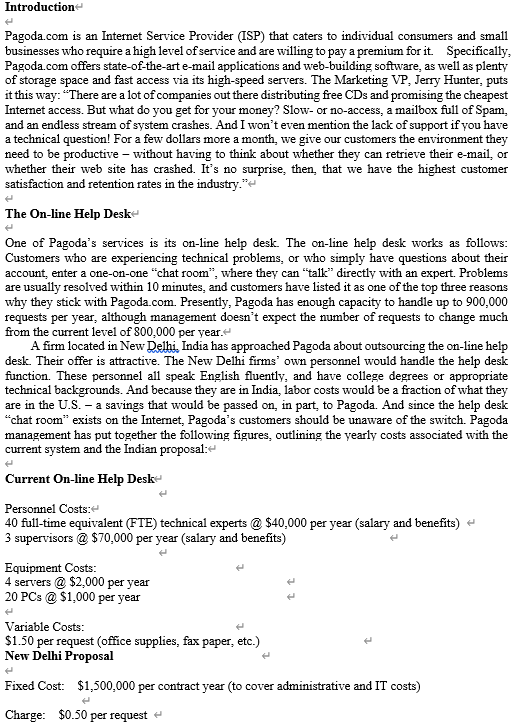
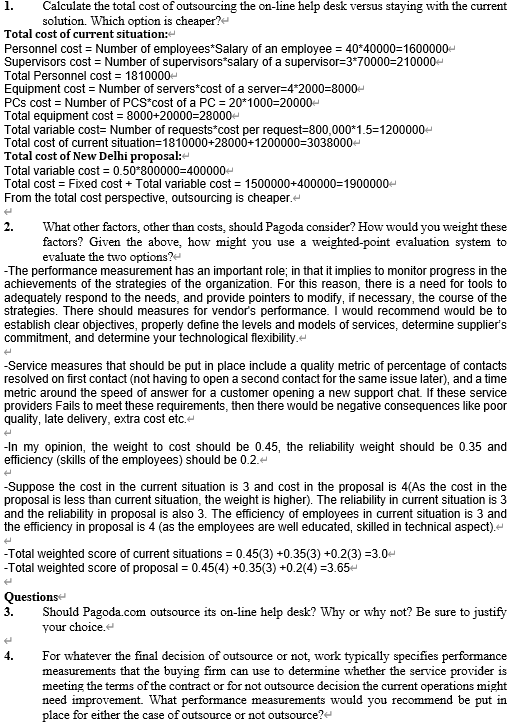
Introduction Pagoda.com is an Internet Service Provider (ISP) that caters to individual consumers and small businesses who require a high level of service and are willing to pay a premium for it. Specifically, Pagoda.com offers state-of-the-art e-mail applications and web-building software, as well as plenty of storage space and fast access via its high-speed servers. The Marketing VP, Jerry Hunter, puts it this way: "There are a lot of companies out there distributing free CDs and promising the cheapest Internet access. But what do you get for your money? Slow- or no-access, a mailbox full of Spam. and an endless stream of system crashes. And I won't even mention the lack of support if you have a technical question! For a few dollars more a month, we give our customers the environment they need to be productive - without having to think about whether they can retrieve their e-mail, or whether their web site has crashed. It's no surprise, then, that we have the highest customer satisfaction and retention rates in the industry." The On-line Help Desk One of Pagoda's services is its on-line help desk. The on-line help desk works as follows: Customers who are experiencing technical problems, or who simply have questions about their account, enter a one-on-one "chat room, where they can "talk" directly with an expert. Problems are usually resolved within 10 minutes, and customers have listed it as one of the top three reasons why they stick with Pagoda.com. Presently, Pagoda has enough capacity to handle up to 900,000 requests per year, although management doesn't expect the number of requests to change much from the current level of 800,000 per year. A firm located in New Delhi, India has approached Pagoda about outsourcing the on-line help desk. Their offer is attractive. The New Delhi firms' own personnel would handle the help desk function. These personnel all speak English fluently, and have college degrees or appropriate technical backgrounds. And because they are in India, labor costs would be a fraction of what they are in the U.S. - a savings that would be passed on, in part to Pagoda. And since the help desk "chat room" exists on the Internet, Pagoda's customers should be unaware of the switch. Pagoda management has put together the following figures, outlining the yearly costs associated with the current system and the Indian proposal: Current On-line Help Desk Personnel Costs: 40 full-time equivalent (FTE) technical experts @ $40,000 per year (salary and benefits) 3 supervisors @ $70,000 per year (salary and benefits) Equipment Costs: 4 servers @ $2,000 per year 20 PCs @ $1.000 per year Variable Costs: $1.50 per request office supplies, fax paper, etc.) New Delhi Proposal Fixed Cost: $1,500,000 per contract year (to cover administrative and IT costs) Charge: $0.50 per request 1. Calculate the total cost of outsourcing the on-line help desk versus staying with the current solution. Which option is cheaper? Total cost of current situation: Personnel cost = Number of employees*Salary of an employee = 40*40000=1600000- Supervisors cost = Number of supervisors salary of a supervisor=3*70000=210000 Total Personnel cost = 1810000 Equipment cost = Number of servers*cost of a server=4*2000=8000 PCs cost = Number of PCS cost of a PC = 20*1000=20000- Total equipment cost = 8000+20000=28000- Total variable cost= Number of requests cost per request=800,000*1.5=1200000 Total cost of current situation=1810000+28000+1200000=3038000- Total cost of New Delhi proposal: Total variable cost = 0.50*800000=400000 Total cost = Fixed cost + Total variable cost = 1500000+400000=1900000- From the total cost perspective, outsourcing is cheaper. 2. What other factors, other than costs, should Pagoda consider? How would you weight these factors? Given the above, how might you use a weighted-point evaluation system to evaluate the two options? -The performance measurement has an important role; in that it implies to monitor progress in the achievements of the strategies of the organization. For this reason, there is a need for tools to adequately respond to the needs, and provide pointers to modify, if necessary, the course of the strategies. There should measures for vendor's performance. I would recommend would be to establish clear objectives, properly define the levels and models of services, determine supplier's commitment, and determine your technological flexibility Service measures that should be put in place include a quality metric of percentage of contacts resolved on first contact (not having to open a second contact for the same issue later), and a time metric around the speed of answer for a customer opening a new support chat. If these service providers Fails to meet these requirements, then there would be negative consequences like poor quality, late delivery, extra cost etc. -In my opinion, the weight to cost should be 0.45, the reliability weight should be 0.35 and efficiency (skills of the employees) should be 0.2.- -Suppose the cost in the current situation is 3 and cost in the proposal is 4(As the cost in the proposal is less than current situation, the weight is higher). The reliability in current situation is 3 and the reliability in proposal is also 3. The efficiency of employees in current situation is 3 and the efficiency in proposal is 4 (as the employees are well educated, skilled in technical aspect). -Total weighted score of current situations = 0.45(3) +0.35(3) +0.2(3) =3.0- -Total weighted score of proposal = 0.45(4) +0.35(3) +0.2(4)=3.654 Questions 3. Should Pagoda.com outsource its on-line help desk? Why or why not? Be sure to justify your choice. 4. For whatever the final decision of outsource or not, work typically specifies performance measurements that the buying firm can use to determine whether the service provider is meeting the terms of the contract or for not outsource decision the current operations might need improvement. What performance measurements would you recommend be put in place for either the case of outsource or not outsource









 Study Help