







Question: read this management lecture and write up a one page summary of the main ideas contained in the lecture Business 270 Leading with Influence No
read this management lecture and write up a one page summary of the main ideas contained in the lecture 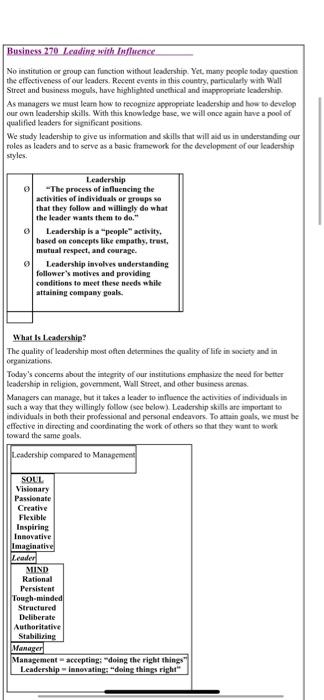
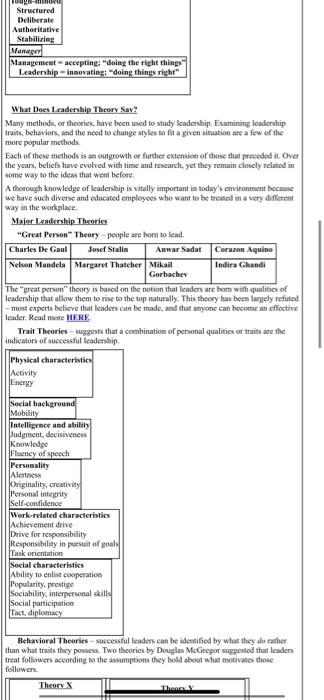
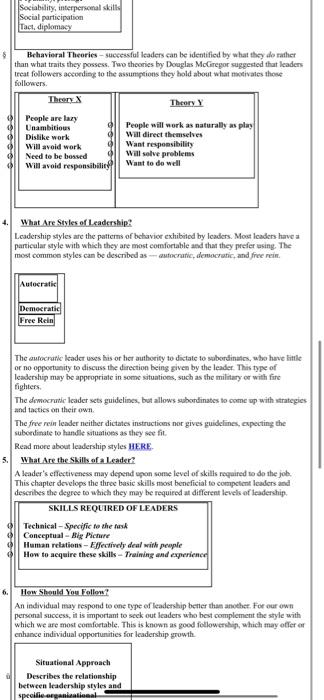
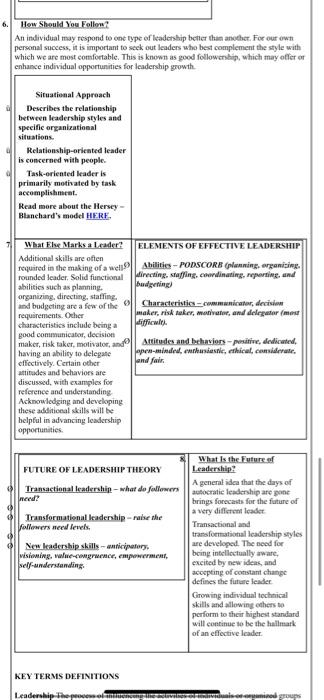
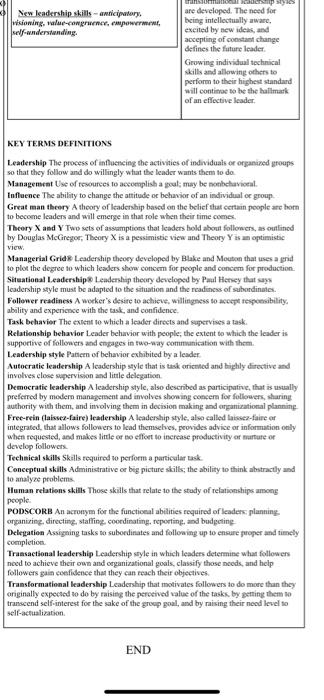
Business 270 Leading with Influence No institution or group can function without leadership. Yet, many people today question the effectiveness of our leaders. Recent events in this country, particularly with Wall Street and business moguls, have highlighted unethical and inappropriate leadership As managers we must learn how to recognize appropriate leadership and how to develop our own leadership skills. With this knowledge base, we will once again have a pool of qualified leaders for significant positions We stady leadership to give us information and skills that will aid us in understanding our roles as leaders and to serve as a basic framework for the developent of our leadership styles. Leadership "The process of influencing the activities of individuals or groups so that they follow and willingly do what the leader wants them to do. Leadership is a "people activity, based on concepts like empathy, trust, mutual respect, and courage. Leadership involves understanding follower's motives and providing conditions to meet these needs while attaining company goals. What Is Leadership The quality of leadership most often determines the quality of life in society and in organizations Today's concems about the integrity of our institutions emphasize the need for better leadership in religion, government, Wall Street, and other business arenas Managers can manage, but it takes a leader to influence the activities of individuals in such a way that they willingly follow (see below). Leadership skills are important to individuals in both their professional and personal endeavors. To attain goals, we must be effective in directing and coordinating the work of others so that they want to work toward the same goals Leadership compared to Management SOLL Visionary Passionate Creathe Flexible Inspiring Innovative Imaginative Leader MIND Rational Persistent Tough-minded Structured Deliberate Authoritative Stabilizing Manager Management accepting: "doing the right things Leadership - Innovating: "doing things right un. Structured Deliberate Authoritative Stabilizing Manager Management accepting: "doing the right things Leadership - innovating: "doing things right" What Does Leadership Theory Sav? Many methods, or theories, have been used to study leadership Examining leadership traits, behaviors, and the need to change styles to fit a given situation are a few of the more popular methods Each of these methods is an outgrowth or further extension of those that proceded it. Over the years, beliefs have evolved with time and research, yet they remain closely related in some way to the ideas that went before A thorough knowledge of leadership is vitally important in today's environment because we have such diverse and educated employees who want to be treated in a very different way in the workplace Major Leadership Theories "Great Person" Theory - people are born to lead Charles De Gaul Josef Stalin Anwar Sadat Corazon Aquino Nelson Mandela Margaret Thatcher Mikail Indira Gandi Gorbachev The great person" theory is based on the notion that leaders are born with qualities of leadership that allow them to rise to the top naturally. This theory has been largely refuted most experts believe that leaders can be made, and that anyone can become an effective leader. Read more HERE Trait Theories - suggests that a combination of personal qualities ar traits are the indicators of successful leadership Physical characteristics Activity Energy Social background Mobility Intelligence and ability pudgment, decisiveness Knowledge Fluency of speech Personality Alertness Originality, creativity Personal integrity self-confidence Work-related characteristics Achievement drive Drive for responsibility Responsibility in pursuit of goals Task orientation Social characteristics Ability to enlist cooperation Popularity, prestige Sociability, interpersonal skills Social participation Tit, diplomacy Behavioral Theories - soccessful leaders can be identified by what they do rather than what traits they possess. Two theories by Douglas McGregor suggested that leaders treat followers according to the assumptions they hold about what motivate these followers. Theory They Sociability, interpersonal skill Social participation Tact, diplomacy Behavioral Theories - successful leaders can be identified by what they do rather than what traits they possess. Two theories by Douglas McGregor suggested that leaders treat followers according to the assumptions they hold about what motivates those followers Theory Theory Y People are lary oll Unambitious People will work as naturally as play o Dislike work will direct themselves will avoid work Want responsibility Need to be bossed Will solve problems Will avoid responsibility Want to do well 4. What Are Styles of Leadership Leadership styles are the patterns of behavior exhibited by leaders. Most leaders have a particular style with which they are most comfortable and that they prefer using. The most common styles can be described as -- autocratic, democratic and free rein. Autocratic Democratic Free Rein The autocratie lader uses his or her authority to dictate to subordinates who have little or no opportunity to discuss the direction being given by the leader. This type of leadership may be appropriate in some situations, such as the military or with fire fighters The democratic leader sets guidelines, but allows subordinates to come up with strategies and tactics on their own. The free rein leader neither dictates instructions not gives guidelines, expecting the subordinate to handle situations as they see fit. Read more about leadership styles HERE 5. What Are the skills of a Leader? A leader's effectiveness may depend upon some level of skills required to do the job. This chapter develops the three basic skills most beneficial to competent leaders and describes the degree to which they may be required at different levels of leadership SKILLS REQUIRED OF LEADERS 9 Technical Specific to the Conceptual - Big Picture Human relations - Effectively deal with people How to acquire these skills - Training and experience 6. How Should You Follow An individual may respond to one type of leadership better than another. For our own personal success, it is important to seek out leaders who hest complement the style with which we are most comfortable. This is known as good followership, which may offer er enhance individual opportunities for leadership growth Situational Approach Describes the relationship between leadership styles and sprealle aganisational How Should You Follow An individual may respond to one type of leadership better than another. For our own personal success, it is important to seek out leaders who best complement the style with which we are most comfortable. This is known as good followership, which may offer or enhance individual opportunities for leadership growth Situational Approach Describes the relationship between leadership styles and specific organizational situations, Relationship-oriented leader is concerned with people. Task-oriented leader is primarily motivated by task accomplishment Read more about the Hersey- Blanchard's model HERE 1 What Else Marks a leader? ELEMENTS OF EFFECTIVE LEADERSHIP Additional skills are often required in the making of a well. Abilities -PODSCORB plning organising rounded leader Solid functional desting staffing, coordinating, reporting, and abilities such as planning. Budgeting) organizing directing, staffing. and budgeting are a few of the oll Characteristics omniator, decision requirements. Other maker, risk taker, motivate and delegater mest characteristics include being a difficult. good communicator, decision maker, risk taker, motivator, and attitudes and behaviors - pestive, dedicated having an ability to delegate open-minded enthusiastic, ethical considerate. effectively. Certain other | fails: attitudes and behaviors are discussed, with examples for reference and understanding Acknowledging and developing these additional skills will be helpful in advancing leadership opportunities. FUTURE OF LEADERSHIP THEORY Transactional leadershin-whar do followers meed? Transformational leadership-raise the Followers need levels New leadership skills - anticipatory, visioning, wegwence, empowerment self-understanding What is the Future of Leadership A general idea that the days of autocratic leadership are gone brings forecasts for the future of a very different leader Transactional and transformational leadership styles are developed. The need for being intellectually aware, excited by new ideas, and accepting of constant change defines the future leader Growing individual technical skills and allowing others to perform to the highest standard will continue to be the hallmark of an effective leader KEY TERMS DEFINITIONS Leadership Theme Erns New leadership skills anticipatory, visioning, walcowgruende, empowerment self-understanding Cadena are developed. The need for being intellectually aware excited by new ideas, and accepting of constant change defines the future loader Growing individual technical skills and allowing others to perform to their highest standard will continue to be the hallmark of an effective leader KEY TERMS DEFINITIONS Leadership The process of influencing the activities of individuals or organized groups so that they follow and do willingly what the leader wants them to do Management Use of resources to accomplish a goal; may be nonbehavioral. Influence the ability to change the attitude of behavior of an individual or group Great man theory A theory of leadership based on the belief that certain people are bom to become leaders and will emerge in that role when their time comes. Theory X and Y Two sets of assumptions that leadets hold about followers, as outlined by Douglas McGregor, Theory X is a pessimistic view and Theory is an optimistic view Managerial Grid Leadership theory developed by Blake and Mouton that uses a grid to plot the degree to which leaders show concem for people and concem for production Situational Leadership Leadership theory developed by Paul Hey that says leadership style must be adapted to the situation and the readiness of subordinates Follower readiness A worker's desire to achieve, willingness to accept responsibility ability and experience with the task, and confidence Task behavior The extent to which a leader directs and supervises a task Relationship behavior Leader behavior with people, the extent to which the leader is supportive of followers and engages in two-way communication with them. Leadership style Pattern of behavior exhibited by a leader Autocratic leadership A leadership style that is task oriented and highly directive and involves close supervision and little delegation Democratic leadership A leadership style, also described as participative, that is usually preferred by modern management and involves showing concem for followers, sharing authority with them, and involving them in decision making and organizational planning Free-rein (laissez-faire) leadership A leadership style, also called laissez-faire or integrated that allows followers to lead themselves, provides advice or information only when requested, and makes little or no effort to increase productivity or nurture of develop followers Technical skills Skills required to perform a particular task Conceptual skills Administrative or big picture skills, the ability to think abstractly and to analyze problems Human relations skills Those skills that relate to the study of relationships among people PODSCORB An acronym for the functional abilities required of leaders, planning organizing, directing, staffing, coordinating, reporting, and budgeting Delegation Assigning tasks to subordinates and following up to ensure proper and timely completion Transactional leadership Leadership style in which leaders determine what followers need to achieve their own and organizational goals, classify those needs and help followers gain confidence that they can reach their objectives Transformational leadership Leadership that motivates followers to do more than they originally expected to do by raising the perceived value of the tasks, by getting them to transcend self-interest for the sake of the group goal, and by raising their need level to self-actualization END Step by Step Solution
There are 3 Steps involved in it
1 Expert Approved Answer
Step: 1 Unlock

Question Has Been Solved by an Expert!
Get step-by-step solutions from verified subject matter experts
Step: 2 Unlock
Step: 3 Unlock
 Study Help