







Question: The lab report gives you the net ionic equation rather than the molecular equation for the clock reaction. Were there any spectator ions present when
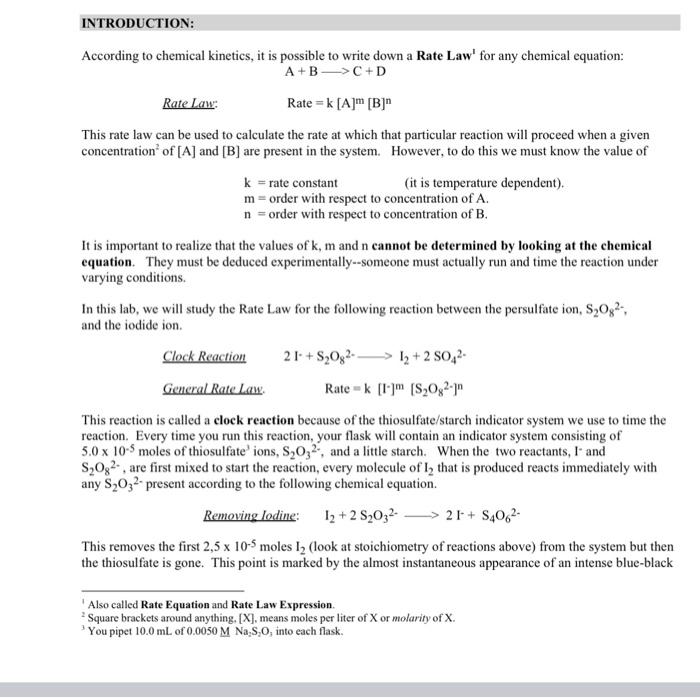
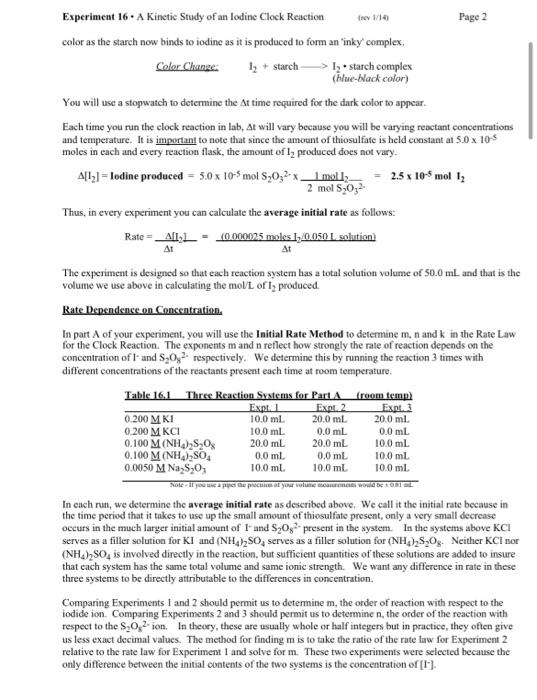
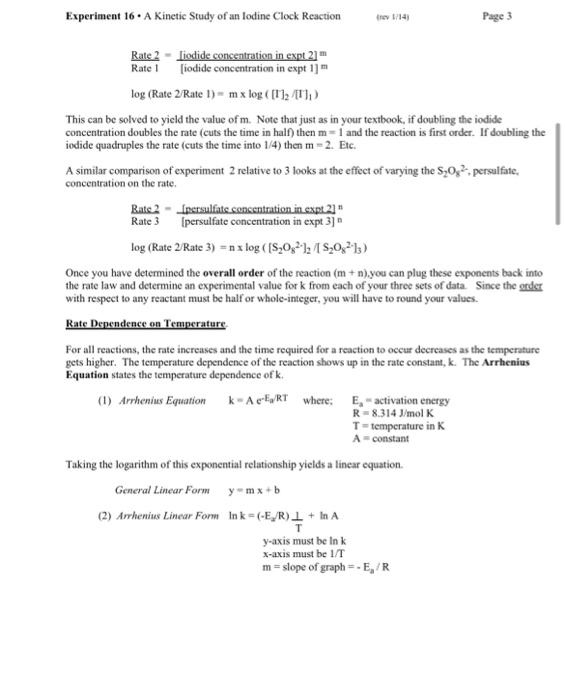
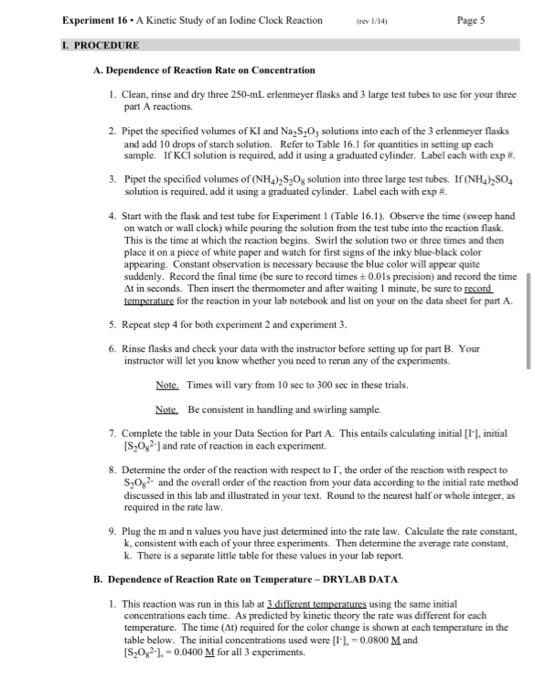
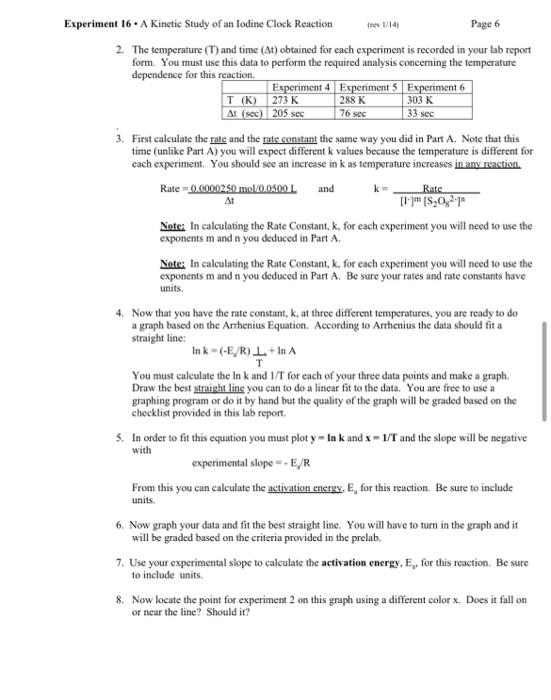
According to chemical kinetics, it is possible to write down a Rate Law' for any chemical equation: A+BC+D Rate Law: Rate =k[A]m[B]n This rate law can be used to calculate the rate at which that particular reaction will proceed when a given concentration of [A] and [B] are present in the system. However, to do this we must know the value of k= rate constant (it is temperature dependent). m= order with respect to concentration of A. n= order with respect to concentration of B. It is important to realize that the values of k,m and n cannot be determined by looking at the chemical equation. They must be deduced experimentally--someone must actually run and time the reaction under varying conditions. In this lab, we will study the Rate Law for the following reaction between the persulfate ion, S2O82 and the iodide ion. Clock Reaction 2I+S2O82I2+2SO42 General Rate Law. Rate =k[I]m[S2O82]n This reaction is called a clock reaction because of the thiosulfate/starch indicator system we use to time the reaction. Every time you run this reaction, your flask will contain an indicator system consisting of 5.0105 moles of thiosulfate ions, S2O32, and a little starch. When the two reactants, Iand S2O82, are first mixed to start the reaction, every molecule of I2 that is produced reacts immediately with any S2O32 present according to the following chemical equation. Removing lodine: I2+2S2O322F+S4O62 This removes the first 2,5105 moles I2 (look at stoichiometry of reactions above) from the system but then the thiosulfate is gone. This point is marked by the almost instantaneous appearance of an intense blue-black 'Also called Rate Equation and Rate Law Expression. 2 Square brackets around anything, [X], means moles per liter of X or molarity of X. 3 You pipet 10.0mL of 0.0050MNaN2S2, into each flask. Experiment 16 * A Kinctic Study of an lodine Clock Reaction (sev 3140 Page 2 color as the starch now binds to iodine as it is produced to form an "inky" complex, You will use a stopwatch to determine the At time required for the dark color to appear. Each time you run the clock reaction in lab, At will vary because you will be varying reactant concentrations and temperature. It is important to note that since the amount of thiosulfate is held constant at 5.0105 moles in each and every reaction flask, the amount of 12 produced does not vary. [I2]=lodineproduced=5.0105molS2O322molS2O321mol=2.5105molI2 Thus, in every experiment you can calculate the average initial rate as follows: Rate=t[]2]=t(0.000025molos]20,050Lsolution) The experiment is designed so that each reaction system has a total solution volume of 50.0mL and that is the volume we use above in calculating the mol L of I2 produced. Rate.Depandence on Concentration. In part A of your experiment, you will use the Initial Rate Method to determine m,n and k in the Rate Law for the Clock Reaction. The exponents m and n reflect how strongly the rate of reaction depends on the concentration of Iand S2O8 2- respectively. We determine this by running the reaction 3 times with difterent concentrations of the reactants present each time at room temperature. In each run, we determine the average initial rate as described above. We call it the initial rate because in the time period that it takes to use up the small amount of thiosulfate present, only a very small decrease oceurs in the much larger initial amount of Iand S2O82 present in the system. In the systems above KCl serves as a filler solution for KI and (NH4)2SO4 serves as a filler solution for (NH4)2S2O8. NeitherKClnor (NH4)2SO4 is involved directly in the reaction, but sufficient quantities of these solutions are added to insure that each system has the same total volume and same ionic strength. We want any difference in rate in these three systems to be directly attributable to the differences in concentration. Comparing Experiments I and 2 should permit us to determine m, the order of reaction with respect to the iodide ion. Comparing Experiments 2 and 3 should permit us to detemine n, the order of the reaction with respect to the S2O52 ion. In theory, these are usually whole or half integers but in practice, they often give us less exact decimal values. The method for finding m is to take the ratio of the rate law for Experiment 2 relative to the rate law for Experiment 1 and solve for m. These two experiments were selected because the only difference between the initial contents of the fwo systems is the concentration of [I]. Experiment 16- A Kinetic Study of an lodine Clock Reaction (ne bia) Page 3 Rate1Rate2=[iodideconcentrationinexpt1]liodideconcentrationinexpt2]mmlog(Rate2Rate1)=mlog([I]2/[1]1) This can be solved to yield the value of m. Note that just as in your textbook, if doubling the iodide concentration doubles the rate (cuts the time in half) then m=1 and the reaction is first order. If doubling the iodide quadruples the rate (cuts the time into 1/4) then m=2. Etc. A similar comparison of experiment 2 relative to 3 looks at the effect of varying the S2O82, persalfate, concentration on the rate. log(Rate2/Rate3)=nlog([S2O82]2/S2O82]3) Once you have determined the overall order of the reaction (m+n) you can plug these exponents back into the rate law and determine an experimental value for k from each of your three sets of data. Since the order with respect to any reactant must be half or whole-integer, you will have to round your values. Rate Dependence on Temperature. For all reactions, the rate increases and the time required for a reaction to occur decreases as the temperature gets higher. The temperature dependence of the reaction shows up in the rate constant, k. The Arrhenius Equation states the temperature dependence of k. (1) Arrhenius Equation k=AeE/RTwhere:Ea=activationenergyR=8.314J/molKT=temperatureinKA=constant Taking the logarithm of this exponential relationship yields a linear equation. General Linear Form y=mx+b (2) Amhenius Linear Form lnk=(E2/R)T1+lnA y-axis must be in k x-axis must be 1/T m=slopeofgraph=Ea/R OCEDURE A. Dependence of Reaction Rate on Concentration 1. Clean, rinse and dry three 250 -mL erlenmeyer flasks and 3 large test tubes to use for your three part A reactions. 2. Pipet the specified volumes of KI and Na2S2O3 solutions into each of the 3 erlenmeyer flasks and add 10 drops of starch solution. Refer to Table 16.1 for quantitics in setting up each sample. If KCl solution is required, add it using a graduated cylinder. Label each with exp i. 3. Pipet the specified volumes of (NH4)2S2O8 solution into three large test tubes. If (NH4)2SO4 solution is required, add it using a graduated cylinder. Label each with exp i. 4. Start with the flask and test tube for Experiment 1 (Table 16,1). Observe the time (sweep hand on watch or wall clock) while poaring the solution from the test tube into the reactioa flask. This is the time at which the reaction begins. Swirl the solution two or three times and then place it on a piece of white paper and watch for first signs of the inky blae-black color appearing. Constant observation is necessary because the blue color will appear quite suddenly. Record the final time (be sure to record times 0.0 is precision) and record the time At in seconds. Then insert the thermometer and after waiting 1 minute, be sure to recond temperature for the reaction in your lab notebook and list on your on the data sheet for part A. 5. Repeat step 4 for both experiment 2 and experiment 3 . 6. Rinse flasks and check your data with the instructor before setting up for part B. Your instructor will let you know whether you need to rerun any of the experiments. Note. Times will vary from 10 sec to 300 sec in these trials. Note. Be consistent in handling and swirling sample. 7. Complete the table in your Data Section for Part A. This entails calculating initial [1-], initial [S2O82] and rate of reaction in each experiment. 8. Determine the order of the reaction with respect to I, the order of the reaction with respect to S2O82 and the overall order of the reaction from your data according to the initial rate method discussed in this lab and illustrated in your text. Round to the nearest half or whole integer, as required in the rate law. 9. Plug the m and n values you have just determined into the rate law. Calculate the rate constant, k, consistent with each of your three experiments. Then determine the average rate constant, k. There is a separate little table for these values in your lab report. B. Dependence of Reaction Rate on Temperature - DRYLAB DATA 1. This reaction was run in this lab at 3 different temperatures using the same initial concentrations each time. As predicted by kinetic theory the rate was different for cach temperature. The time ( t) required for the color change is shown at each temperature in the table below. The initial concentrations used were [I]4=0.0800M and [S2O82]3=0.0400M for all 3 experiments. 2. The temperature (T) and time (t) obtained for each experiment is recorded in your lab report form. You must use this data to perform the required analysis concerning the temperature dependence for this peartion 3. First calculate the rate and the nute constant the same way you did in Part A. Note that this time (unlike Part A) you will expect different k values because the temperature is different for each experiment. You should see an increase in k as temperature increases in any reaction. Rate=t0.0000250molu0.0500Landk=[I]m[S2Os2]nRate Note: In calculating the Rate Constant, k, for each experiment you will need to use the exponents m and n you deduced in Part A. Note: In calculating the Rate Constant, k, for each experiment you will need to use the exponents m and n you deduced in Part A. Be sure your rates and rate constants have units. 4. Now that you have the rate constant, k, at three different temperatures, you are ready to do a graph based on the Arrhenius Equation. According to Arrhenius the data should fit a straight line: lnk=(E/R)T1+lnA You must calculate the in k and 1/T for each of your three data points and make a graph. Draw the best straight line you can to do a linear fit to the data. You are free to use a graphing program or do it by hand but the quality of the graph will be graded based on the checklist provided in this lab report. 5. In order to fit this equation you must plot y=lnk and x=1/T and the slope will be negative with experimentalslope=E/R From this you can calculate the activation energy, Ea for this reaction. Be sure to include units. 6. Now graph your data and fit the best straight line. You will have to turn in the graph and it will be graded based on the criteria provided in the prelab. 7. Use your experimental slope to calculate the activation energy, Ey for this reaction. Be sure to include units. 8. Now locate the point for experiment 2 on this graph using a difterent color x. Does it fall on or near the line? Should it
Step by Step Solution
There are 3 Steps involved in it

Get step-by-step solutions from verified subject matter experts
 Study Help