







Question: Consider a setting in which two potential contributors to a public good, measured as total quantity Q, decide on their own how much to
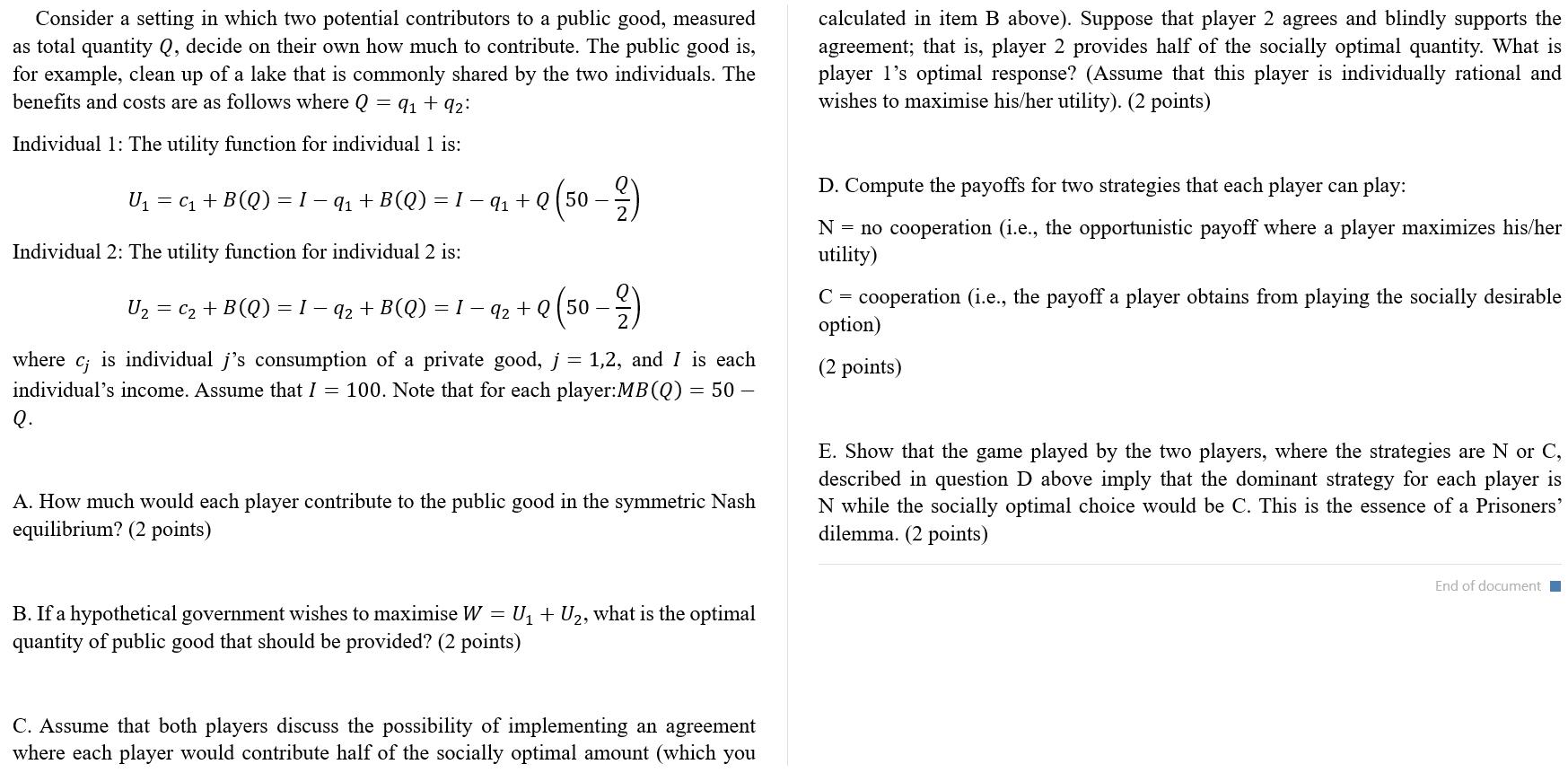
Consider a setting in which two potential contributors to a public good, measured as total quantity Q, decide on their own how much to contribute. The public good is, for example, clean up of a lake that is commonly shared by the two individuals. The benefits and costs are as follows where Q = 91 +92: Individual 1: The utility function for individual 1 is: U = C + B(Q) = 1 q +B(Q) = 1-q +Q (50 Individual 2: The utility function for individual 2 is: ---/-) U = C + B(Q) = 1 q +B(Q) = 1 - 9 + Q (50 -Q (50-2) where j is individual j's consumption of a private good, j = 1,2, and I is each individual's income. Assume that I = 100. Note that for each player:MB(Q) = 50 - Q. A. How much would each player contribute to the public good in the symmetric Nash equilibrium? (2 points) B. If a hypothetical government wishes to maximise W = U + U, what is the optimal quantity of public good that should be provided? (2 points) C. Assume that both players discuss the possibility of implementing an agreement where each player would contribute half of the socially optimal amount (which you calculated in item B above). Suppose that player 2 agrees and blindly supports the agreement; that is, player 2 provides half of the socially optimal quantity. What is player l's optimal response? (Assume that this player is individually rational and wishes to maximise his/her utility). (2 points) D. Compute the payoffs for two strategies that each player can play: N = no cooperation (i.e., the opportunistic payoff where a player maximizes his/her utility) C = cooperation (i.e., the payoff a player obtains from playing the socially desirable option) (2 points) E. Show that the game played by the two players, where the strategies are N or C, described in question D above imply that the dominant strategy for each player is N while the socially optimal choice would be C. This is the essence of a Prisoners' dilemma. (2 points) End of document
Step by Step Solution
There are 3 Steps involved in it
A In the symmetric Nash equilibrium each player contributes an equal amount to the public good Lets denote the contribution of each player as q q1 q2 ... View full answer

Get step-by-step solutions from verified subject matter experts
 Study Help