Question: https://www.youtube.com/watch?v=3klMM9BkW5o https://stlcc.edu/student-support/academic-success-and-tutoring/writing-center/writing-resources/pathos-logos-and-ethos.aspx https://youtu.be/XZwht1UQG3Q?si=Fm0PTyb6FBpqdNt0 https://youtu.betdQqXcD8Ogwrt https://alabama.instructure.com/courses/85290/files/17707214/download?wrap=1 Textbook: A writer's reference 10th edition OVERVIEW: Ancient Greek rhetoricians distinguished among three kinds of appeals to influence readers?ethical, logical,
OVERVIEW: "Ancient Greek rhetoricians distinguished among three kinds of appeals to influence readers?ethical, logical, and emotional. As you evaluate arguments, identify these appeals and question their effectiveness. Ethical arguments (ethos), also known as credibility arguments, call upon a writer's character, knowledge, and authority. Reasonable arguments/logical appeals (logos) appeal to readers' sense of logic, rely on evidence, and use inductive and deductive reasoning. Emotional arguments (pathos) appeal to readers' beliefs and values" (Hacker & Sommers, 2021, p. 77). "When you study how writers influence readers through language, you are analyzing the rhetoric (available means of persuasion) of what you read. When you identify a writer's purpose for responding to a situation by composing an essay that puts forth claims meant to sway a particular audience, you are performing a rhetorical analysis" (Greene & Lidinsky, 2021, p. 53). DEFINITION: The rhetorical analysis is an essay grounded in argumentation. The rhetorical analysis builds upon the reaction; instead of responding to a reading personally, students will evaluate the text's quality or worth according to a set of established criteria. The critique also builds upon the review; rather than reviewing the quality of a product, book, or movie, students are evaluating the quality or effectiveness of a writer's argument. The critique is a much more analytical and intellectual enterprise than a simple summary, a reaction, or a review. A rhetorical critique requires students to analyze the quality of a text by judging how effectively the author uses the three rhetorical appeals ethos, logos, and pathos.
Modified by Holly Powell on October 1, 2024 THE WRITNG ASSIGNMENT GUIDELINES: ? A P A format (see A P A section of our textbook or look at the video provided under course content). ? Write in third person point of view. ? Analyze the author's use of the rhetorical appeals, ethos, logos, and pathos, in the text. ? Address logical fallacies and counterarguments. ? Compose an analytical thesis sentence (as on pages 62-64 of our textbook). ? Include a ti tle page (see page 255), three questions in your introduction (see page 256), headings (example seen on pages 256, 258, 260, 262), and a Refere nce page (see page 263). ? Only use one source for this essay: "Selma Blair Became a Disabled Icon Overnight. Here's Why We Need More Stories Like Hers." by Zipporah Arielle (from the book entitled Disability Visibility: First-Person Stories from the Twenty-first Century edited by Alice Wong). ? This essay should be six paragraphs (minimum) in length. WRITING PROMPT: Wri te a rhetorical analysis of "Selma Blair Became a Disabled Icon Overnight. Here's Why We Need More Stories Like Hers." Your essay should analyze the author's use of rhetorical appeals (ethos, logos, pathos) to deliver an argument. ESSAY WRITING NOTES: Focus on analyzing the authors' use of ethos, logos, and pathos. Address logical fallacies. Follow the organization seen in the outline below. ESSAY ORGANIZATION: I. Titl e Page is required. See example on page 255 of our book A Writer's Reference. [Also note: No Abstract is required.] II. Introductory Paragraph: a. Begin your essay on your second page by stating your essay ti tle again as seen on page 256 in our textbook A Writer's Reference. b. Open your essay by capturing your audience's attention. c. Include basic information about the source and the source's content. d. Provide context. The best way to d o thi s is to state the rhetorical situation (what is the issue at hand and why is the author writing this argument?) e. Mention the author's name and the titl e of the source. Also mention the book this source is found in and the editor's name. Additionally, mention the year the book was published. f. Author's Purpose or Claim: Mention the authors' main point stated in your o w n words. g. State three questions as seen in the example on page 256. For this essay, your three questions need to address (1) ethos, (2) logos, and (3) pathos. h. Your thesis statement will be the last sentence in intro paragraph (after the three questions). It will include an analysis of the author's argument. Page 64 and similar to the example in our book A Writer's Reference on page 65 (last sentence in the first paragraph). i. Write in third person point of view. III. Transition Paragraph: a. Give a summary of the work. b. In this case, you are summarizing the text. You may refer to the text as a source, an essay, or a text.
Modified by Holly Powell on October 1, 2024 c. The last sentence will discuss how the work concludes. d. Your opinion should not appear in this paragraph. IV. ETHOS (Supporting Paragraph 1): a. Begin with a transition sentence (you've covered the introduction and the summary, now transition into your first attempt to support your thesis). This transition sentence must also serve as your topic sentence. b. This sentence must support your thesis. c. You must include textual evidence to support your reason. Look at the text for exact wording. d. Set up your quotes by offering a signal phrase (Smith (2023) argued that. . .) or context (Smith (2023) suggests. . .). Use proper A P A format. e. After each quotation, provide analysis of this rhetorical strategy (in this case, how did the use of ethos support the author's argument?). You need to make sure your readers understand how the textual evidence supports your topic sentence. f. Important: Include evidence of logical fallacies. g. Mention counter arguments if applicable. h. Your last sentence should close the paragraph. V. LOGOS (Supporting Paragraph 2): a. Begin with a transition sentence/topic sentence. b. This sentence must support your thesis. c. You must include at least two quotes, textual evidence, to support your reason. d. Set up your quotes by offering a signal phrase (Smith (2023) argued that. . .) or context (Smith (2023) suggests. . .). Look at the text for exact wording. Use proper A P A format. e. After each quotation, provide analysis of this rhetorical strategy (in this case, how did the use of logos support the author's argument?). You need to make sure your readers understand how the textual evidence supports your topic sentence. f. Important: Include evidence of logical fallacies. g. Mention counter arguments if applicable. h. Your last sentence should close the paragraph. VI. PATHOS (Supporting Paragraph 3): a. Begin with a transition sentence/topic sentence. b. This sentence must support your thesis. c. You must include at least two quotes, textual evidence, to support your reason. d. Set up your quotes by offering a signal phrase (Hodge (2023) argued that. . .) or context (Hodge (2023) suggests. . .). Look at the text for exact wording. Use proper A P A format. e. After each quotation, provide analysis of this rhetorical strategy (in this case, how did the use of pathos support the author's argument?). You need to make sure your readers understand how the textual evidence supports your topic sentence. f. Important: Include evidence of logical fallacies. g. Mention counter arguments if applicable. h. Your last sentence should close the paragraph. VII. Closing Paragraph: a. Restate your thesis in a different way. b. Provide closure to your analysis of the authors' article. VIII. Refer ence Page a. List the source in correct A PA Format
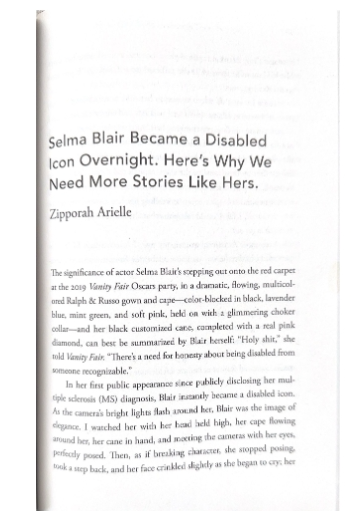
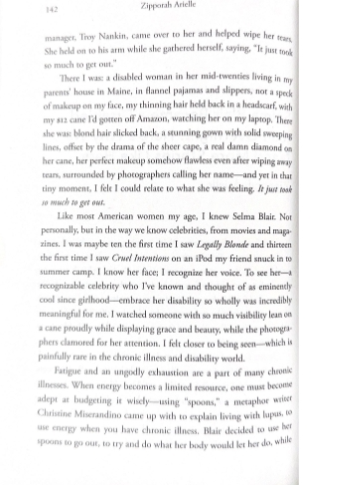
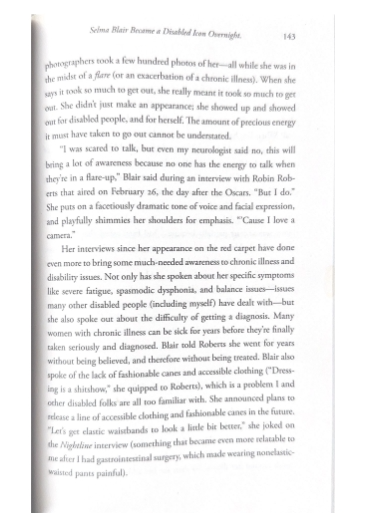
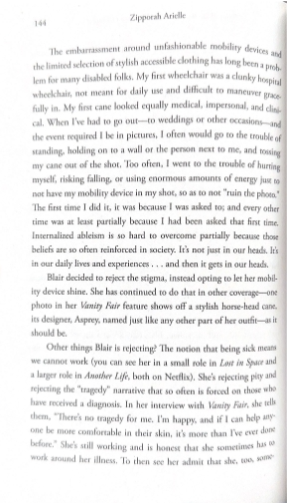
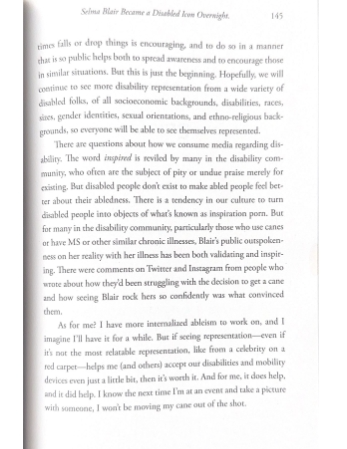
Selma Blair Became a Disabled Icon Overnight. Here's Why We Need More Stories Like Hers. Zipporah Arielle The significance of actor Selma Blair's stepping out onto the red carpet at the 2019 Wound Fair Oscars party. In a dramatic, Howing, multicol- ored Ralph & Russo gown and cape-color-blocked in black, lavender blue. mint green, and soft pink, held on with a glimmering choker collar-and her black customized cane, completed with a real pink diamond, can best be summarized by Blair benself: "Holy shit," she told Vanity Fair "There's a need for bonney about being disabled from someone recognizable." In her first public appearance since publicly disclosing her mul tiple sclerosis (MS) diagnosis, Blair instantly became a disabled icon. As the camera's bright lights flash around her, Blair was the image of elegance. I watched her with her hand held high, her cape flowing around her, her cane in hand, and meeting the cameras with her eyes. perfectly posed. Then, as if breaking character, she stopped posing wok a wep back, and her face crinkled lightly as she began to cry, her142 Zipporah Arielle manager, Troy Nankin, came over to her and helped wipe her tears, She held on to his arm while she gathered herself, saying. "It just took so much to get out." There I was a disabled woman in her mid-twenties living in my parents' house in Maine, in flannel pajamas and slippers, not a speck of makeup on my face, my thinning hair held back in a headscarf, with my aid cane I'd gouen off Amazon, watching her on my laptop. There the was blond hair slicked back, a stunning gown with solid sweeping lines, offset by the drama of the sheer cape, a real damn diamond on her cane, her perfect makeup somehow flawless even after wiping away bran, surrounded by photographers calling her name-and yet in chat tiny moment, I felt I could relate to what she was feeling, fe juit fast Like most American women my age, I knew Selma Blair Not personally, but in the way we know celebrities, from movies and maga rises. I was maybe ten the first time I saw Legally Blonde and thirteen the first time I saw Cruel Aveations on an ipod my friend snuck in to summer camp. I know her face, I recognize her woke. To me her- recognizable celebrity who I've known and thought of as eminently cool since girlhood-embrace her disability so wholly was incredibly meaningful for me. I watched someone with so much whibility lean on a cane proudly while displaying grace and beauty, while the photogri pher clamored for her attention, I felt closer to being seen-which is painfully rare in the chronic illness and disability workd. Fatigue and an ungodly exhaustion are a part of many chronic illnesses. When energy becomes a limited resource, one must become adept at budgeting is wisely-using "spoons," a metaphor wrist Christine Miserandino came up with to explain living with lupus, to use encigy when you have chronic illness. Blair decided to use ber spoon to go out, to try and do what her body would let her do, whileSelma Blair Broome a Disabled Jen Overnight. 143 photographers took a few hundred photos of her-all while she was in the midst of a flare (or an exacerbation of a chronic illness). When she says it took so much to get out, she really meant it took so much to get out. She didn't just make an appearance: she showed up and showed out for disabled people, and for herself. The amount of precious energy it must have taken to go out cannot be understated. "I was scared to talk, but even my neurologist said no, this will bring a lot of awareness because no one has the energy to talk when they're in a flare-up," Blair said during an interview with Robin Rob- eris that aired on February 26, the day after the Oscars, "But I do." She puts on a facetiously dramatic tone of voice and facial expression, and playfully shimmies her shoulders for emphasis. "Cause I love a camera. Her interviews since her appearance on the red carpet have done even more to bring some much-needed awareness to chronic illness and disability issues. Not only has she spoken about her specific symptoms like severe fatigue, spasmodic dysphonia, and balance issues-issues many other disabled people (including myself) have dealt with-but she also spoke out about the difficulty of getting a diagnosis. Many women with chronic illness can be sick for years before they're finally taken seriously and diagnosed. Blair told Roberts she went for years without being believed, and therefore without being treated. Blair also spoke of the lack of fashionable canes and acceuible clothing ("Dress- ing is a shitshow," she quipped to Robert), which is a problem I and other disabled folks are all too familiar with. She announced plans to release a line of accessible clothing and fashionable canes in the future. "Let's get elastic waistbands to look a liule bir bewer." she joked on the Mightone interview (something that became even more relatable to me after I had gastrointestinal surgery, which made wearing nonclayic- waisted pants painful).Zipporah Arielle 144 The embarrassment around unfashionable mobility devices and the limited selection of stylish accessible clothing has long been a prob lem for many disabled folks. My first wheelchair was a clunky hospital wheelchair not meant for daily use and difficult to maneuver grace- fully in. My first cane looked equally medical, Impersonal, and cling cal, When I've had to go out-to weddings or other occasions-and the event required I be in pictures, I often would go to the trouble of standing, holding on to a wall or the person next to me, and toising my cane out of the shot, Too often. I went to the trouble of hurting myself, risking falling, or using enormous amounts of energy just m not have my mobility device in my shot, so as to not "ruin the phoin" The firm time I did it, it was because I was asked sos and every other time was at least partially because I had been asked that first time, Insernadined ablelam is so hard to overcome partially because chow belief are so often reinforced In society. It's not just in our heads. It's In our daily lives and experiences . . . and then it gets in our heads. Blair decided to reject the stigma, instead opting to let her mobil- hey device thing. She has continued to do that in other coverage-one photo in her Visdry Fur feature shows off a stylish horse-head cane. its designer, Asprey, named just like any other part of her outfit-as it should be Other things Blair is rejecting The notion that being sick mears we cannot work (you can see her in a small role in Lost in Space and a larger role in Another Life, both on Netflix). She's rejecting pay and rejecting the "tragedy" narrative that so often is forced on those who have received a diagnosis. In her interview with Vanity Fair, she tells them, "There's no tragedy for me. I'm happy, and if I can help any one be more comfortable in their skin, it's more than I've ever done before." She's still working and is honest that she sometimes has to work around her illness, To then see her admit that she, was wonSelma Blair Became a Disabled Jen Overnight. 145 times falls or drop things is encouraging, and to do so in a manner that is so public helps both to spread awareness and to encourage those In similar situations. But this is just the beginning. Hopefully, we will continue to see more disability representation from a wide variety of disabled folks, of all socioeconomic backgroundh, diubilities, races, dines, gender identities, sexual orientations, and ethno-religious back- grounds, so everyone will be able to see themselves represented. There are questions shout how we consume media regarding dis- ability. The word inspired is reviled by many in the disability com- munity, who often are the subject of pity or undue praise merely for existing. But disabled people don't exist to make abled people feel bet- ter about their abledness. There is a tendency in our culpare to turn disabled people into objects of what's known as inspiration porn. But for many in the disability community, particularly those who use canes or have MS or other similar chronic illnesses, Blair's public outspoken- ness on her reality with her illness has been both validating and inspir- ing. There were comments on Twitter and Instagram from people who wrote about how they'd been struggling with the decision to get a cane and how seeing Blair rock hers so confidently was what convinced them. As for me? I have more internalized ableism to work on, and I imagine I'll have is for a while. But if seeing representation-even if it's not the most relatable representation, like from a celebrity on a red carpet-helps me (and other) accept our disabilities and mobility devices even just a little bit, then it's worth it. And for me, it does help, and it did help. I know the next time I'm at an event and take a picture with someone, I won't be moving my cane out of the shot
Step by Step Solution
There are 3 Steps involved in it
1 Expert Approved Answer
Step: 1 Unlock
Question Has Been Solved by an Expert!
Get step-by-step solutions from verified subject matter experts
Step: 2 Unlock
Step: 3 Unlock
Students Have Also Explored These Related Business Writing Questions!









 Study Help