







Question: According to the WLLN (Application 1 to Theorem 9), if the r.v.s X 1 ,...,X n are i.i.d. with finite X 1 , then The
According to the WLLN (Application 1 to Theorem 9), if the r.v.s X1,...,Xn are i.i.d. with finite ԐX1, then

The following example shows that it is possible for {Sn/n} to converge in probability to a finite constant, as n → ∞, even if the ԐX1 does not exist. To this effect, for j = 1, 2,..., let Xj be i.i.d. r.v.s such that P(Xj = -n) = P(Xj = n) = c/n2 log n, n ≥ 3, where

Then show that ԐX1 does not exist, but

Where
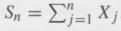
Show that ԐX1 does not exist by showing that ԐX1+ = ԐX1- = ∞. Next, set Xnj = Xj if |Xj| nj = 0 otherwise, j = 1,2…> 3, and let
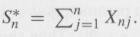
Then show that (i)
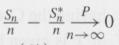
by showing that
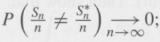
(ii) Ԑ(S*n/n) = 0
(iii)
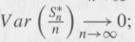
(iii), conclude that

Then (i) and (iv) complete the proof.
In all Exercises 11-16, i is to be treated as a real number, subject, of course, to the requirement that i2 = -1
Sn Sn P EX1, where S, = xj. , j=1
Step by Step Solution
3.58 Rating (158 Votes )
There are 3 Steps involved in it
First X 1 X 1 c n3 1n log n and n3 1n log n 25 dxx 05 logx 05 3 dtt log t 3 d log tlog t log log t 3 ... View full answer

Get step-by-step solutions from verified subject matter experts
Document Format (1 attachment)

742-M-S-P (6959).docx
120 KBs Word File
 Study Help