







Question: Balanced scorecard (H. Kaplan, adapted) Caltex, Inc., refines gasoline and sells it through its own Caltex l3as Stations. On the basis of market research, Caltex
Balanced scorecard (H. Kaplan, adapted) Caltex, Inc., refines gasoline and sells it through its own Caltex l3as Stations. On the basis of market research, Caltex determines that 60% of the overall gasoline market consists of “service-oriented customers,” medium- to high-income individuals who are willing to pay a higher price for gas if the gas stations can provide excellent customer service, such as a clean facility, a convenience store, friendly employees, a quick turnaround, the ability to pay by credit card, and high-octane premium gasoline. The remaining 40% of the overall market are “price shoppers” who look to buy the cheapest gasoline available. Caltex’s strategy is to focus on the 60% of service-oriented customers. Caltex’s balanced scorecard for 2009 follows. For brevity, the initiatives taken under each objective are omitted.
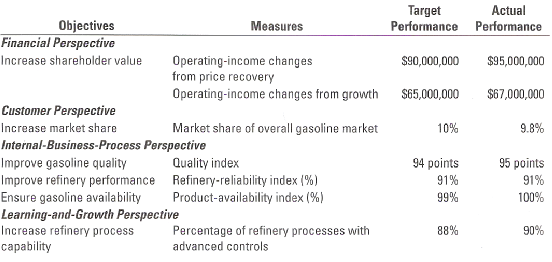
1. Was Caltex successful in implementing its strategy in 2009? Explain your answer.
2. Would you have included some measure of employee satisfaction and employee training in the learning-and-growth perspective? Are these objectives critical to Caltex for implementing its strategy? Why or why not? Explain briefly.
3. Explain how Caltex did not achieve its target market share in the total gasoline market but still exceeded its financial targets. Is “market share of overall gasoline market” the correct measure of market share? Explain briefly.
4. Is there a cause-and-effect linkage between improvements in the measures in the internal business-process perspective and the measure in the customer perspective? That is, would you add other measures to the internal-business-process perspective or the customer perspective? Why or why not? Explain briefly.
5. Do you agree with Caltex’s decision not to include measures of changes in operating income from productivity improvements under the financial perspective of the balanced scorecard? Explain briefly.
Target Performance Actual Objectives Financial Perspective Measures Performance $95,000,000 Increase shareholder value Operating-income changes from price recovery Operating-income changes from growth $90,000,000 S65,000,000 $67,000,000 Customer Perspective Increase market share Market share of overall gasoline market 10% 9.8% Internal-Business-Process Perspective Improve gasoline quality Improve refinery performance Refinery-reliability index (%) Ensure gasoline availa bility Learning-and-Growth Perspective Increase refinery process capability Quality index 94 points 95 points 91% 91% Product-availability index (%) 99% 100% Percentage of refinery processes with advanced controls 88% 90%
Step by Step Solution
3.49 Rating (182 Votes )
There are 3 Steps involved in it
Balanced scorecard 1 Caltexs strategy is to focus on serviceoriented customers who are willing to pay a higher price for services Even though gasoline is largely a commodity product Caltex wants to di... View full answer

Get step-by-step solutions from verified subject matter experts
Document Format (1 attachment)

24-B-C-A-B-S (50).docx
120 KBs Word File
 Study Help