







Question: Consider a digital communication system that uses a repetition code for the channel encoding/decoding. In particular, each transmission is repeated times, where n = 2m
Consider a digital communication system that uses a repetition code for the channel encoding/decoding. In particular, each transmission is repeated times, where n = 2m + 1 is an odd integer. The decoder operates as follows, if in a block of n received hits, the number of 0s exceeds the number of is, the decoder decides in favor of a 0. Otherwise, it decides in favor of a 1. An error occurs when m + 1 or more transmissions out of n = 2m + 1 are incorrect. Assume a binary symmetric channel.
(a) For n = 3, show that the average probability of error is given by Pe = 3p2(l ? p) + p3?where p is the transition probability of the channel.
(b) For is 5, show that the average probability of error is given by Pe = 10p3?(1 ? p)2 + 5p4(1 ? p) + p5
(c) Hence, for the general case, deduce that the average probability of error is given by
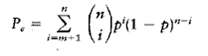
P. = p'(1-p"-i
Step by Step Solution
3.30 Rating (168 Votes )
There are 3 Steps involved in it
a When each symbol is repeated three times we have Messages 000 1 2 111 Unused signals 001 010 011 1... View full answer

Get step-by-step solutions from verified subject matter experts
Document Format (1 attachment)

19-E-T-E-C-S (141).docx
120 KBs Word File
 Study Help