







Question: Consider an arbitrary digital filter with transfer function? (a) Perform a two-component polyphase decomposition of H(z) by grouping the even-numbered samples h 0 (n) =
Consider an arbitrary digital filter with transfer function?
(a) Perform a two-component polyphase decomposition of H(z) by grouping the even-numbered samples h0(n) = h(2n) and the odd-numbered samples h1(n) = h(2n +1). Thus show that H(z) can be expressed as:
H(z) = H0(z2) + z?1H1(z2) and determine the H0(z) and H1(z).
(b) Generalized the result in part (a) by showing that H(z) can decomposed into an D-component polyphase filter structure with transfer function, Determine Hk(z).
(c) For the IIR filter with transfer function H(z) = 1/ 1?az?1
Determine H0(z) and H1(z) for the two-component decomposition.
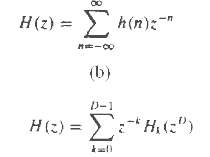
H(z) = h(n):-" (b) D-1 H(2) = :* H,(:") "H,(")
Step by Step Solution
3.43 Rating (156 Votes )
There are 3 Steps involved in it
a b c Hz h2n2n h2n ... View full answer

Get step-by-step solutions from verified subject matter experts
Document Format (1 attachment)

31-E-T-E-D-S-P (918).docx
120 KBs Word File
 Study Help