







Question: Consider a causal linear time-invariant system with system function H(z) and real impulse response. H(z) evaluated for z = e j? is shown in Figure.
Consider a causal linear time-invariant system with system function H(z) and real impulse response. H(z) evaluated for z = ej? is shown in Figure.
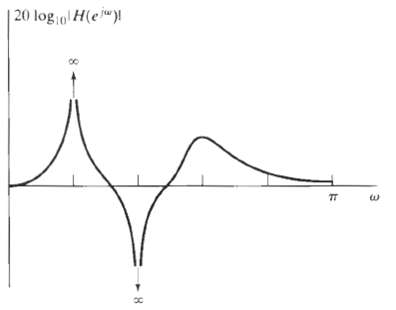
(a) Carefully sketch a pole-zero plot for H(z) showing all information about the pole and zero locations that can be inferred from the figure.
(b) What can be said about the length of the impulse response?
(c) Specify whether j?) is linear.?
(d) Specify whether the system is stable.
| 20 log 10 H(e " TT
Step by Step Solution
3.38 Rating (167 Votes )
There are 3 Steps involved in it
a b Since hn has poles we know hn is IIR c Since hn is causal and IIR it cannot be symmetric and th... View full answer

Get step-by-step solutions from verified subject matter experts
Document Format (1 attachment)

30-E-T-E-D-S-P (233).docx
120 KBs Word File
 Study Help