







Question: Consider the application of EM to learn the parameters for the network in Figure (a), given the true parameters in Equation (20.7). a. Explain why
Consider the application of EM to learn the parameters for the network in Figure (a), given the true parameters in Equation (20.7).
a. Explain why the EM algorithm would not work if there were just two attributes in the model rather than three.
b. Show the calculations for the first iteration of EM starting from Equation (20.8).
c. What happens if we start with all the parameters set to the same value p?
d. Write out an expression for the log likelihood of the tabulated candy data in terms of the parameters, calculate the partial derivatives with respect to each parameter, and investigate the nature of the fixed point reached in part(c)
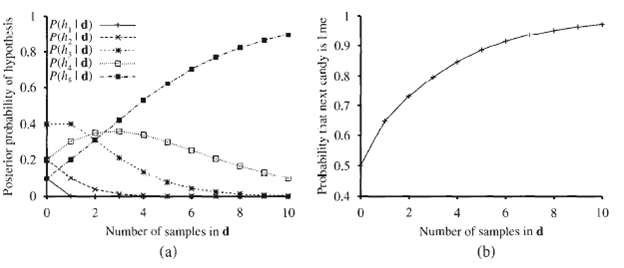
Pih, Id) P(A, I d) 0.8 P(h, I d) P(h, I d) Pih, I d) 0.6 0.9 0.8 0.7 0.4 0.6 0.2 0.5 0.4 2 10 6. 8. 10 Number of samples in d Number of samples in d (b) (a) Posterior probability of hypothesis Probability that next candy is I me
Step by Step Solution
3.40 Rating (162 Votes )
There are 3 Steps involved in it
a With three attributes there are seven parameters in the model and the empirical data give frequencies for 2 8 classes which supply 7 independent numbers since the 8 frequencies have to sum to the total sample size Thus the problem is neither under nor overconstrained With two attributes there are five parameters in the model and the empirical data give frequencies for 22 4 classes which supply 3 independent num ... View full answer

Get step-by-step solutions from verified subject matter experts
Document Format (1 attachment)

21-C-S-A-I (286).docx
120 KBs Word File
 Study Help