







Question: Flow near a wall suddenly set in motion (approximate solution) (Fig. 4B.2). Applu procedure like that of Example 4.4-1 to get an approximate solution for
Flow near a wall suddenly set in motion (approximate solution) (Fig. 4B.2). Applu procedure like that of Example 4.4-1 to get an approximate solution for Example 4.1.1
(a) Integrate Eq. 4.4-1 over y to get make use of the boundary conditions and the Leibniz rule for differentiating an integral (Eq. C.3-2) to rewrite Eq. 4B.2-1 in the form Interpret this result physically.
(b) We know roughly what the velocity profiles look like. We can make the following reasonable postulate for the profiles: Here S(t) is a time-dependent boundary-layer thickness. Insert this approximate expression into Eq. 4B.2-2 to obtain
(c) Integrate Eq. 4B.2-5 with a suitable initial value of S(t), and insert the result into Eq. 4B.2-3 to get the approximate velocity profiles.
(d) Compare the values of v,/v∞ obtained from (c) with those from Eq. 4.1-15 at y/√4vt = 0.2, 0.5, and 1.0. Express the results as the ratio of the approximate value to the exact value.
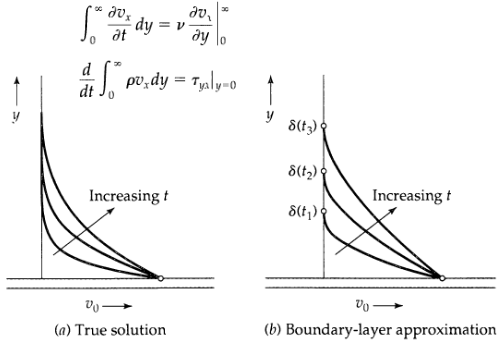
dv, dy : at dy di J, pv,dy = Tynly-0 8(t;) { 8(t2) Increasing t Increasing t 8(t,) (b) Boundary-layer approximation (a) True solution
Step by Step Solution
3.37 Rating (172 Votes )
There are 3 Steps involved in it
PS dt 20x dz t Flow near a wall suddenly set in motion approxim... View full answer

Get step-by-step solutions from verified subject matter experts
Document Format (1 attachment)

6-E-C-E-T-P (80).docx
120 KBs Word File
 Study Help