







Question: Harmonic distortion in digital sinusoidal generators an ideal sinusoidal generator produces the signal x(n) = cos2?f0n -? Total power(a) Show that(b) By using the Taylor
Harmonic distortion in digital sinusoidal generators an ideal sinusoidal generator produces the signal x(n) = cos2?f0n -?
Total power(a) Show that(b) By using the Taylor approximation compute one period of x (n) for f0 = 1/96, 1/32, 1/256 by increasing the number of terms in the Taylor expansion form 2 to 8.(c) Compute the THD and plot the power density spectrum for each sinusoid in part (b) as well as for the sinusoids obtained using the computer cosine function. Comment on the results.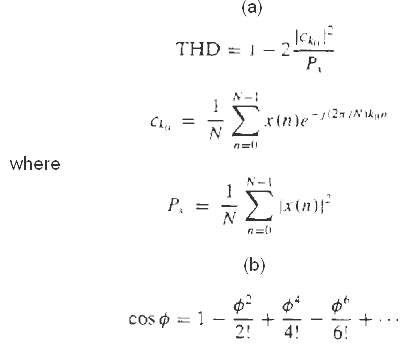
(a) THD = 1- 2- P, me > r(n)e 2 IN kan n= where N- 2(n) (b) cos = 1 - 2! 4! 6!
Step by Step Solution
3.42 Rating (165 Votes )
There are 3 Steps involved in it
a b For f 0 196 refer to figure For f 0 132 refer to figure For f 0 1256 refe... View full answer

Get step-by-step solutions from verified subject matter experts
Document Format (1 attachment)

31-E-T-E-D-S-P (670).docx
120 KBs Word File
 Study Help