







Question: Should patients who are bleeding from the stomach get transfusions when their hemoglobin level falls below 7 grams per deciliter (restrictive strategy) or when it
Should patients who are bleeding from the stomach get transfusions when their hemoglobin level falls below 7 grams per deciliter (restrictive strategy) or when it falls to 9 grams per deciliter (liberal strategy)? A study used random assignment with 461 patients assigned to the restrictive strategy and 460 to the liberal strategy (Villanueva et al. 2013). The table shows survival after six weeks in each group.
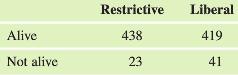
a. Calculate the percentage alive in each of the treatment groups, and write a sentence comparing the percentages in the context of this study. Call the restrictive group 1 and the liberal group 2, and find the difference, p1ˆ’ p2.
b. Find a 95% confidence interval for the difference in proportions alive in the two groups, and explain whether the interval captures 0 and what that means. Use the same difference as in part a. Assume that the conditions are met, although we have random assignment and not a random sample.
c. For the 95% confidence interval from part b, explain what the signs of the boundary values mean and whether we can conclude that one treatment causes the better result.
d. If you had a relative with bleeding and his hemoglobin level dropped to 8.5 grams per deciliter, would you argue for a transfusion or wait until it dropped further?
Restrictive Liberal Alive 438 419 Not alive 23 41
Step by Step Solution
3.31 Rating (157 Votes )
There are 3 Steps involved in it
a 438438 23 438461 0950 or 950 of the restrictive group were alive and 419419 41 419460 0911 or 911 ... View full answer

Get step-by-step solutions from verified subject matter experts
Document Format (1 attachment)

484-M-S-S-D (1395).docx
120 KBs Word File
 Study Help