







Question: (a) Show that u n = r n cos nθ, u n = r n sin nθ, n = 0, 1,· · ·, are solutions
(a) Show that un= rncos nθ, un= rnsin nθ, n = 0, 1,· · ·, are solutions of Laplace€™s equation ˆ‡2u = 0 with ˆ‡2u given by (5). (What would unbe in Cartesian coordinates? Experiment with small n.)
(b) Solve the Dirichlet problem using (20) if R = 1 and the boundary values are u(θ) = -100 volts if -π < θ < 0, u(θ) = 100 volts if 0 < θ < π. (Sketch this disk, indicate the boundary values.)
(c) Show that the solution of the Neumann problem ˆ‡2u = 0 if r < R, uN(R, θ) = f (θ) (where uN = ˆ‚u/ˆ‚N is the directional derivative in the direction of the outer normal) is
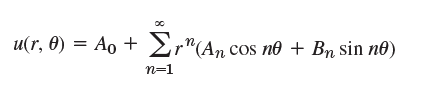
with arbitrary A0 and
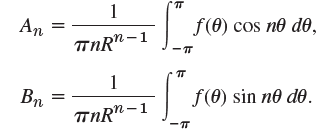
(d) Solve ˆ‡2u = 0 in the annulus 1 < r < 2 if ur (1, θ) = sin θ, ur (2, θ) = 0.
u(r, 0) = Ao + Er"(An cos no + Bn sin n) n=1 An f (0) cos n d, -1 nR- Bn nR*-1 f (0) sin n d. -
Step by Step Solution
3.51 Rating (168 Votes )
There are 3 Steps involved in it
a b c The form of the series results ... View full answer

Get step-by-step solutions from verified subject matter experts
 Study Help