







Question: Answer Exercises 9.7.1 and 9.7.2 using the Daubechies wavelets instead of the Haar wavelets. Do you see any improvement in your approximations? Discuss the advantages
Answer Exercises 9.7.1 and 9.7.2 using the Daubechies wavelets instead of the Haar wavelets. Do you see any improvement in your approximations? Discuss the advantages and disadvantages of both in light of these examples.
Data From Exercise 9.7.1
Let f(x) = x.
(a) Determine its Haar wavelet coefficients cj,k.
(b) Graph the partial sums sr(x) of the Haar wavelet series (9.136) where j goes from 0 to r = 2, 5, and 10. Compare your graphs with that of f and discuss what you observe. Is the series converging to the function? Can you prove this?

(c) What is the maximal deviation ΙΙ f − sr ΙΙ∞ = max{| f(x) − sr(x) || 0 ≤ x ≤ 1} for each of your partial sums?
Data From Exercise 9.7.2
Answer Exercise 9.7.1 for the functions
(a) x2 − x,
(b) cos πx,
(c)
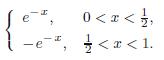
Data From Exercise 9.7.1
Let f(x) = x.
(a) Determine its Haar wavelet coefficients cj,k.
(b) Graph the partial sums sr(x) of the Haar wavelet series (9.136) where j goes from 0 to r = 2, 5, and 10. Compare your graphs with that of f and discuss what you observe. Is the series converging to the function? Can you prove this?

(c) What is the maximal deviation ΙΙ f − sr ΙΙ∞ = max{| f(x) − sr(x) || 0 ≤ x ≤ 1} for each of your partial sums?
f(x) 2 cop(2) + 22-1 cjkW;;k(2). j=0 k=0 (9.136)
Step by Step Solution
3.41 Rating (170 Votes )
There are 3 Steps involved in it

Get step-by-step solutions from verified subject matter experts
 Study Help