







Question: Repeat Example 17.6 but using first-, second-, third-, and fourth order interpolating polynomials to predict the population in 2000 based on the most recent data.
Repeat Example 17.6 but using first-, second-, third-, and fourth order interpolating polynomials to predict the population in 2000 based on the most recent data. That is, for the linear prediction use the data from 1980 and 1990, for the quadratic prediction use the data from 1970, 1980, and 1990, and so on. Which approach yields the best result?
Example 17.6
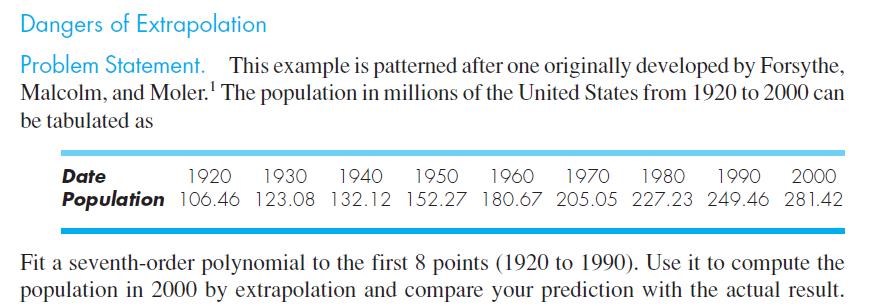
Dangers of Extrapolation Problem Statement. This example is patterned after one originally developed by Forsythe, Malcolm, and Moler. The population in millions of the United States from 1920 to 2000 can be tabulated as Date 1920 1930 1940 1950 1960 1970 1980 1990 2000 Population 106.46 123.08 132.12 152.27 180.67 205.05 227.23 249.46 281.42 Fit a seventh-order polynomial to the first 8 points (1920 to 1990). Use it to compute the population in 2000 by extrapolation and compare your prediction with the actual result.
Step by Step Solution
3.30 Rating (156 Votes )
There are 3 Steps involved in it
ANSWER To apply different orders of interpolating polynomials to predict the population in 2000 we need to use the population data from different year... View full answer

Get step-by-step solutions from verified subject matter experts
 Study Help