



Question: Ordinarily, Wald's likelihood ratio statistic is essentially the same as Wilks's statistic, which in one-parameter problems, is the squared ratio of the estimate to its
Ordinarily, Wald's likelihood ratio statistic is essentially the same as Wilks's statistic, which in one-parameter problems, is the squared ratio of the estimate to its standard error. But there are exceptional cases where a substantial discrepancy may occur, and variance-components models provide good examples. In order to understand the source of the discrepancy, simulate data with simple structure as follows:
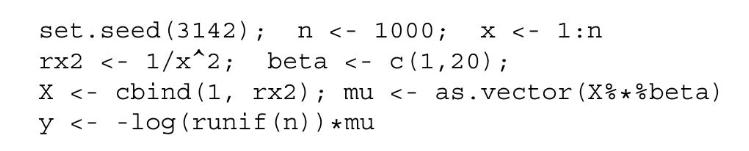
The null hypothesis is that \(\mu \propto \mathbf{1}\) is constant, and the alternative is that \(\mu=X \beta\) for some \(\beta\) with non-negative components. Test this hypothesis using Wilks's likelihood ratio statistic, and also using the Wald statistic. Recall the exponential assumption, which implies that the dispersion parameter is one.
set.seed (3142); n < rx2 < 1/x^2; beta < 1000; x < 1:n c (1, 20); X
Step by Step Solution
3.35 Rating (167 Votes )
There are 3 Steps involved in it
Youve provided an image containing R code for a simulation experiment Here what seems to be sugg... View full answer

Get step-by-step solutions from verified subject matter experts