







Question: Let X 1 , X 2 , ¦ , X n be uniformly distributed on the interval 0 to a. Recall that the maximum likelihood
(a) Argue intuitively why ˆa cannot be an unbiased estimator for a.
(b) Suppose that E(â) = na / (n +1). Is it reasonable that â consistently underestimates a? Show that the bias in the estimator approaches zero as n gets large.
(c) Propose an unbiased estimator for a.
(d) Let Y = max(Xi ). Use the fact that Y ‰¤ y if and only if each Xi ‰¤ y to derive the cumulative distribution function of Y . Then show that the probability density function of Y is
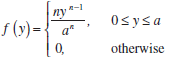
Use this result to show that the maximum likelihood estimator for a is biased.
(e) We have two unbiased estimators for a: the moment estimator â = 2X̅ and â = [(n + 1)] /n max(Xi), where max(Xi ) is the largest observation in a random sample of size n. It can be shown that V(â ) = a2 / (3n) and that V (â ) = a2 / [n(n + 2)]. Show that if n > 1, â2 is a better estimator than â. In what sense is it a better estimator of a?
f (y)= - 0, Osysa a" otherwise
Step by Step Solution
3.39 Rating (168 Votes )
There are 3 Steps involved in it
a cannot be unbiased since it will always be less th... View full answer

Get step-by-step solutions from verified subject matter experts
 Study Help