







Question: Consider the variable elimination algorithm in Figure 14.11. a. Section 14.4 applies variable elimination to the query P(Burglary | JohnCalls = true,MaryCalls = true). Perform
a. Section 14.4 applies variable elimination to the query
P(Burglary | JohnCalls = true,MaryCalls = true).
Perform the calculations indicated and check that the answer is correct.
b. Count the number of arithmetic operations performed, and compare it with the number performed by the enumeration algorithm.
c. Suppose a network has the form of a chain: a sequence of Boolean variables X1, . . . ,Xn where Parents(Xi)={Xiˆ’1} for i=2, . . . , n. What is the complexity of computing P(X1 |Xn =true) using enumeration? Using variable elimination?
d. Prove that the complexity of running variable elimination on a polytree network is linear in the size of the tree for any variable ordering consistent with the network structure.
Figure 14.11
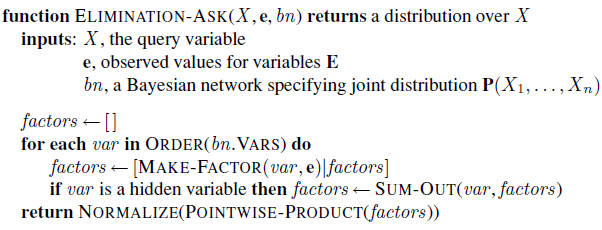
function ELIMINATION-ASK(X, e, bn) returns a distribution over X inputs: X, the query variable e, observed values for variables E bn, a Bayesian network specifying joint distribution P(X1,..., Xn) factors -[] for each var in ORDER(bn. VARS) do factors - [MAKE-FACTOR(var, e)|factors] if var is a hidden variable then factors SUM-OUT(var, factors) return NORMALIZE(POINTWISE-PRODUCT(factors))
Step by Step Solution
3.41 Rating (151 Votes )
There are 3 Steps involved in it
Great youve provided Question 2 from the classic BurglaryEarthquakeAlarm Bayesian Network You are as... View full answer

Get step-by-step solutions from verified subject matter experts
 Study Help