







Question: Translate the financial advisor knowledge base, Section 2.4, into conceptual graph form. Data from section 2.4 As a final example of the use of predicate
Translate the financial advisor knowledge base, Section 2.4, into conceptual graph form.
Data from section 2.4
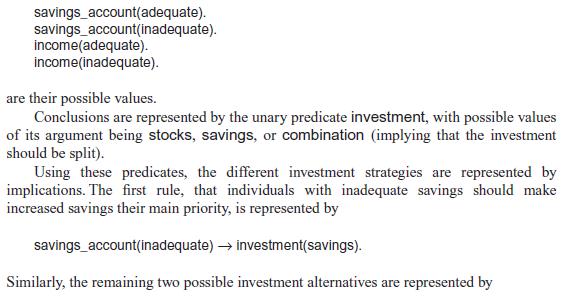
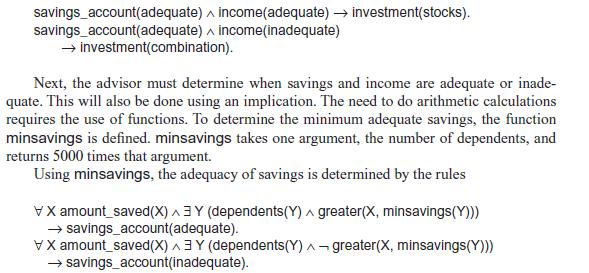
As a final example of the use of predicate calculus to represent and reason about problem domains, we design a financial advisor using predicate calculus. Although this is a simple example, it illustrates many of the issues involved in realistic applications. The function of the advisor is to help a user decide whether to invest in a savings account or the stock market. Some investors may want to split their money between the two. The investment that will be recommended for individual investors depends on their income and the current amount they have saved according to the following criteria: 1. Individuals with an inadequate savings account should always make increasing the amount saved their first priority, regardless of their income. 2. Individuals with an adequate savings account and an adequate income should consider a riskier but potentially more profitable investment in the stock market. 3. Individuals with a lower income who already have an adequate savings account may want to consider splitting their surplus income between savings and stocks, to increase the cushion in savings while attempting to increase their income through stocks. The adequacy of both savings and income is determined by the number of dependents an individual must support. Our rule is to have at least $5,000 in savings for each dependent. An adequate income must be a steady income and supply at least $15,000 per year plus an additional $4,000 for each dependent. To automate this advice, we translate these guidelines into sentences in the predicate calculus. The first task is to determine the major features that must be considered. Here, they are the adequacy of the savings and the income. These are represented by the predicates savings account and income, respectively. Both of these are unary predicates, and their argument could be either adequate or inadequate. Thus,
Step by Step Solution
3.43 Rating (162 Votes )
There are 3 Steps involved in it
Full Translation of Financial Advisor Knowledge Base Section 24 into Conceptual Graph Form Introduction to the Problem This exercise models a financial advisors decision system using Conceptual Graphs ... View full answer

Get step-by-step solutions from verified subject matter experts
 Study Help