







Question: Find the resultant vectors if the given changes are made in the indicated examples of this section. In Example 4, find the resultant if 70
Find the resultant vectors if the given changes are made in the indicated examples of this section.
In Example 4, find the resultant if 70° is changed to 20°.
Data from Example 4
Find the resultant of the three given vectors in Fig. 9.25. The magnitudes of these vectors are T = 422, U = 405, and V = 210.
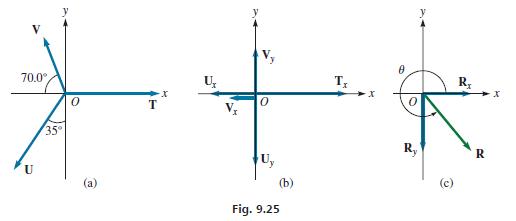
We will start by changing each given angle to a standard-position angle (abbreviated SP Angle). In the following table, we show the x- and y-components of the given vectors, and the sums of these components give us the components of R.

We now use the components of R to find its magnitude and reference angle:
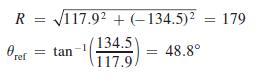
Because Rx is positive and Ry is negative, we know that θ is a fourth-quadrant angle. Therefore, to find θ, we subtract θref from 360°. This means θ = 360° − 48.8° = 311.2°
70.0 U 35 0 (a) X U 0 U Fig. 9.25 (b) Tx X 0 Ry R R X
Step by Step Solution
3.45 Rating (161 Votes )
There are 3 Steps involved in it
To find the resultant of the three given vectors we can use vector addition First we can draw the th... View full answer

Get step-by-step solutions from verified subject matter experts
 Study Help