







Question: Referring to Example 5, show that if the difference in loudness of two sounds is d decibels, the louder sound is 10d /10 more intense
Referring to Example 5, show that if the difference in loudness of two sounds is d decibels, the louder sound is 10d /10 more intense than the quieter sound.
Data from Example 5
The human ear responds to sound on a scale that is approximately proportional to the logarithm of the intensity of the sound. Therefore, the loudness of sound (measured in dB) is defined by the equation b = 10 log(I /I0), where I is the intensity of the sound and I0 is the minimum intensity detectable.
A busy street has a loudness of 70 dB, and riveting has a loudness of 100 dB. To find how many times greater the intensity Ir of the sound of riveting is than the intensity Ic of the sound of the city street, we substitute in the above equation. This gives

To solve for Ic and Ir we divide each side by 10 and then use exponential form:
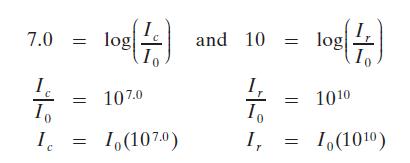
Because we want the number of times Ir is greater than Ic we divide Ir by Ic:

Thus, the sound of riveting is 1000 times as intense as the sound of the city street.
70 10 log 10 log = 0 and 100 = 10 log ( 0
Step by Step Solution
3.32 Rating (158 Votes )
There are 3 Steps involved in it
To show that if the difference in loudness of two sounds is d decibels the louder sound is 10... View full answer

Get step-by-step solutions from verified subject matter experts
 Study Help