







Question: Solve the given problems. Use a ruler and protractor as in Examples 6 and 7. A ship travels 20 km in a direction of 30
Solve the given problems. Use a ruler and protractor as in Examples 6 and 7. A ship travels 20 km in a direction of 30° south of east, then turns and goes due south for another 40 km, and finally turns again 30° south of east and goes another 20 km. What is the ship’s displacement from its original position?
Data from Example 6
Two persons pull horizontally on ropes attached to a car that is stuck in mud. One person pulls with a force of 500 N directly to the right, while the other person pulls with a force of 350 N at an angle of 40° from the first force, as shown in Fig. 9.8(a). Find the resultant force on the car.
We make a scale drawing of the forces as shown in Fig. 9.8(b), measuring the magnitudes of the forces with a ruler and the angles with a protractor. [The scale drawing of the forces is made larger and with a different scale than that in Fig. 9.8(a) in order to get better accuracy.] We then complete the parallelogram and draw in the diagonal that represents the resultant force. Finally, we find that the resultant force is about 800 N and that it acts at an angle of about 16° from the first force.
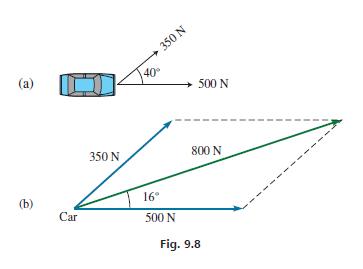
(a) (b) Car 350 N 350 N 40 16 500 N 500 N 800 N Fig. 9.8
Step by Step Solution
3.46 Rating (182 Votes )
There are 3 Steps involved in it
To solve this problem we need to find the vector sum of the three legs of the ships journey We can u... View full answer

Get step-by-step solutions from verified subject matter experts
 Study Help