







Question: In Example 3.1, adapt the code to include a posterior predictive (p)-tests to assess skewness and kurtosis in the residuals. For example, the (p)-test for
In Example 3.1, adapt the code to include a posterior predictive \(p\)-tests to assess skewness and kurtosis in the residuals. For example, the \(p\)-test for skewness would compare a skew measure for replicates
Data from Example 3.1
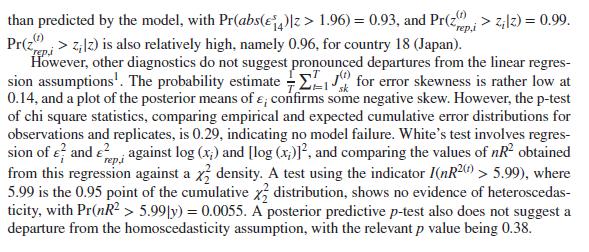
\[D_{\text {rep }}^{\text {skew }}=\frac{1}{n} \sum_{i=1}^{n} \varepsilon_{\text {rep }, i}^{3(t)} / \sigma^{3(t)} \quad \text { against } \quad D_{\text {obs }}^{\text {skew }}=\frac{1}{n} \sum_{i=1}^{n} \varepsilon_{i}^{3(t)} / \sigma^{3(t)}\]
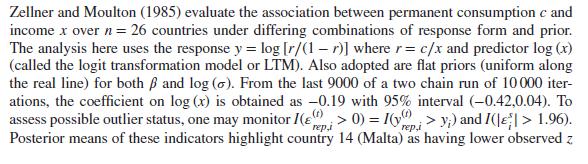
Zellner and Moulton (1985) evaluate the association between permanent consumption c and income x over n = 26 countries under differing combinations of response form and prior. The analysis here uses the response y = log [r/(1 - r)] where r = c/x and predictor log (x) (called the logit transformation model or LTM). Also adopted are flat priors (uniform along the real line) for both and log (a). From the last 9000 of a two chain run of 10000 iter- ations, the coefficient on log (x) is obtained as -0.19 with 95% interval (-0.42,0.04). To assess possible outlier status, one may monitor (i > 0) = Iyi > y;) and I(||> 1.96). Posterior means of these indicators highlight country 14 (Malta) as having lower observed z (t) rep,i rep.i
Step by Step Solution
3.46 Rating (156 Votes )
There are 3 Steps involved in it

Get step-by-step solutions from verified subject matter experts
 Study Help