







Question: Refer to Problem 24. Find the second-best solution. How does it compare to the optimal solution found in Problem 24? Why might the second-best solution
Refer to Problem 24.
Find the second-best solution. How does it compare to the optimal solution found in Problem 24? Why might the second-best solution be preferred?
Problem 24
In this problem, we revisit the Martin-Beck plant location problem described in Problem 10.
The management of Martin-Beck has decided to do a clean-sheet analysis. Rather than assume that the St. Louis plant is fixed as open, management wants to run a model that allows for any plant or set of plants to be open so that total cost is minimized. The annual fixed cost and the capacities of the proposed plants have been estimated (see Problem 10). The variable costs for the proposed plant locations are estimated to be the following: Detroit (\($4.26),\) Toledo (\($4.19),\) Denver (\($4.69),\) and Kansas City (\($4.20)\).
We need an estimate of the fixed cost and variable cost at the current St. Louis plant. The file stlouis_mb contains 15 observations from previous years that will allow us to estimate these.
Problem 10
The Martin-Beck Company operates a plant in St. Louis with an annual capacity of 30,000 units. Product is shipped to regional distribution centers located in Boston, Atlanta, and Houston. Because of an anticipated increase in demand, Martin-Beck plans to increase capacity by constructing a new plant in one or more of the following cities: Detroit, Toledo, Denver, or Kansas City. The estimated annual fixed cost and the annual capacity for the four proposed plants are as follows: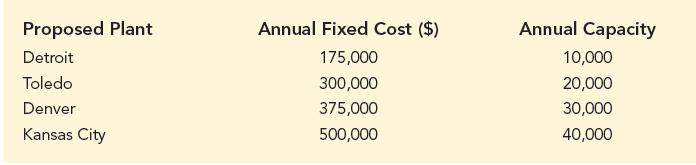
Proposed Plant Detroit Toledo Denver Kansas City Annual Fixed Cost ($) Annual Capacity 175,000 10,000 300,000 20,000 375,000 500,000 30,000 40,000
Step by Step Solution
There are 3 Steps involved in it

Get step-by-step solutions from verified subject matter experts
 Study Help