







Question: Consider an RLC circuit driven by a programmable current source i(t) as shown in the diagram. The voltage appearing across the capacitor is v(t).
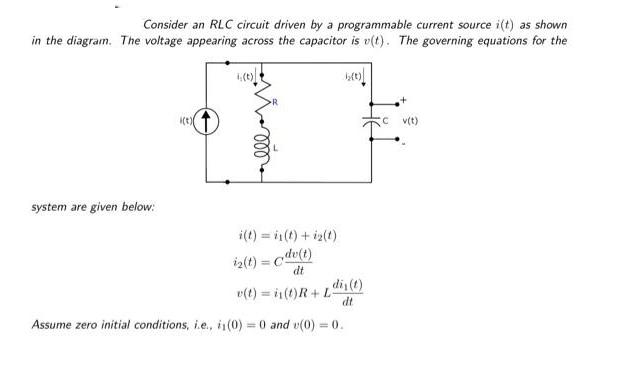
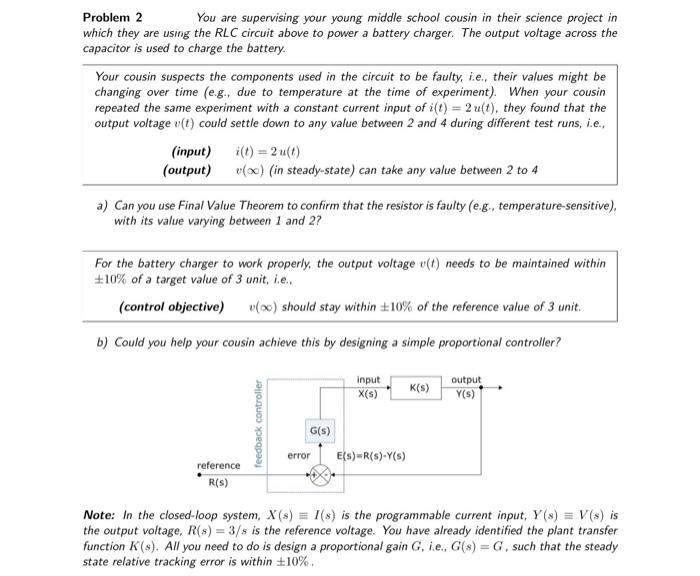
Consider an RLC circuit driven by a programmable current source i(t) as shown in the diagram. The voltage appearing across the capacitor is v(t). The governing equations for the 45(0)/ system are given below: i(t)( i(t) = in (t) + iz(t) i2(t) = dv(t) dt diy(t) e(t)=(t)R+ L dt. Assume zero initial conditions, i.e., i1(0) = 0 and v(0) = 0. v(t) Problem 2 You are supervising your young middle school cousin in their science project in which they are using the RLC circuit above to power a battery charger. The output voltage across the capacitor is used to charge the battery. Your cousin suspects the components used in the circuit to be faulty, i.e., their values might be changing over time (e.g., due to temperature at the time of experiment). When your cousin repeated the same experiment with a constant current input of i(t) = 2 u(t), they found that the output voltage v(t) could settle down to any value between 2 and 4 during different test runs, i.e., i(t) = 2u(t) v(x) (in steady-state) can take any value between 2 to 4 (input) (output) a) Can you use Final Value Theorem to confirm that the resistor is faulty (e.g., temperature-sensitive), with its value varying between 1 and 2? For the battery charger to work properly, the output voltage (t) needs to be maintained within #10% of a target value of 3 unit, i.e.. (control objective) v() should stay within 10% of the reference value of 3 unit. b) Could you help your cousin achieve this by designing a simple proportional controller? reference R(S) feedback controller error G(s) input X(s) E(S)=R(S)-Y(S) K(s) output Y(s) Note: In the closed-loop system, X (s) = 1(s) is the programmable current input, Y(s) = V(s) is the output voltage, R(s) = 3/s is the reference voltage. You have already identified the plant transfer function K(s). All you need to do is design a proportional gain G, i.e., G(s) = G, such that the steady state relative tracking error is within 10%.
Step by Step Solution
3.41 Rating (154 Votes )
There are 3 Steps involved in it

Get step-by-step solutions from verified subject matter experts
 Study Help