







Question: Exercises 12 and 13 refer to the data in Example 1. Approximate the derivative with the symmetric difference quotient (SDQ) approximation: (a) At what t
Exercises 12 and 13 refer to the data in Example 1. Approximate the derivative with the symmetric difference quotient (SDQ) approximation: 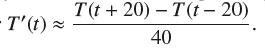
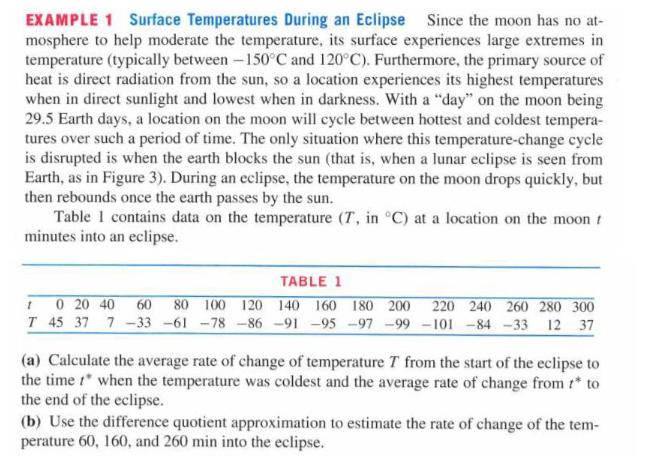
(a) At what t does the SDQ approximation give the fastest rate of increase of temperature? What is the rate of change?
(b) At what t does the SDQ approximation give the fastest rate of decrease of temperature? What is the rate of change?
- T' (t) T(t + 20) - T(t - 20) 40
Step by Step Solution
★★★★★
3.48 Rating (155 Votes )
There are 3 Steps involved in it
1 Expert Approved Answer
Step: 1 Unlock

We calculate the following SDQ approximations to the rate of cha... View full answer
Question Has Been Solved by an Expert!
Get step-by-step solutions from verified subject matter experts
Step: 2 Unlock
Step: 3 Unlock
 Study Help