







Question: Let a, b, c be nonzero vectors. Assume that b and c are not parallel, and set v = ax (bx c), (a) Prove that:
Let a, b, c be nonzero vectors. Assume that b and c are not parallel, and set
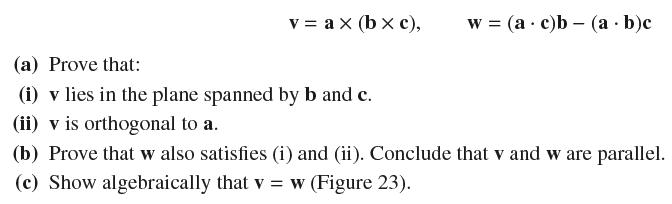
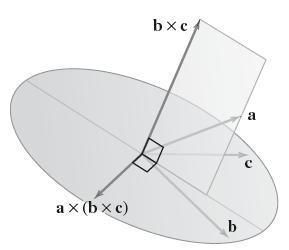
v = ax (bx c), (a) Prove that: (i) v lies in the plane spanned by b and c. (ii) v is orthogonal to a. w = (a c)b (a . b)c . (b) Prove that w also satisfies (i) and (ii). Conclude that v and w are parallel. (e) Show algebraically that v = w (Figure 23).
Step by Step Solution
★★★★★
3.37 Rating (153 Votes )
There are 3 Steps involved in it
1 Expert Approved Answer
Step: 1 Unlock

a Since v is the cross product of a and another vector b c then v is orthogonal to a Furthermore v i... View full answer
Question Has Been Solved by an Expert!
Get step-by-step solutions from verified subject matter experts
Step: 2 Unlock
Step: 3 Unlock
 Study Help