







Question: Let (mathbf{F}) be the vortex field (Figure 24): Let (C) be a curve in polar form (r=f(theta)) for (theta_{1} leq theta leq theta_{2}) [Figure 25(B)],
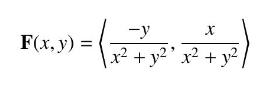
Let \(\mathbf{F}\) be the vortex field (Figure 24):
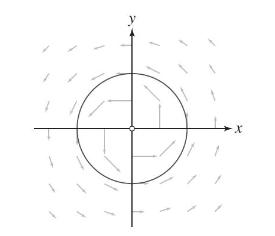
Let \(C\) be a curve in polar form \(r=f(\theta)\) for \(\theta_{1} \leq \theta \leq \theta_{2}\) [Figure 25(B)], parametrized by \(\mathbf{r}(\theta)=\) \((f(\theta) \cos \theta, f(\theta) \sin \theta))\) as in Exercise 60.
(a) Show that the vortex field in polar coordinates is written \(\mathbf{F}(r, \theta)=r^{-1}\langle-\sin \theta, \cos \thetaangle\).
(b) Show that \(\mathbf{F} \cdot \mathbf{r}^{\prime}(\theta) d \theta=d \theta\).
(c) Show that \(\int_{C} \mathbf{F} \cdot d \mathbf{r}=\theta_{2}-\theta_{1}\).
-) =(++2 ) 1x + y x + y F(x, y) =
Step by Step Solution
3.53 Rating (160 Votes )
There are 3 Steps involved in it
a Letting xr cos theta and yr sin theta we have beginaligned mathbfF leftlanglefracyx2y2 fracxx2y2ig... View full answer

Get step-by-step solutions from verified subject matter experts
 Study Help