







Question: Let (mathcal{D}) be the region bounded by a simple closed curve (C). A function (varphi(x, y)) on (mathcal{D}) (whose second-order partial derivatives exist and are
Let \(\mathcal{D}\) be the region bounded by a simple closed curve \(C\). A function \(\varphi(x, y)\) on \(\mathcal{D}\) (whose second-order partial derivatives exist and are continuous) is called harmonic if \(\Delta \varphi=0\), where \(\Delta \varphi\) is the Laplace operator defined in Eq.(12).
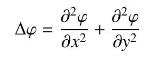
Show that \(f(x, y)=x^{2}-y^{2}\) is harmonic. Verify the mean-value property for \(f(x, y)\) directly [expand \(f(a+r \cos \theta, b+r \sin \theta)\) as a function of \(\theta\) and compute \(\left.I_{\varphi}(r)ight]\). Show that \(x^{2}+y^{2}\) is not harmonic and does not satisfy the mean-value property.
8 _0 Aq = + x2 y2
Step by Step Solution
3.46 Rating (153 Votes )
There are 3 Steps involved in it
We show that the function fx yx2y2 is harmonic by showing that Delta ffracpartial2 fpartial x2fracpa... View full answer

Get step-by-step solutions from verified subject matter experts
 Study Help