



Question: Let (partial mathcal{R}) be the boundary of the rectangle in Figure 1, and let (partial mathcal{R}_{1}) and (partial mathcal{R}_{2}) be the boundaries of the two
Let \(\partial \mathcal{R}\) be the boundary of the rectangle in Figure 1, and let \(\partial \mathcal{R}_{1}\) and \(\partial \mathcal{R}_{2}\) be the boundaries of the two triangles, all oriented counterclockwise.
(a) Determine \(\oint_{\partial \mathcal{R}_{1}} \mathbf{F} \cdot d \mathbf{r}\) if \(\oint_{\partial \mathcal{R}} \mathbf{F} \cdot d \mathbf{r}=4\) and \(\oint_{\partial \mathcal{R}_{2}} \mathbf{F} \cdot d \mathbf{r}=-2\).
(b) What is the value of \(\oint_{\partial \mathcal{R}} \mathbf{F} d \mathbf{r}\) if \(\partial \mathcal{R}\) is oriented clockwise?
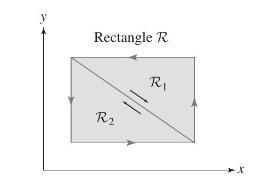
Rectangle R R R
Step by Step Solution
3.40 Rating (159 Votes )
There are 3 Steps involved in it
a To determine the line integral ointpartial mathcalR1 mathbfF cdot d mathbfr we can use the fact th... View full answer

Get step-by-step solutions from verified subject matter experts