







Question: Let R 0 = [0, 1] [0, 1] be the unit square. The translate of a map 0 (u, v) = ((u, v),
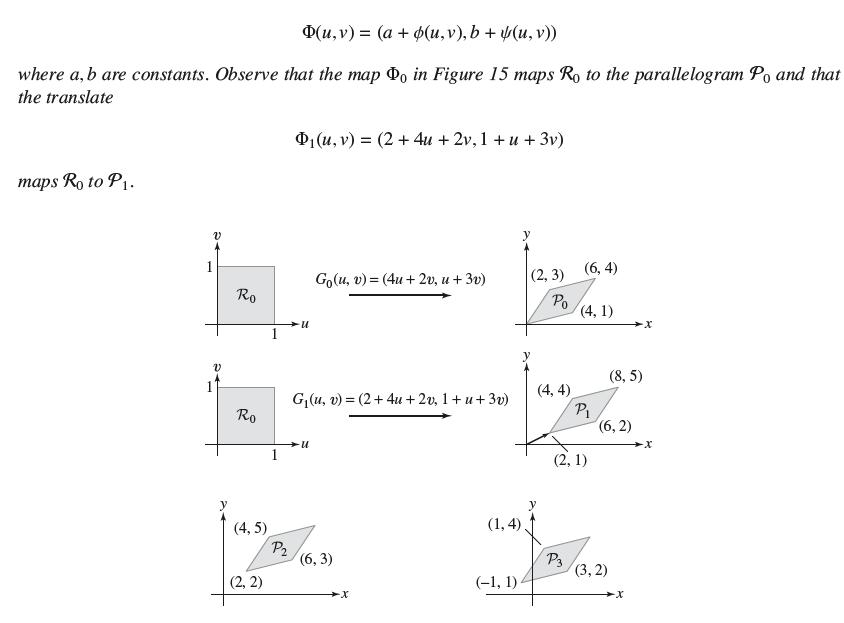
Let R0 = [0, 1] × [0, 1] be the unit square. The translate of a map Φ0(u, v) = (ϕ(u, v), ψ(u, v)) is a map
Sketch the parallelogram P with vertices (1, 1), (2, 4), (3, 6), (4, 9) and find the translate of a linear mapping that maps R0 to P.
D(u, v) = (a + d(u, v), b + y(u, v)) where a, b are constants. Observe that the map Do in Figure 15 maps Ro to the parallelogram Po and that the translate maps Ro to P. V Ro Ro (4, 5) (2, 2) P D (u, v) = (2+4u + 2v, 1 + u + 3v) Go(u, v) = (4u+ 2v, u + 3v) G(u, v) = (2+4u +2v, 1+u+3v) -U (6, 3) -X (1,4). (-1, 1). (2, 3) (6,4) Po (4,4) (4,1) P3 P (2, 1) (8,5) (6,2) (3, 2)
Step by Step Solution
3.47 Rating (160 Votes )
There are 3 Steps involved in it
The parallelogram P is shown in the figure We first trans... View full answer

Get step-by-step solutions from verified subject matter experts
 Study Help