







Question: Suppose that Q(x) = (x a)(x b), where a b, and let P/Q be a proper rational function so that (a) Show
Suppose that Q(x) = (x − a)(x − b), where a ≠ b, and let P/Q be a proper rational function so that
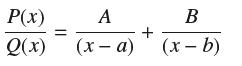
(a) Show that 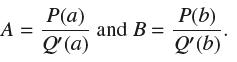
(b) Use this result to find the partial fraction decomposition for P(x) = 3x − 2 and Q(x) = x2 − 4x − 12.
P(x) Q(x) A (x-a) + B (x-b)
Step by Step Solution
★★★★★
3.45 Rating (165 Votes )
There are 3 Steps involved in it
1 Expert Approved Answer
Step: 1 Unlock

a Clearing denominators gives us Setting x a then yields while setting x b yields therefore ... View full answer
Question Has Been Solved by an Expert!
Get step-by-step solutions from verified subject matter experts
Step: 2 Unlock
Step: 3 Unlock
 Study Help